Product Overview
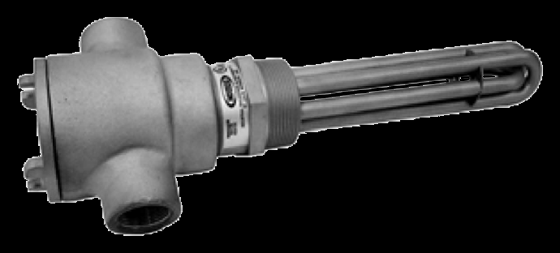
The screw-plug immersion heater is Aspeq Heating Group’s small-tank, lower-pressure immersion build — the element bundle is welded into a hex-head NPT pipe-thread fitting (1″ through 2-1/2″) that screws straight into a threaded coupling on the tank or pipe. Choose the screw-plug style when total kW and pressure are modest and a coupling is the easiest way in; for larger kW, higher pressure, ASME-code vessels, or the largest hazardous-area builds, the flanged immersion heater is the step up. Element diameter, sheath alloy, watt density, voltage, and controls are configured to the application — the specifications and the design considerations below walk through those choices.
Key Features & Benefits
- Threads into a standard NPT nozzle — a one-piece forged hex / thread / riser mounts into a threaded nozzle on the tank or pipe, with gaskets and plates as the installation requires. A simpler, lower-cost way to put electric heat into a small tank or a pipe run than a full ANSI flange.
- Voltage follows the body size — the larger thread bodies carry the larger-diameter element and a higher dielectric rating (the exact diameter-to-voltage breakdown is in the specifications). It means a higher-voltage replacement belongs on the larger body — match the body to the voltage and the rebuild is right.
- Encapsulated, no-loosen bussing — the bus connections are permanent and sealed inside the epoxy terminal seal, so there is no bolted bus joint to back out and arc. One less field connection to fail.
- Explosion-resistant for Class I & II — pipe-thread construction is available for hazardous locations, with the threaded joint making up the flamepath (Groups and engaged-thread detail in the specifications). Mandatory where the area is classified — give us the Group and T-code and the heater is built to match.
- Matched factory controls or built-in thermostat — contactor, SCR, S5 / S10 step controller, or Vernier hybrid — or a built-in thermostat for simple standalone duty on a small heater. From plug-and-go to tight PID control, the heater and its control arrive built for each other.
Specifications
- Operating principle
- Electric resistance (Joule) heating — AC current passes through an 80/20 nickel-chrome coil embedded in compacted magnesium-oxide insulation inside a metal sheath. On a screw-plug immersion heater the elements are welded or silver-soldered into a hex-head NPT pipe-thread fitting that screws directly into a threaded coupling on the tank or pipe; the sheath sits in the process fluid with essentially 100% efficiency. No flame, no flue.
- Mounting / installation
- Screw-plug (NPT pipe thread) — a one-piece forged hex / thread / riser assembly threads into a matching coupling or half-coupling welded to the tank or pipe. The screw-plug style is the lighter-weight answer for smaller tanks and lower-pressure service, where a full ANSI flange is more heater than the job needs. For larger kW, higher pressure, ASME-code vessels, or the largest hazardous-area builds, step up to the flanged immersion heater.
- Pipe-thread sizes
- 1″, 1-1/4″, 2″, and 2-1/2″ NPT (tapered ANSI pipe thread), in Quick-Ship stock and built-to-order listings, with 3″ NPT available as a special-order (non-Fast-Track) size. Element diameter follows the thread size: the 1″ and 1-1/4″ heaters use .312″ elements (rated to 277 V); the 2″ and 2-1/2″ heaters use the larger .475″ element (rated to 600 V). The fitting matches the sheath: 304 stainless steel is the Aspeq standard for both the sheath element and its welded pipe-thread fitting; copper sheaths with forged-brass (silver-soldered) fittings, and steel, are supplied on request.
- Element construction
- Compacted tubular elements, magnesium-oxide (MgO) filled and high-pressure-roller compacted, with all U-bends repressed for dielectric integrity. Element diameter is matched to the thread size — .312″ on 1″ / 1-1/4″ heaters (to 277 V) and .475″ on 2″ / 2-1/2″ heaters (to 600 V), the larger diameter giving extra dielectric insulation. Type 304 stainless element spacers hold the elements apart to prevent hot spots. Sheath thermocouples are clamped to the sheath rather than welded through it — an Aspeq reliability philosophy, since a weld penetration risks a pinhole that becomes a moisture-ingress and shorting failure point over the life of the heater.
- Sheath materials
- Steel · copper · 304 stainless steel (the Aspeq standard) · 316 / 321 stainless steel · Incoloy 800 / 840 · Inconel 600 · Monel 400 · titanium, with other sheath alloys available on request. Selection is matched to the fluid’s chemistry and temperature (see the sheath / watt-density table below); Incoloy can always replace steel or stainless steel.
- Header / fitting materials
- Pipe-thread fitting matches the sheath material — 304 stainless steel standard, welded into a fitting of like material; forged-brass (with a copper sheath) and steel are supplied on request. Incoloy 800, Inconel 600, and 316 stainless steel fittings are available as special-order header options, selected for chemical compatibility at the wetted side of the plug. (Monel 400 is offered as a sheath alloy rather than a header material.)
- Cold (unheated) section length
- Unheated (cold) section at the element ends prevents sheath overheating where the element exits the liquid. Standard cold ends on the pipe-thread build: 3″ for copper, steel, and stainless-steel sheaths; 6″ for Incoloy. Vertically-mounted heaters and applications where the fluid may not fully cover the elements need a longer cold end — specify on order.
- Terminal seals
- Three seal options matched to operating temperature: moisture-resistant epoxy seals standard on copper-sheathed heaters to 250°F fluid temperature; mica terminal insulators standard on steel, stainless, and Incoloy sheaths (no epoxy) for higher-temperature service; ceramic-to-metal hermetic seals available for applications requiring an absolute moisture seal to 1000°F.
- Process / fluid temperature
- Standard catalog: 250°F maximum operating temperature on copper-sheath builds. Steel, stainless, Incoloy, and Inconel sheath options extend the temperature envelope to roughly 1000°F at the sheath, with Inconel 600 (a nickel-chromium alloy grade, not a temperature) setting the ceiling. Specify the maximum process temperature with the order; sheath selection, cold-end length, and terminal seal are matched to it.
- Watt density
- Watt density (W/in² of element surface) is matched to the process fluid (see table below) and to the maximum process temperature. Indeeco Table I is the source of record. General reference across the range: clean circulating water ~60–75 W/in² at the high end (water is an excellent convector), oils and heat-transfer fluids ~20 W/in² mid-range, and heavy / viscous or heat-sensitive fluids well under 10 W/in² at the low end — the lower the density, the cooler the sheath film, which is what keeps a sensitive fluid from coking or scaling.
- Fluid & sheath compatibility
- The Aspeq immersion platform publishes a per-fluid sheath-and-watt-density selection table covering 90+ process fluids — water, glycols, fuel and heat-transfer oils, asphalt, caustics, acids, brines and seawater, refrigerants, and forced air. Representative rows below show the highest-traffic process fluids; the full table travels with the quote.
Recommended Sheath Material & Watt Density by Fluid
| Fluid | Fluid temp | Max W/in² | Recommended sheath |
|---|---|---|---|
| Water (clean process) | 212°F | 60–75 | Copper, Steel, 304/316 SS, Incoloy 800 |
| Water (demineralized / DI) | 180°F | 40–60 | 316 SS, Incoloy 800 |
| Glycol / water mix | 212°F | 40–60 | Copper, 304/316 SS, Incoloy 800 |
| Light fuel oil / kerosene | 200°F | 15–25 | Steel, 304 SS, Incoloy 800 |
| Heavy / Bunker oil | 180°F | 3–5 | Steel, 304 SS, Incoloy 800 |
| Heat-transfer oil (Dowtherm-A) | 500°F | 3–5 | Steel, 304/316 SS, Incoloy 800 |
| Asphalt | 300°F | 5–8 | Steel, 304 SS, Incoloy 800 |
| Caustic (NaOH 50%) | 180°F | 20–30 | Steel, 304 SS, Nickel (consult factory) |
| Acetic acid (50%) | 200°F | 20–25 | 316 SS, Monel 400, Titanium |
| Sulfuric acid (10%) | 180°F | 10–15 | 316 SS, Titanium |
| Sodium chloride brine / seawater | 180°F | 15–25 | Monel 400, Titanium, Incoloy 800 |
| Air (process, forced) | 1000°F | 15–30 | Incoloy 800, Inconel 600 |
- Wattage range
- Screw-plug heaters carry one to a few elements, so total wattage is modest by design — per-size kW per the catalog Quick-Ship and listing tables across the 1″–2-1/2″ range, matched to the required watt density at quote time. The screw-plug style is the low-kW, small-tank answer; when the duty calls for high total kW, the flanged build carries the larger element bundle.
- Voltage / phase
- 120 V, 208 V, 240 V, 277 V, and 480 V standard, single- and three-phase. The voltage ceiling follows the element diameter, which follows the thread size: 1″ and 1-1/4″ heaters (.312″ elements) are rated to 277 V; 2″ and 2-1/2″ heaters (.475″ elements) are rated to 600 V. Three-phase circuits are balanced using a multiple of three elements per circuit.
- Circuiting
- Catalog standard: one electrical circuit, single-stage operation, with outlet box temperature designed for 250°F maximum. Multiple circuits available on request for two-stage and SCR-trim control schemes paired with matching panels.
- Bus bars
- Bussing is permanent and encapsulated in the epoxy terminal seal — there is no bolted bus connection to loosen and arc. Stainless-steel bus bars are used on higher-temperature builds; copper where amperage is high and the joint stays cool.
- Thermostat options
- Built-in thermostats provide automatic temperature control without a separate field controller. The thermostat carries the heater load directly in load-carrying (line-power) duty up to 40 A; larger heaters run it in pilot duty (250 VA at 277 V maximum) to switch a magnetic contactor. The built-in DA thermostat is fully adjustable across its 60–250°F range (specify on order); single-pole for single-phase / pilot-duty three-phase, or two-pole for load-carrying. Thermostat mounted inside the terminal box.
- Control integration
- Matched factory control packages cover the full spectrum: contactor panels for on / off duty cycle, SCR power controllers for proportional and tight-tolerance outlet-temperature control, S5 / S10 step controllers for multi-stage sequencing, and Vernier Controls (hybrid step + SCR-trim) for SCR-grade precision at step-controller cost. PID temperature loop with thermocouple or RTD input plus an independent high-limit safety are standard on factory panels.
- Terminal enclosure
- Standard outlet box: NEMA 1 general-purpose (4″ octagon or sheet-metal rectangular box with 3/4″ knockouts). NEMA 4 liquidproof, NEMA 4/12 painted steel, and NEMA 4X fiberglass enclosures available where moisture or washdown is a concern. Stainless-steel outlet box option offered. Pipe-thread heaters with a Type 3R / 4 / 4X / 12 box are factory-torqued to maintain the environmental rating.
- Hazardous-area rating
- Explosion-resistant pipe-thread construction available for hazardous locations — CSA-approved for Class I, Division 1, Groups B, C, and D (flammable gases and vapors) and Class II, Division 1, Groups E, F, and G (combustible dusts). The threaded joint must make up a proper flamepath: a minimum of five engaged threads for Groups C and D, seven for Group B. The explosion-proof pipe-thread build is rated for horizontal mounting in a maximum 40°C ambient; a conduit sealing fitting is required at the enclosure on Division 1 and Division 2 installations. Specify the area classification, Group, and required T-code with the quote.
- Ambient temperature
- Standard catalog: 40°C / 104°F maximum ambient. Higher-ambient and outdoor / weatherproof variants on request.
- Approvals & listings
- UL and CSA listings available on all standard copper, 304 / 316 stainless, Incoloy, and steel-sheathed heaters (UL File E23541), in NEMA Type 1, 4, and 4X environments. NEC compliance with Articles 500–516 (and CEC Part 1 Section 18) governs hazardous-location installation; the user is responsible for installing the required high-temperature limit and, on tank applications, low-liquid-level control.
- Build & lead time
- Custom build-to-order — no published price list, quote-only. Lead times typically run about 1 to 4 weeks, with ‘Fast Track’ options for 1 week or 1 business day when capacity allows, and depending on configuration.
Common Applications
- Cooling-tower basin freeze protection — immersion heaters and matched control panels
- Heating and freeze protection of small process, chemical-feed, and lube-oil tanks — threads into an existing coupling
- Maintaining fuel oil, gear oil, and hydraulic reservoirs at pumpable viscosity — oil & gas, power generation
- Process and sanitary hot-water tanks where total kW is modest — food & beverage
- Freeze protection and process heating for small chemical-feed tanks — water & wastewater
- Lower-pressure tank and pipe heating that threads into an existing coupling
- Tank heating inside a classified area — Class I & II with explosion-resistant pipe-thread construction
Design & Selection Considerations
- Watt density is the make-or-break spec — set it by the fluid, not the footprint — too much W/in² drives the sheath film temperature past what the fluid tolerates: oils coke, hard water scales, glycols and heat-transfer fluids degrade, and the sheath burns out. Use the input form to tell us the fluid and we work backward to a safe watt density (see the per-fluid range in the specifications). This is the No. 1 reason immersion heaters fail early.
- Replacing or crossing over? — an Aspeq nameplate (Indeeco / Heatrex / Accutherm) is all we need to rebuild it exactly; crossing from another brand, send the details and we’ll match the equivalent. Designing a new one: match the body to the voltage — .312″ elements (1″ / 1-1/4″) carry 277 V, .475″ (2″ / 2-1/2″) carry 600 V.
- Seal and torque the thread — but do not over-tighten — screw-plug heaters seal on the NPT taper: apply PTFE tape or pipe dope and wrench-tighten on the provided hex, then re-tighten after the first heating cycle or two as the joint seats. Over-torquing can crack the fitting or distort the plug. Tight enough to seal, not so tight you split the forging — and check it again after it has run hot.
- Stainless is not automatically the corrosion answer — 304 / 316 stainless stress-corrosion-cracks in chlorides — seawater, brines, and some process waters. Those services want Incoloy 800, titanium, or Monel 400, not stainless. Match the sheath alloy to the chemistry before you default to “stainless.”
- Dry-firing kills heaters — design for full immersion — an element fired in air instead of liquid is gone in seconds. A low-liquid-level cutoff plus an independent high-limit are not optional on tank service. Protect against an empty or low tank and you eliminate the most common field failure.
- Settled solids bake the sheath — in tanks with sediment or sludge, mount the plug above the sludge line and/or de-rate watt density — the section buried in solids loses its convection path and overheats. If the tank collects solids, keep the elements up out of them.
- Leave clearance to withdraw the heater — you need roughly the element length of free space in front of the coupling to unscrew and pull the heater for service without draining or cutting the tank. Easy to forget at the P&ID stage — and expensive to discover at the first service call.
- Megger and bake out after storage — the magnesium-oxide insulation is hygroscopic, so a heater off the shelf can read low insulation resistance. Megger it and bake out the absorbed moisture (low-voltage energizing or an oven) before putting it in service. The maintenance-tech gotcha — a “bad” new heater is usually just damp MgO.
- Match the control to the temperature tolerance you actually need — a built-in thermostat or an on/off contactor is fine for a forgiving tank; a tight outlet ΔT or a heat-sensitive fluid wants SCR or multi-stage step control for fine resolution and soft-start. Pick your required turndown before you pick the control.
To spec the right Heatrex screw-plug immersion heater:
Use the input form to send your fluid or gas, target temperature rise (ΔT) and maximum outlet temperature, flow rate range (min / max), maximum design pressure and pressure drop, the heater environment (hazardous / corrosive / weatherproof), voltage and phase available, and the temperature-control method — and we’ll spec the right Aspeq heater & control package for your application.
Electric Heating Application Sheet ›Talk to an engineer directly — Scott Prater, Principal · 917-580-0878 · scott@pratertechnical.com
Specifications compiled by Prater Technical Partners from Aspeq Heating Group product datasheets.