Product Overview
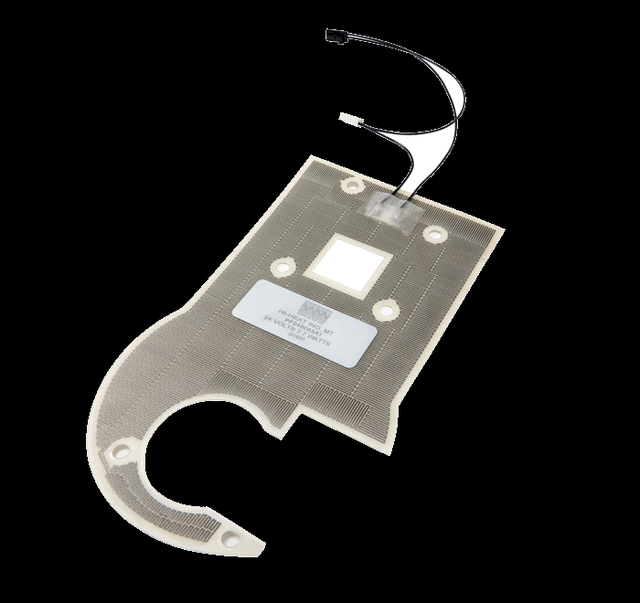
A flexible heater built for medical and laboratory equipment brings precise, uniform heat to instruments and analyzers where the heater must conform to the device and hold a tight, repeatable temperature. Because the thin substrate adheres directly to the part, it heats the component itself — a reagent reservoir, a sample block, an enclosure — rather than the surrounding air, and an etched-foil element spreads the heat evenly with the tight resistance tolerance instrument work needs. Hi-Heat builds these to your drawing and/or specification, in the substrate the device calls for: silicone rubber for general instrument and washdown duty, or polyimide (Kapton) where thinness, low outgassing, and tight clearances matter. Typical homes are blood analyzers, respiratory and hydrotherapy units, incubators, freeze dryers, reagent reservoirs, and other diagnostic and lab equipment.
Key Features & Benefits
- Heat goes into the part, not the air — the heater wraps or adheres directly to the surface, so it conducts heat into the metal instead of warming the surrounding space — faster response and far less wasted energy than heating the ambient. The efficient way to hold a specific item at temperature.
- Conforms to the shape the application actually has — a thin flexible substrate follows valve bodies, pump housings, instrument enclosures, and curved tanks that a rigid heater or a straight cable cannot cover well. Shaped to the part, not the part to the heater.
- Built to your drawing, in the substrate the environment needs — silicone for rugged moisture and washdown duty, polyimide for vacuum/cleanroom and tight-clearance electronics, polyester for cost-sensitive low-temperature work — every heater laid out to the surface, temperature, and environment you give us. One platform, the right material for the job.
- Control and safety designed in — a bonded-in sensor, a thermostat or PID/SCR loop, and an independent high-limit make a complete controlled assembly — or a snap-action thermostat laminates right into the heater for a compact integral package. Holds the set point and protects the part.
- UL Recognized and ISO 9001:2015 behind it — the heater is a UL Recognized Component (with customer-specific UL file numbers available) made under a third-party-audited ISO 9001:2015 quality system — the documentation an OEM and its inspector expect. Drops into a UL-Listed end product as a recognized component.
Specifications
- Operating principle
- Electric resistance (Joule) heating — current passes through a resistance element laminated into a thin, conformable substrate, so the heater can wrap or adhere directly to a surface that is not flat and put its heat into the part rather than into the surrounding air.
- Substrate (construction)
- Three substrates, chosen by temperature, ruggedness, and thickness: silicone rubber (rugged, moisture-tolerant, the general-purpose choice), polyimide / Kapton (the thinnest format, with aerospace-grade thermal stability and low outgassing for vacuum and cleanroom service), and polyester film (a cost-effective option for low-temperature OEM work).
- Element type
- Wire-wound — a resistance wire laid in a pattern, reaching the highest watt densities and economical for many shapes; or etched-foil — a thin metal foil photo-etched into a precise circuit that spreads heat very uniformly, holds a tight resistance tolerance, and can be routed around cut-outs and sensors. Etched-foil delivers a lower, more even watt density; wire-wound gives maximum watt density or lowest cost.
- Shape, area & thickness
- Built to the surface it heats — the heated area and shape are laid out to your drawing or sketch, with cut-outs, holes, and lead-exit locations placed where the part requires. The flexible substrate conforms to irregular surfaces (valve bodies, pump housings, instrument enclosures, curved tanks) that a rigid or cable-style heater cannot follow.
- Attachment to the part
- Three common methods: factory-applied pressure-sensitive adhesive (PSA) backing for a clean smooth surface (the quickest install); factory vulcanizing or bonding to a plate or component for the best thermal contact and durability; or mechanical clamping / strapping for pipes, drums, and removable installations. Intimate, gap-free contact is the goal — an air gap is thermal resistance that makes the heater run hotter than it should.
- Sensors & lead exits
- A temperature sensor (thermistor, RTD, or thermocouple) can be bonded into or next to the heater, and a snap-action thermostat can be laminated right into the assembly for a compact integral control. Lead-wire type, length, and exit location are specified per job.
- Temperature range
- By substrate (verbatim): polyester film serves to about 105°C (221°F); silicone rubber is UL rated with a maximum continuous operating temperature of 200°C (392°F) and remains flexible at −57°C (−70°F); polyimide / Kapton serves to about 260°C (500°F) with aerospace-grade thermal stability and low outgassing for vacuum and cleanroom use. Every construction has a maximum temperature and watt density — running within them is what gives a flexible heater a long service life.
- Watt density
- Watt density (watts per square inch) is the value to get right — too high scorches the substrate or the part, too low cannot reach temperature. It is set by the substrate, the element type (etched-foil spreads a lower, more even density; wire-wound reaches higher densities), and what the part can take without a hot spot, and is sized per job rather than published as a fixed catalog value.
- Voltage
- Wound to the application voltage, single-phase — specify the available service voltage with the request.
- Control & safety
- A flexible heater needs a control loop and an independent safety. Typical packages pair a bonded-in temperature sensor with a thermostat (on/off duty) or a PID controller driving an SCR or solid-state relay (tight control), plus an independent high-limit cut-out so a control fault cannot overheat the part. For compact installs a snap-action thermostat laminates into the heater.
- Certifications
- UL Recognized Component — customer-specific UL file numbers available; the silicone-rubber line is UL-rated for continuous operation to 200°C (392°F). Manufacture is ISO 9001:2015 certified (Perry Johnson Registrars, ANAB-accredited).
- Build & ordering
- Custom build-to-drawing-and/or-specification — substrate, element, watt density, shape, cut-outs, lead exits, sensors, and attachment are specified per job, so virtually every heater is engineered to its part. No published price list, quote-only. Hi-Heat is an authorized-distribution line: Prater Technical Partners is the vendor of record, with the heater drop-shipped from the factory (optional Prater kitting).
Common Applications
- Blood analyzers and diagnostic instruments — holding a sample block or reagent at a precise temperature
- Respiratory therapy and hydrotherapy units
- Reagent and liquid reservoirs — keeping fluids at a controlled working temperature
- Incubators and medical freeze dryers
- Laboratory equipment and analyzers — uniform heat for repeatable results
- Exam-table drawers and patient-warming equipment
Design & Selection Considerations
- Pick etched-foil when uniformity and repeatability matter — instrument and analyzer work lives on a tight, repeatable temperature; an etched-foil element spreads heat far more evenly than wire-wound and holds a tighter resistance tolerance, so the sample or reagent sees the same temperature run to run. For diagnostics, even heat is the whole point — favor etched-foil.
- Specify the control to the tolerance the assay needs — a forgiving warm-keep loop runs fine on a thermostat, but a tight set point on a sample block or reagent wants a PID controller with an SCR for fine resolution and soft-start. Use the input form to tell us the target temperature and the tolerance and the control follows. The required tolerance, not the heater, sets the control.
- Choose the substrate for cleanliness and clearance — silicone rubber suits general instrument and washdown duty; polyimide (Kapton) is the choice where thickness, tight clearances, and low outgassing matter (sealed or vacuum sub-assemblies, tightly-spaced electronics). Match the substrate to the device environment, not just the temperature.
- Bond it for gap-free, repeatable thermal contact — a controlled instrument temperature depends on intimate contact; an air gap behind the heater is thermal resistance that shifts the reading and makes the heater run hot. Factory vulcanizing or bonding to the part gives the best, most repeatable contact for precision work. Repeatable contact is repeatable temperature.
- Plan the sensor location with the heater — where the sensor sits relative to the heater and the thermal mass it controls drives how tightly the loop holds — sense at the controlled point, not at the heater face. Bond the sensor in at build time so its position is fixed. Sense what you care about, not the heater.
- Hand the UL file to the device maker — the heater ships as a UL Recognized Component and can carry a customer-specific UL file number, so it folds cleanly into a UL-Listed medical or lab device; the device’s own medical approvals remain the equipment maker’s scope. Recognized component in, listed device out.
To spec the right Hi-Heat medical or laboratory heater:
Use the input form to send a drawing or sketch of the surface, the target maintain temperature, the minimum ambient (for freeze / condensation duty), the voltage available, the environment (washdown, vacuum, cleanroom, abrasion), and the quantity — and we’ll spec the substrate, element, watt density, attachment, and control to suit, then quote it.
Electric Heating Application Sheet ›Talk to an engineer directly — Scott Prater, Principal · 917-580-0878 · scott@pratertechnical.com
Specifications compiled by Prater Technical Partners from Hi-Heat Industries published product specifications.