Product Overview
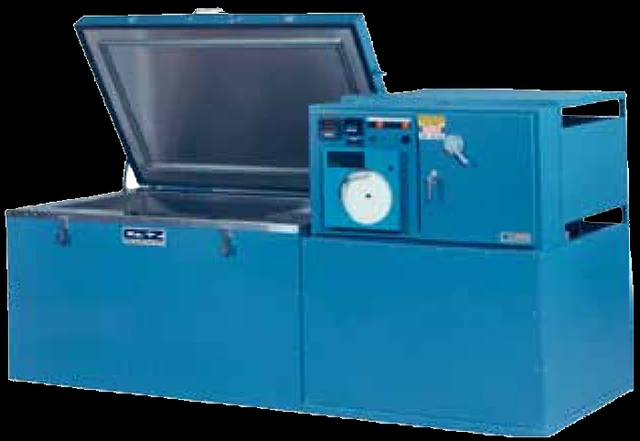
The CSZ T-Series is a heavy-duty top-loading production chilling chamber — an ultra-low industrial freezer built for heat treating and high-throughput cold processing. It chills steel to −120°F (−84°C) to transform retained austenite to martensite — relieving internal stress, stabilizing dimensions, and increasing hardness. The T-Series is top-loading, taking high-capacity production loads by hand or hoist, with optional casters for mobility; high-volume air circulation holds uniform cooling, and the heliarc-welded vapor-tight cabinet is built to survive a harsh heat-treat floor. For parts that arrive on a charge car, the front-loading TF-Series is the sibling build.
Key Features & Benefits
- Built to last for decades — heavy-duty construction and refrigeration are engineered for long service life — CSZ cites freezers still running in the field at 30+ years. A capital freezer you buy once, not a lab cabinet you replace.
- Holds up in a harsh heat-treat environment — the cabinet and refrigeration are built to survive side-by-side service with heat-treat furnaces and the dirt, heat, and abuse of a production floor (T & TF-Series). Rated for the shop, not just a clean room.
- Vapor-tight welded liner that resists moisture — a heliarc-welded vapor-tight liner with a brushed-stainless interior keeps moisture out of the insulation, which is what slowly kills a deep-cold cabinet. The detail that protects the insulation value over decades.
- Trouble-free operation that saves on maintenance — simple, rugged refrigeration with NEMA-12 enclosures, oil-tight switches, and fused components is built to run continuously with minimal attention. Low running cost, few service calls.
- Easy loading for the way you actually work — gas-spring or pneumatic lids on the top-loaders, front-loading rollers and guides on the TF-Series to mate with charge cars and part baskets, and casters on the V-Series for mobility. The freezer fits the workflow instead of dictating it.
Specifications
- Type & operating principle
- Heavy-duty top-loading production chilling chamber — an ultra-low industrial freezer built for heat-treat and high-throughput cold processing. The T-Series is top-loading for high-capacity production loads handled by hand or hoist.
- Loading / configuration
- Top-loading with a lid/door switch, for hand or hoist loading of high-capacity production loads. Optional casters add mobility on the shop floor.
- Cabinet & interior construction
- Heliarc-welded vapor-tight liner with a brushed stainless-steel interior, adjustable chrome-plated latch, oil-tight switches and lights, lid/door switch, and fully enclosed NEMA-12 electrical compartments with fused components — built to hold up in harsh heat-treat environments.
- Insulation
- Thick, non-settling low-“K”-factor foam insulation for continuous operation and reduced operating cost.
- Temperature range
- −40°F to −120°F (−40°C to −84°C) standard; optional liquid-nitrogen cooling to −300°F (−184°C).
- Refrigeration system
- Mechanical refrigeration with zero-ozone-depletion refrigerants, a water-cooled condenser, refrigeration pressure gauges, and service taps; a manual-defrost switch is standard (automatic defrost optional). Air-cooled / remote refrigeration is available. For repeated hot-charge duty, refrigerant-injection compressor cooling is available to protect the low-stage compressor (standard on the front-loading TF-Series).
- Cooling capacity / sizing
- Rated by recovery: the pounds of 75°F steel a pre-chilled −120°F chamber recovers within one hour — from about 50 lb/hr on the smallest T models to 600+ lb/hr on the high-capacity heavy-duty builds, set by the compressor package (e.g. T-25-7.5-7.5 at 638 lb/hr).
- Workspace / size range
- T-Series workspace from about 36×24×26 in to 72×48×48 in (L×W×D). Custom sizes (including 168 cu ft and larger) are built to order.
- Air circulation & uniformity
- High-volume air circulation provides uniform cooling throughout the chamber.
- Controller
- Digital-display temperature controller standard.
- Alarms & monitoring
- Lid/door switch standard; optional temperature recorders, running-time meter, and product soak timer.
- Electrical / power
- 230 V or 460 V, 3-phase, 60 Hz standard; 50 Hz operation optional (performance is reduced at 50 Hz).
- Options & custom capabilities
- Custom-size chambers, casters, access ports, automatic defrost systems, liquid-nitrogen cooling or LN₂ boost cooling, liquid baths, air-cooled / remote refrigeration, EIA-232/485 communications, Windows-based software, temperature recorders, explosion-proof chambers, electrical disconnect switch, custom control interface, and 50 Hz operation.
- Build & lead time
- Quote-only — there is no published CSZ price list, because most units are configured or custom-engineered to the application. A standard freezer carries a routine build lead time; a large or custom unit (custom size, custom temperature range, explosion-proof, LN₂ cooling) carries a longer engineered-build lead. Prater Technical Partners scopes the configuration and lead time with the quote.
Common Applications
- Cold-treating steel to transform retained austenite to martensite — relieves stress, stabilizes dimensions, and increases hardness (heat treating)
- High-throughput age-hardening, stress-relieving, and dimensional stabilization of production runs
- Hand- or hoist-loaded batch cold processing of parts and baskets between furnace operations
- Cold-treating tool steels, dies, and gauges to lock in dimensional stability
- Shrink-fit / expansion assembly of large components — including wind-turbine parts on custom builds
Design & Selection Considerations
- Rate the load by recovery, not just by volume — capacity is rated by hourly recovery of a hot steel charge (see the Cooling capacity spec), so a heavier or hotter charge needs a higher-capacity model — and the part still takes additional time to stabilize after the air recovers, depending on its thickness and exposed surface. Size from your hourly throughput and part mass, not from interior cubic feet.
- Check the floor loading before you site it — the floor is rated for 200 lb per square foot as standard; a heavy charge or a large custom build can exceed that and needs floor reinforcement (available). Confirm the rated dead load against your heaviest charge at the layout stage.
- Match the loading style to the process — top-loading V and T cabinets suit hand or hoist loading of parts and baskets; the front-loading TF-Series is built to run side-by-side with batch furnaces and charge cars. Pick the door/lid style for how the parts arrive, not the other way around.
- Decide how deep the cold really needs to go — the standard envelope reaches −120°F (−84°C); going colder means optional liquid-nitrogen cooling, which adds a bulk LN₂ supply and safe venting with oxygen monitoring for personnel. Specify the deepest temperature the process needs — not the deepest available — because deeper cold costs capital and operating money.
- Protect the compressor on a hot charge — dropping a load of hot parts into a deep-cold chamber spikes the suction load; the T/TF heavy-duty builds use refrigerant-injection compressor cooling to protect the low-stage compressor. Heavy heat-treat duty wants the protected compressor package, not a light-duty refrigeration system.
- Plan for defrost and condenser cooling — a manual-defrost switch is standard on the T/TF heavy-duty cabinets (automatic defrost is optional); the standard condenser is water-cooled, so confirm a cooling-water supply or specify air-cooled / remote refrigeration. Settle the defrost strategy and the heat-rejection path before installation.
To spec the right CSZ T-Series freezer:
Use the input form to send the parts you are cold-treating (size, weight, and material), your required low temperature, and your hourly throughput, plus whether parts are loaded by hand or hoist — that sets the cooling-capacity model. Use the input form to tell us if you need refrigerant-injection compressor protection, automatic defrost, casters, LN₂ cooling, or a custom size. (If parts arrive on a charge car, look at the front-loading TF-Series instead.)
Environmental Test Application Sheet ›Talk to an engineer directly — Scott Prater, Principal · 917-580-0878 · scott@pratertechnical.com
Specifications compiled by Prater Technical Partners from Cincinnati Sub-Zero published product specifications.