Product Overview
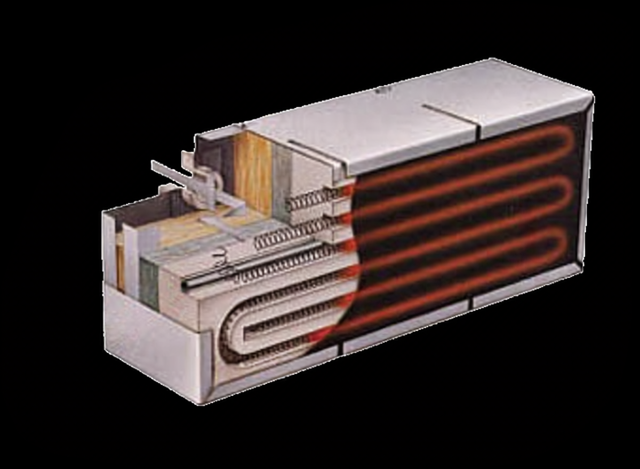
The F Series is Solar Products’ quartz-composite-face medium-wave infrared panel — the best-selling workhorse of the line. The face is a patented quartz-fabric / ceramic-fiber-coil composite that radiates medium-wave IR directly onto the workpiece at up to 25 watts/in², with high radiant efficiency held over the panel’s life. It is the standard choice for thermoforming top and bottom oven zones and similar surface- and web-heating duty, built to drawing in sizes up to 30″ wide.
Key Features & Benefits
- Energy lands on the product, not the air — radiant infrared sends heat straight to the workpiece, so the part absorbs it directly while the surrounding air stays comparatively cool — faster heat-up, energy concentrated where it counts, and output that drops almost the moment you turn the panel down. The right tool when you are heating a defined surface or web, not a roomful of air.
- Medium-wave output most materials readily absorb — the emitter works in the medium-wave band, which is well matched to plastics, coatings, paints, and organic materials — the energy is absorbed at the surface and converted to heat rather than passing through or reflecting away. Match the wavelength to the material and the heating is fast and efficient; the wrong band wastes energy on the air.
- Built to your drawing, not pulled off a shelf — every panel is made to order — dimensions, wattage, watt density, emitter type, and mounting are specified per job and arranged to the oven zone or fixture, which is why these go into OEM machinery and process lines rather than a catalog. The panel fits the process, not the other way round.
- Proportional zone control comes with the panels — fast radiant response pairs naturally with SCR / PID control, and Solar Products supplies the matched zone controls and tuning, so the heat profile can be trimmed across the oven width and length. The control scheme is built to the panel layout, not bolted on after.
- Drops into — or re-optimizes — an existing oven — because the panels are built to drawing, a replacement can match the dimensions, wattage, wavelength, and mounting of the panels it replaces, or be re-specified if the original was the wrong wavelength or watt density for the substrate. A retrofit is a chance to fix the original spec, not just swap a failed panel.
Specifications
- Operating principle
- Electric radiant infrared heating — an electric resistance element heats an emitter face (or tube) that radiates medium-wave infrared energy directly onto the workpiece or web, rather than warming the air the way a convection oven does. The energy lands on the product surface, so drying, curing, laminating, thermoforming, and preheating run faster and under tighter control.
- Emitter / face construction
- Quartz-composite face — a patented process bonds quartz fabric with a ceramic-fiber coil support using a high-temperature material and special cement, giving a rugged radiant face with no external reflector required. The standard, best-selling Solar Products panel face.
- Wavelength band
- Medium-wave infrared, 2.3 to 6 microns, with most energy in the medium band at high watt densities — well absorbed by plastics, coatings, paints, and organic materials.
- Radiant efficiency
- 78.5%, maintained over time without external reflectors — independently verified by Hydro-Québec’s LTEE certified test lab.
- Watt density
- Up to 25 watts/in² (39 kW/m²) maximum — set the operating density to what the substrate and line speed can take.
- Heat delivered to product
- 2.4 Btu/ft²/sec delivered to the product at maximum watt density; 1.15 Btu/ft²/sec at half density.
- Panel / element dimensions
- Built to drawing up to 30″ (762 mm) wide and 84″ (2133 mm) long — not both maximums simultaneously — and shaped to the fixture: rectangular (most common), square, round, or C-shaped, with the radiant face aimed in a single or dual direction and edge compensation available to even out cold spots across wide webs. Panel depth is built from 1¼″ to 6″ (3″ typical), set by the available space and the required back-temperature.
- Life expectancy
- Typical 25,000 hours within design conditions.
- Voltage / phase
- Built for any commercial or industrial supply voltage — 120, 208, 220, 230, 240, 277, 380, 415, 460, 480, 575, and 600 V, single- or three-phase, with dual- or triple-voltage configurations available. The voltage and phase are set with the order.
- Control method
- Medium-wave panels respond quickly, which suits proportional control: an SCR power controller proportioning each zone, a PID loop reading panel or product temperature, and multiple independently controlled zones to tune the heat profile across the oven. Solar Products supplies integrated SCR zone controls and PID tuning with the panels.
- Options & accessories
- Configurable to the application — back-mounted fans, multi-zone heaters, a pyrometer view port through the heater, a replaceable type-K thermocouple, cool-down / drying air holes, parallelogram modules for zoning across wide webs, stainless-steel or no housing (heater board only), wire leads, an electrical junction box, and ¼-20 mounting studs. Specified per drawing.
- Material & process match
- The medium-wave band suits plastics, paints, powder and e-coat finishes, and organic coatings; the F face is the default for thermoforming top and bottom zones and similar surface- and web-heating duty. Use the input form to tell us the substrate, process temperature, and line speed and the panel is tuned to it.
- Build & lead time
- Custom build-to-order — virtually every panel is built to the application (dimensions, wattage, wavelength, watt density, emitter type, and mounting). No published price list; pricing is quote-only. Lead times typically run about 3 to 14 weeks depending on configuration.
Common Applications
- Thermoforming oven top and bottom heating zones
- Paint, powder-coating, and e-coat curing ovens
- Screen-print curing and high-speed drying lines
- Glass tempering, bending, and annealing furnace banks
- Semiconductor and electronics process heating
- Automotive fiberglass and composite curing
Design & Selection Considerations
- Match the wavelength to the material — not the other way round — materials absorb some wavelengths far better than others; the medium-wave band suits most plastics, paints, coatings, and organics, but the substrate is what should drive the emitter choice. Use the input form to tell us the material and the series and emitter follow. The wrong wavelength heats the air and the oven instead of the part.
- Watt density is bounded by what the substrate can take — a higher watt density heats faster but can scorch a heat-sensitive web or coating; the safe density is set by the substrate and the line speed, not by the maximum the panel can deliver. Size the density to the product, then pick the series that reaches it.
- Standoff distance and reflective / convective losses size the system — the wattage to reach temperature at the required line speed, the panel footprint that matches the oven zone, the standoff from panel to product, and the number of zones all factor into the layout. Use the input form to give us the target material, the process temperature, and the line speed and the panel count, wattage, and layout follow.
- Run the panel at its rating — over-firing is the main life-limiter — kept within design conditions an emitter lasts for years; the common early-failure causes are running hotter than rated, mechanical damage to the emitter face, contamination or overspray baking on, and thermal-cycling stress at the connections. A panel that fails early is usually run above its rating or is the wrong construction for the duty.
- Read the right temperature — panel or product — a PID loop can hold panel temperature or product temperature, and the two behave very differently on a moving web; decide which you are controlling before you pick the control points and zone count. Use the input form to tell us how many zones and whether you read panel or product temperature, and the scheme is built to match.
To spec the right Solar Products F Series panel:
Solar Products panels are custom build-to-order, so the quote is only as good as the application data. To spec and price the right panel, have ready: the target material (substrate type and thickness), the process temperature and required line speed or dwell time, the oven zone dimensions and standoff distance, the number of control zones, and the available voltage and phase. The more complete the data up front, the faster and tighter the quote.
Electric Heating Application Sheet ›Talk to an engineer directly — Scott Prater, Principal · 917-580-0878 · scott@pratertechnical.com
Specifications compiled by Prater Technical Partners from Aspeq Heating Group published product literature.