Product Overview
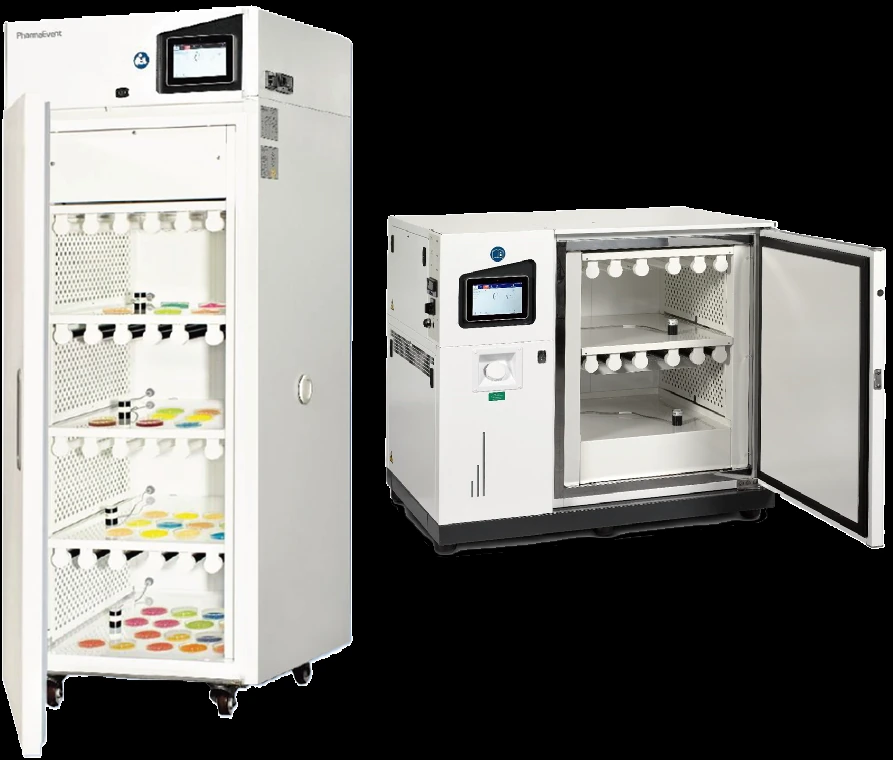
A CSZ PharmaEvent photostability chamber is a constant temperature/humidity reach-in that adds a calibrated light system to test to ICH guideline Q1B Option 2. The cool-white fluorescent and UV-A lamps are fully compliant with the guideline’s spectral requirement; built-in light sensors and an integration calculator drive exposure to a programmed target (for example 1.2 million lux-hours and 200 Wh/m²), completing full exposure in under three days. Two reach-in sizes — benchtop C/250/L and upright C/500/L — run +5°C to +50°C and 20–90% RH on the S!MPAC 21 CFR Part 11 controller (per the manufacturer’s declaration), with GMP-compliant documentation and optional IQ/OQ packages.
Key Features & Benefits
- Lamps compliant with the ICH spectral requirement — the cool-white and UV-A lamps are fully compliant with the spectral requirement Q1B Option 2 sets, so the light source meets the guideline rather than approximating it. The lamp set is built to the standard, not bench-matched to it.
- Dose is metered and driven automatically — built-in calibrated light sensors and an integration calculator drive exposure to a programmed lux-hour and Wh/m² target, so the chamber runs the dose to the protocol without manual tracking. Set the target; the chamber reaches it and stops.
- Full exposure in under three days — the lamp power levels let a complete Q1B exposure finish in less than three days, which keeps a development or release study moving. The light dose is not the schedule bottleneck.
- Uniform irradiation, by design — specimens sit at a fixed distance from the lamps and the natural close-range non-uniformity is corrected by visible-light and UV filter systems, so every shelf sees a comparable dose. Uniform exposure is the hard part of photostability — it is engineered in.
- Audit-ready, with the validation line drawn honestly — the S!MPAC controller and optional S!MPATI pharma software give a 21 CFR Part 11 audit trail and a GMP-documented process per the manufacturer’s declaration, while validating the installed system stays your responsibility. Regulated-workflow tools, described as what they are.
Specifications
- Operating principle
- A constant temperature/humidity reach-in chamber that adds a calibrated light system to expose a specimen to a controlled, measured dose of visible and ultraviolet light per ICH Q1B Option 2. Built-in light sensors meter the dose, so the chamber drives exposure to a programmed target automatically.
- Configuration & access
- Reach-in, in two sizes: benchtop C/250/L (2 light tiers) and full-size upright C/500/L (4 light tiers). White interior surfaces maximize reflectivity; the cabinet is compact enough to fit through common doorways.
- Temperature range
- +5°C to +50°C lights off; +5°C to +50°C (C/250/L) or +10°C to +50°C (C/500/L) lights on. 5°C operation also gives cold-storage simulation.
- Humidity range
- 20% to 90% RH (dew point +5°C to +40°C).
- Workspace volume & sizes
- 9 cu ft (235 L, C/250/L) and 18 cu ft (460 L, C/500/L); shelving storage area 7.7 sq ft and 15.6 sq ft respectively.
- Load / shelf capacity
- 55 lb (25 kg) distributed load per shelf; 110 lb (50 kg) total on C/250/L, 220 lb (100 kg) on C/500/L.
- Control tolerance (in time)
- ±0.1°C to ±0.5°C temperature in time, ±1% to ±2% RH.
- Uniformity (in space)
- Temperature ±0.5°C to ±1.0°C in space (to ±1.5°C with lighting); cool-white light uniformity ~±8% and UV-A uniformity ~±12% from the median reading, evened by visible-light and UV filter systems.
- Light system
- Cool-white fluorescent and UV-A lamps fully compliant with the spectral requirement of the ICH guideline (Q1B Option 2), arranged in light tiers with calibrated light sensors for level feedback and light-equalization filters for uniform exposure. A unique integration calculator exposes product to a programmable target (for example 1.2 million lux-hours and 200 Wh/m²), completing full exposure testing in under 3 days. Optional dimming control allows lower light levels; optional LED lamps replicate modern illumination.
- Standards & protocols
- Built specifically to ICH guideline Q1B Option 2 for pharmaceutical photostability; GMP-compliant design and documentation.
- Controller & software
- S!MPAC® controller with a 7″ multi-user WebSeason® touchscreen, audit trail, alarm management, and trend viewing, over an Ethernet interface; 21 CFR Part 11 compliant control system per the manufacturer’s declaration, with optional S!MPATI® pharma software for a fully documented GMP process. Validating the system in your GxP environment remains the end user’s responsibility.
- Validation documentation
- Optional IQ/OQ documentation and site-execution packages; factory calibrations are performed at +25°C/60% RH and +40°C/75% RH.
- Humidity water supply
- Integral humidity water tank (3.4–4.9 gal) or external feed; demineralized or RO water (pH 6–7, conductivity 5–20 µS/cm) via a patented high-efficiency humidification system.
- Electrical service
- 220/230 VAC ±10%, 1 ph, 50/60 Hz.
- Build & lead time
- CSZ chambers are quote-only; photostability units are catalog-configured to size, lamp/filter set, controller, and documentation, with lead time confirmed at quotation.
Common Applications
- ICH Q1B Option 2 photostability testing of drug substances and products
- Light-exposure testing for nutraceutical, biotech, food, flavor, fragrance, and cosmetic products
- Combined constant temperature/humidity plus controlled light dose for forced-degradation studies
- GMP-documented release and stability photostability studies in pharmaceutical labs
- Cold-storage-simulating light testing at 5°C operation
Design & Selection Considerations
- Confirm Option 2 is the path your protocol takes — these chambers are built specifically for ICH Q1B Option 2 — the cool-white-plus-UV-A approach; make sure that is the option your study uses before specifying, because the lamp set is the whole point of the chamber. The option dictates the light source.
- Plan the exposure geometry around uniform dose — uniform irradiation depends on every specimen sitting at the same distance from the lamps; lay out the load on the tiers accordingly and rely on the equalization filters rather than fighting them. How you load the shelves affects the dose each sample sees.
- Re-calibrate the light sensors on your quality interval — the dose control is only as good as the sensor calibration; fold light-sensor verification into the maintenance schedule alongside the factory temperature/humidity calibrations. The metered dose depends on calibrated sensors.
- Match the lamp option to the illumination you are simulating — standard cool-white/UV-A lamps are the ICH reference, while the optional LED lamps replicate modern illumination and dimming control allows lower levels; pick the lamp set against what your study needs to represent. Decide the light option up front — it changes the build.
- Keep the humidity water clean — humidity control wants demineralized or RO water in spec (pH 6–7, low conductivity); size the tank or external feed and keep the water in range so humidity holds and the humidifier stays serviceable. Water quality is part of holding the condition.
To spec the right CSZ photostability chamber:
To configure the right chamber, the application drives every choice — so the more of this you can give us up front, the tighter the quote:
- the test standard or protocol you are working to (ICH Q1A / Q1B Option 2, IEC 62660-2, SAE J2464, a UL battery method, an internal spec);
- the test article — size, weight, quantity, and (for powered tests) the heat it dissipates;
- the required temperature and humidity range and how tightly you need them held;
- whether the work is regulated (21 CFR Part 11 audit trail, IQ/OQ/PQ qualification) — and, for battery work, the hazard scope (cell chemistry and the abuse you intend to run);
- your site — available power, water, drainage, doorway and ceiling clearance, and floor loading.
Talk to an engineer directly — Scott Prater, Principal · 917-580-0878 · scott@pratertechnical.com
Specifications compiled by Prater Technical Partners from Cincinnati Sub-Zero published product specifications.