Product Overview
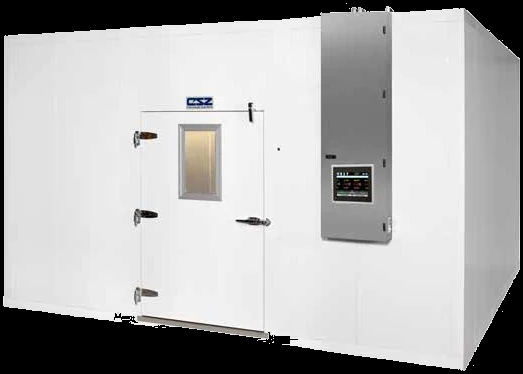
A CSZ stability walk-in room (WMST series) holds ICH Q1A temperature/humidity stability conditions at batch scale — −20°C to +60°C, optional humidity to 95% RH, in standard sizes from 288 to 2025 cu ft and custom configurations beyond. It is the answer when the volume of product on test outgrows a reach-in: you load racks and carts through an 8′ door, hold ±0.3°C, and run the same EZT-570S 21 CFR Part 11 controller (per the manufacturer’s declaration) used across the CSZ line. Redundant refrigeration and IQ/OQ/PQ on-site validation are available; the factory-trained team assists with assembly and start-up.
Key Features & Benefits
- Stability conditions at batch scale — the room holds the same ICH Q1A conditions a reach-in does, but for the volume of product a study or an ongoing stability program actually generates — loaded on racks and carts you walk in to. When the batch outgrows the reach-in, the conditions do not have to change.
- Sized and configured to your batch, not a fixed catalog box — standard sizes span an order of magnitude and custom configurations go further, so the room fits the load and the floor space rather than forcing a compromise. The room is built around your program.
- Same audit-ready controller as the reach-in line — the EZT-570S brings the same 21 CFR Part 11 audit trail, alarms, and remote access used across the CSZ line, so a lab can scale from reach-in to room without relearning the control or the data path. One control language from bench to room.
- Uptime designed in for long studies — redundant refrigeration is available because a multi-month stability study cannot tolerate a single compressor taking the room out; the option exists for exactly that risk. Protection for the studies you cannot afford to restart.
- Factory-assisted on site — the factory-trained service team handles assembly, start-up, training, and validation, which matters on a field-built room far more than on a plug-in reach-in. The hard part of a walk-in — getting it right on your floor — is supported.
Specifications
- Operating principle
- A uniform temperature/humidity-conditioned room held to ICH Q1A stability conditions for testing and storing large batches of product. Each conditioning system is tested before shipment; the factory-trained service team assists with assembly, start-up, training, and validation on site.
- Configuration & access
- Walk-in room, temperature-only or temperature & humidity, with an 8′-wide × 78″-high door with a heated viewing window and vapor-proof lights (double doors available). You walk in to load racks and carts — the answer when batch volume exceeds a reach-in.
- Temperature range
- −20°C to +60°C — covering ICH Q1A long-term, intermediate, and accelerated conditions plus refrigerated and sub-zero storage; custom configurations reach deeper (CSZ has built −70°C pharmaceutical storage rooms).
- Humidity range
- Optional, 20% to 95% RH, with an electronic humidity sensor on humidity models.
- Refrigeration system
- Integral air-cooled condenser standard; a redundant refrigeration system is available where uptime on a long study matters.
- Workspace volume & sizes
- Standard sizes 288, 512, 800, 1152, and 2025 cu ft (6×6×8 ft through 15×15×9 ft); other sizes and configurations available, so the room is matched to the batch rather than the batch to the room.
- Control tolerance (in time)
- ±0.3°C temperature and ±2.5% RH humidity (WMST Series specifications); better tolerances are achievable over narrower ranges — consult the factory for the figure your protocol requires.
- Uniformity (in space)
- ±1.0°C, or designed to the application.
- Standards & protocols
- Built to meet ICH Q1A guidelines for drug substances and products; the chambers also support ASTM medical-device, shipping-container, and packaging methods within their performance range.
- Controller & software
- CSZ EZT-570S touchscreen controller, 21 CFR Part 11 compliant per the manufacturer’s declaration — data logging, USB data-file access, Ethernet control and monitoring, email/text alarm notification, audit trail, digital signatures, full system security, and power-recovery options; EIA-485/EIA-232 interface for multi-chamber software control. Validating the system in your GxP environment remains the end user’s responsibility.
- Validation documentation
- IQ/OQ/PQ qualification protocol available; on-site validation optional, performed by the factory-trained service team that also handles assembly, start-up, and training.
- Humidity water supply
- A reverse-osmosis water filtration system and a dry-air purge system are available options for humidity service.
- Build & lead time
- CSZ chambers are quote-only; a walk-in stability room is custom-built to size, door configuration, humidity, and redundancy, with a build and field-assembly lead time confirmed at quotation.
Common Applications
- ICH Q1A pharmaceutical stability testing and ongoing stability programs at batch volume
- Long-term and R&D storage of drug substances and products under controlled conditions
- Medical-device, packaging, and shipping-container conditioning to ASTM methods
- Bulk storage of pharmaceutical product at sub-zero conditions in custom-configured rooms
- Personal-care and consumer-product stability and accelerated-aging at scale
Design & Selection Considerations
- Reach-in or walk-in — decide on batch volume, not just article size — the room earns its cost when you are conditioning or storing many units at once or loading by rack and cart; a handful of samples still belongs in a reach-in. Use the input form to tell us the batch volume and we draw the line. Volume, not single-article size, decides the form factor.
- Hold the realistic tolerance for the range you need — the room holds ±0.3°C and ±2.5% RH across its full range — well inside the band the ICH Q1A conditions allow — and tighter over a narrower band; specify the band your protocol actually uses so the design targets the real requirement. Tolerance and range trade off — spec both together.
- Plan the site: floor, drainage, water, and access — a walk-in is a building element — it needs floor loading for the loaded racks, condensate drainage, a clean (RO) water supply for humidity, and a path to assemble it in place. Run the site checklist before the order. The room has to be built where it lands.
- Decide redundancy against the cost of a lost study — a single refrigeration failure on a months-long study can invalidate it; weigh redundant refrigeration against the value of the product on test and the cost of restarting. Redundancy is cheap next to a restarted stability program.
- Schedule qualification with the field build — IQ/OQ/PQ and on-site validation are sequenced after assembly and start-up; coordinate them with the build so the room is qualified when the study is ready to load. Qualification follows assembly — plan the calendar.
To spec the right CSZ stability walk-in room:
To configure the right chamber, the application drives every choice — so the more of this you can give us up front, the tighter the quote:
- the test standard or protocol you are working to (ICH Q1A / Q1B Option 2, IEC 62660-2, SAE J2464, a UL battery method, an internal spec);
- the test article — size, weight, quantity, and (for powered tests) the heat it dissipates;
- the required temperature and humidity range and how tightly you need them held;
- whether the work is regulated (21 CFR Part 11 audit trail, IQ/OQ/PQ qualification) — and, for battery work, the hazard scope (cell chemistry and the abuse you intend to run);
- your site — available power, water, drainage, doorway and ceiling clearance, and floor loading.
Talk to an engineer directly — Scott Prater, Principal · 917-580-0878 · scott@pratertechnical.com
Specifications compiled by Prater Technical Partners from Cincinnati Sub-Zero published product specifications.