Product Overview
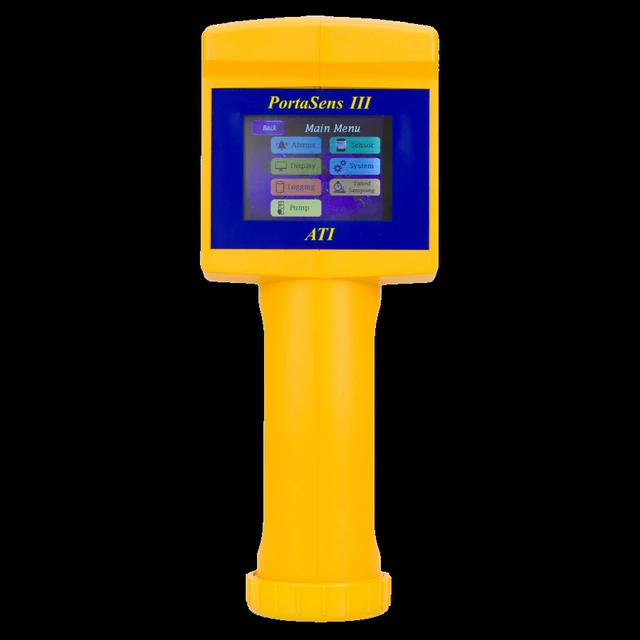
The ATi D16 PortaSens III is the hand-held member of the ATi family — a portable gas leak detector for finding the source of a leak, checking confined spaces, and spot-verifying concentrations in the workplace. A built-in pump and external sampling wand actively draw sample from precise spots a fixed area monitor never reaches, so a survey converges on the exact leak rather than confirming one is somewhere in the room. Like the rest of the line, it reads the interchangeable H-Series smart sensor — any of 60+ modules, each factory-calibrated and swapped in the field with no recalibration, so one detector measures phosgene now and ammonia a minute later. Those same modules also drop into the wall-mounted D12 and B12 units, so a site stocks one shelf of spares for both its portable and its fixed gas detection. A backlit color touch-screen, three-level visual/audible alarms, and a 4 GB datalogger with USB download make the survey documentable, and a rechargeable NiMH battery runs about 10 hours.
Key Features & Benefits
- One instrument, 60+ gases — the D16 accepts any of more than 60 H-Series smart sensor modules; each ships factory-calibrated and needs no calibration step when it plugs in, so changing the installed module is all it takes to go from phosgene to ammonia in under a minute. Carry one detector and a handful of sensors, not a detector per gas.
- Sniffs out the leak source, not just the area — an internal pump pulls sample through an external wand, so you probe valve packing, flanges and fittings and follow the rising concentration to the exact leak site — the job a fixed area monitor cannot do. Find where the leak is, not just that there is one.
- Shares the sensor with your fixed network — the D16 uses the same H-Series smart sensor as the fixed D12 and B12 transmitters, so a single calibrated-spare pool and one calibration workflow serve both portable and fixed gas detection. One sensor family across the whole site.
- Logs the survey, color touchscreen up front — a 4 GB datalogger records millions of points (1–60 min interval) for USB download, behind a backlit color touch-screen and three-level visual/audible alarms — a survey you can document, not just read in the moment. Walk the route, then prove what you found.
Specifications
- Detection principle
- Hand-held detector reading an interchangeable H-Series smart sensor — electrochemical for toxic gases, plus new IR sensors for methane (%LEL) and CO₂. A built-in pump draws sample to the sensor through an external wand, so the instrument actively sniffs rather than waiting for diffusion.
- Sensors
- Any of 60+ H-Series smart sensor modules — each a sensor, amplifier and calibration memory in one plug-in package, factory-calibrated, and changed in the field without recalibration. The carrying case holds a spare battery plus up to two sensor keepers (up to eight extra sensors ready to use); a detector can go from, e.g., phosgene to ammonia in under a minute by swapping the module.
- Target gases
- Chlorine, bromine, fluorine, chlorine dioxide, ozone, ammonia, CO, H₂, O₂, phosgene, HCl, HCN, HF, H₂S, NO / NO₂ / NOx, SO₂, ethylene oxide, formaldehyde, acid gas, alcohol, hydrogen peroxide, peracetic-acid vapor, the semiconductor hydrides (arsine, diborane, germane, phosphine, silane, H₂Se), plus IR methane (%LEL) and CO₂ — one gas per installed sensor.
- Measuring range
- Dependent on the sensor module — from 0–500/2000 ppb (diborane, germane, phosphine, arsine) and 0–1/5 ppm (chlorine, bromine, fluorine, ozone, ClO₂) up through ppm-decade toxics to 0–20/100% LEL (IR methane) and 0–0.2/1.5% CO₂. Each module carries a minimum and maximum data-logging range.
- Sampling
- Internal sample pump with an external sampling wand (10 in. Teflon-lined wand supplied) — draws sample from precise points around valve packing, flanges and fittings to find the higher concentration near a leak. Instantaneous and timed-sampling modes; one-hand pistol grip.
- Display
- Backlit, touch-sensitive color graphics LCD.
- Alarms
- Three concentration alarms (caution, warning, danger, with adjustable setpoints), plus low-flow and low-battery alarms — shown on the LCD and signaled by an audible beeper; visual and audible.
- Datalogging
- Internal 4 GB datalogger (millions of data points) with a USB computer interface to transfer stored gas values; storage interval programmable 1–60 minutes. Logging accuracy is sensor-dependent, generally ±5% of value (limited by cal gas), with sensitivity typically 0.1–1% of the module range.
- Power / battery
- Rechargeable NiMH D-cell running about 10 hours continuously (two D cells supplied), or alkaline D cells; supplied with a 100–240 VAC 2-cell charger.
- Enclosure / rating
- Glass-filled polycarbonate body; operating −13 to 131°F (−25 to 55°C), 0–95% non-condensing humidity. RoHS compliant; CE (LVD 2014/35/EU, EMC 2014/30/EU).
- Dimensions / weight
- 3.5 × 9 × 5.5 in. (89 × 229 × 140 mm), shipping weight 7 lb (3.2 kg). Supplied in a padded carrying case with spare filters, flow meter, USB cable, spare battery, charger, sensor keeper and calibration tee.
Common Applications
- Leak surveys — tracing the source around valve packing, flanges, compression fittings and piping with the wand and pump
- Ammonia refrigeration and ozone generator skids — locating leaks in plant areas with many potential leak points
- Confined-space and pre-entry checks — spot-measuring a target gas before a worker enters a vessel or pit
- Source tracking after a fixed alarm — walking down the point that tripped a D12 or B12
- Workplace exposure spot checks — verifying area concentrations with a logged, documented reading
Design & Selection Considerations
- Build the sensor kit around the gases you actually survey — the D16 ships without sensors — you choose modules from the 60+ available, each ranged for a specific gas. The case holds up to eight spare sensors on keepers, so a refrigeration crew might carry only ammonia while a fab crew carries several hydrides. Decide the gas list and the ranges before ordering. The instrument is generic; the value is in the sensor kit you spec.
- Keep sensors calibrated — the field swap does not skip calibration upstream — a module plugs in and runs because it carries its own calibration memory, but that calibration was done beforehand and drifts over time. Plan a rotation: keep freshly calibrated H-Series modules on the shelf (returned to Badger Meter or bench-calibrated) and swap them in. The same module pool can also feed the fixed D12 / B12 network. Hot-swappable in the field, but the calibration discipline lives behind it.
- Use it to chase what the fixed system flags — not as a substitute for it — the D16 is a survey and verification tool: confined-space entry checks, spot measurement, and tracking down the source after a fixed D12 or B12 alarms. It is hand-carried and battery-powered, not a continuous fixed monitor. Fixed units watch the area continuously; the D16 finds the source.
- It is not an explosion-proof or intrinsically safe instrument — the D16 is a glass-filled-polycarbonate portable, not a classified-area fixed transmitter. For continuous monitoring inside a hazardous area, use the explosion-proof D12 or the intrinsically safe F12iS. Confirm your site’s rules for portable instruments in classified areas before survey work. Match the instrument to the area-classification rules of where you carry it.
To spec the right portable gas detector:
Use the input form to tell us the target gas and its range, the background atmosphere, the area classification, and how many points you need to watch — and we’ll spec the sensor chemistry, transmitter, holder and controller for your application.
Gas Detection Application Sheet ›Talk to an engineer directly — Scott Prater, Principal · 917-580-0878 · scott@pratertechnical.com
Specifications compiled by Prater Technical Partners from Badger Meter ATi / GasSens gas-detection product literature.