Product Overview
The ATi F12 is the smart-sensor toxic-gas transmitter platform in the ATi line — one transmitter family that takes any of roughly sixty interchangeable H-Series smart sensors, each carrying its own electronics and calibration memory so a freshly calibrated spare drops into a live unit in the field. It ships in two forms that share that sensor set and differ only in power and area-classification: the F12iS is intrinsically safe and loop-powered (12–28 VDC) for classified zones behind an I.S. barrier, and the F12/D is line-powered (24–30 VDC, 115 or 230 VAC) with alarm relays on its VAC and 12–30 VDC builds. Both carry a 96×32 backlit graphic display with menu-driven setup, an internal datalogger, an optional Auto-Test that verifies the sensor with a real gas sample instead of a bump test, an IP65 weatherproof housing, and HART communications (with Modbus RTU additionally on the F12/D). Sensor holders run integral, on a 6 ft extension, remote to 500 ft, or duct-mounted, with a heated option for high humidity.
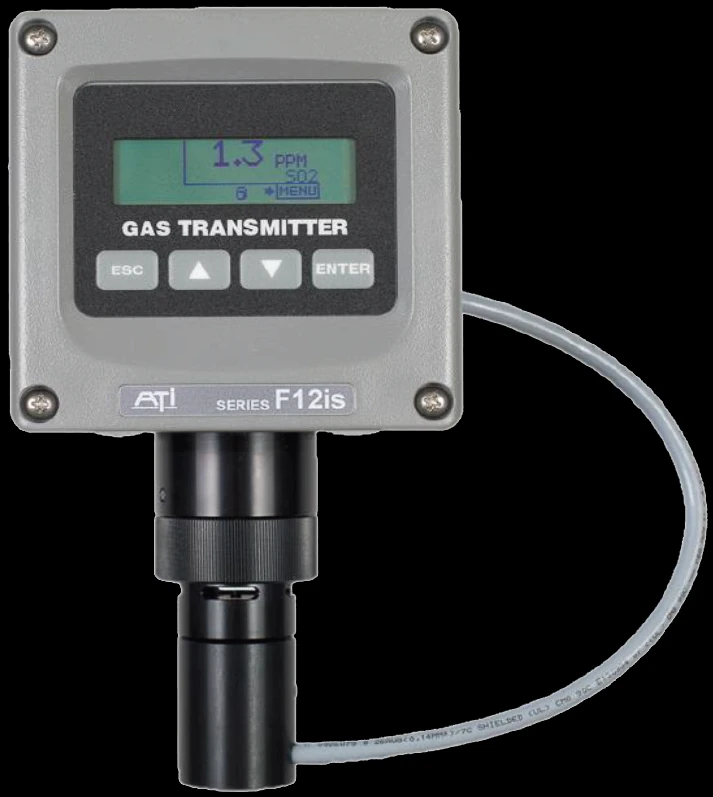
Two power / area-class variants
The F12 is one smart-sensor platform with two ways to power and protect it. The F12/D is line-powered with an on-board datalogger and relay options; the F12iS is intrinsically safe and loop-powered for classified zones. Both share the same ~60 H-Series sensors, the graphic display and Auto-Test — pick by your power source and how you certify the hazardous area.
- Power 24–30 VDC, 115 VAC or 230 VAC; relays on the VAC and 12–30 VDC builds
- HART or Modbus RTU; 4–20 mA, 600 Ω max at 24 VDC
- Auto-Test generator option, heated-sensor option, internal datalogger; CE / RoHS
- Loop-powered 12–28 VDC, 25 mA; I.S. barrier required on the loop
- UL/CSA I.S. Class I/II/III Div 1; ATEX/IECEx listed
- Optional HART; 4–20 mA, 600 Ω max at 24 VDC
Key Features & Benefits
- One platform, ~60 gases, two safety schemes — the F12 takes any of about sixty interchangeable H-Series smart sensors, and the same platform ships either line-powered (F12/D) or intrinsically safe and loop-powered (F12iS) — so the choice is power and area-classification, not a different product. Standardize on one transmitter family across the plant.
- Calibrate on the bench, swap in the field — each smart sensor stores its own calibration, so a spare is calibrated off-line and dropped into a live transmitter without bringing calibration gas into the plant, and the "sensor keeper" holds standby cells biased ready-to-use. No calibration-gas handling at the point, no warm-up wait on the swap.
- Real-gas Auto-Test instead of bump tests — the optional Auto-Test generates an actual gas sample at the sensor to confirm it responds and logs the result in sensor memory — eliminating manual bump testing and the documentation that goes with it. Verified response on a schedule, recorded automatically.
- Datalogger and graphic display on board — a 96×32 backlit graphic LCD with menu navigation shows live concentration and reviews or graphs the internal datalogger (1–60 minute intervals) right at the unit — no laptop to read recent history. Trend the point without leaving the field.
Specifications
- Detection principle
- Electrochemical cell — the F12 platform is designed for electrochemical sensors only, packaged in the interchangeable H-Series smart-sensor module with its own signal-conditioning electronics.
- Target gases
- Roughly 30 toxic and reactive gases across the smart-sensor catalog — chlorine, bromine, chlorine dioxide, ozone, fluorine, ammonia, CO, hydrogen, oxygen, phosgene, the hydrogen halides (HCl, HF, HCN), NO/NO₂, SO₂, ethylene oxide, formaldehyde, hydrogen peroxide, peracetic-acid vapor and the semiconductor hydrides (arsine, diborane, germane, hydrogen selenide, phosphine, silane).
- Measuring range
- Set by the chosen sensor and user-adjustable within its limits — from 0–500 ppb (arsine, diborane, germane, phosphine) and 0–1 ppm (chlorine, bromine, chlorine dioxide, fluorine) through ppm-scale toxics up to 0–10% H₂ and 0–25% O₂.
- Sensor (H-Series smart module)
- Around 60 interchangeable H-Series smart sensors — the cell, its electronics and a calibration memory in one plug-in module, with automatic recognition and stored per-sensor calibration history. The optional "sensor keeper" accessory (00-0981) stores up to four spare cells.
- Accuracy / repeatability
- Generally ±5–10% of value (limited by the available calibration-gas accuracy), with electronic repeatability ±1% and linearity ±0.5%; zero drift under 2% full-scale per month (non-cumulative) and span drift typically under 3% per month.
- Response time
- Sensor-dependent — set by the gas and full-scale range of the chosen H-Series module.
- Outputs
- 4–20 mA, 600 Ω max at 24 VDC on both variants. The F12/D adds alarm relays on its 115 VAC, 230 VAC and 12–30 VDC builds, with a remote alarm-reset input where relays are fitted; the loop-powered F12iS is 4–20 mA only.
- Digital communication
- HART over the 4–20 mA loop on either variant; Modbus RTU (RS-232/485) is additionally available on the F12/D. Field-ordered.
- Sensor holder / mounting options
- Integral as standard, or a 6 ft cable extension, a remote junction box with digital output to 500 ft, or a duct-mount insertion sensor; a heated sensor holder option prevents condensation in high humidity.
- Area classification
- The F12iS is intrinsically safe — UL/CSA I.S. for Class I, II and III, Division 1 locations and ATEX/IECEx listed (–30 to +60°C, IP65), with an I.S. barrier required on the loop. The F12/D is the general-purpose, line-powered unit (CE / RoHS).
- Power
- F12/D is line-powered — 24–30 VDC (100 mA), 115 VAC or 230 VAC (6 VA), or 12–30 VDC (250 mA) on the relay build. F12iS is loop-powered from the 4–20 mA loop, 12–28 VDC, 25 mA max (75 mA with the heated sensor option).
- Display
- 96×32 dot-matrix backlit graphic LCD with a menu-driven, four-button operator interface for concentration, setup and on-screen review of logged data.
- Enclosure / rating
- IP65 polycarbonate with stainless hardware, weatherproof and corrosion-resistant on both variants.
- Operating temperature / humidity
- –30 to +60°C at 10–95% RH non-condensing (oxygen-sensor minimum –20°C).
- Calibration
- Each sensor stores its own zero/span history in module memory, reviewable on the display; calibration adapters slide into the holder for the calibration gas, and an internal data logger records values at user intervals of 1–60 minutes, reviewable or graphable on screen. The optional Auto-Test sensor-response check is described in the features above.
- Dimensions / mounting
- 1.5 lb (0.68 kg), wall- or pipe-mount on a bracket with U-bolts for 1.5 in. or 2 in. pipe (panel-mount kit optional).
Common Applications
- Semiconductor and specialty gas — ppb-level hydride monitoring (arsine, diborane, germane, phosphine, silane)
- Water and wastewater — chlorine, chlorine dioxide and ozone leak and exposure detection
- Intrinsically-safe areas — F12iS loop-powered toxic monitoring in classified zones with an I.S. barrier
- Sterilization and pharma — ethylene oxide, hydrogen peroxide and peracetic-acid vapor monitoring
- High-humidity ducts and process streams — heated-sensor builds that avoid condensation on the cell
Design & Selection Considerations
- Match the sensor chemistry to the gas — the target gas sets the detection principle: electrochemical for toxic gases (chlorine, ammonia, H₂S, ozone and ~30 others, ppb–ppm), catalytic-bead for combustibles as %LEL (the C12-17), and infrared (NDIR) where a catalytic bead would be poisoned, where oxygen is absent, or for CO₂ and high-level ammonia (the D12Ex-IR and E12-15). Electrochemical for toxics, catalytic for routine combustible-LEL, infrared for poison-prone or oxygen-free service.
- Plan around the H-Series interchangeable smart sensor — the sensor, its amplifier, and a calibration memory live in one plug-in H-Series module, so a freshly calibrated sensor swaps into a live transmitter in the field with no recalibration and no downtime — keep a calibrated spare on the shelf and rotate it on a schedule, and re-task a transmitter to a different gas by fitting a different sensor. The H-Series swap is the single biggest reason the maintenance burden on an ATi system stays low.
- Specify the area classification up front — a classified area drives the protection method and the holder: the explosion-proof D12 installs in classified areas, and the F12 family covers both schemes — the F12iS is intrinsically safe and loop-powered, the F12/D line-powered with display and datalogger. Intrinsic safety depends on the right barrier and wiring on your side. Use the input form to tell us the Class / Division or Zone and gas group and the transmitter, holder and documentation are specified to suit.
- Build the sampling train for a wet or remote stream — gas that will not reach the sensor on its own needs help: the A21 diaphragm pump draws a sample from a duct or remote point and alarms on loss of flow, and the C21 Dri-Gas dehumidifies it so a saturated stream does not blind the cell; for a permanently wet stream the B12 Wet uses sensors rated for 100% RH. Use the input form to tell us the stream temperature, humidity and distance and the sampling train is built around it.
- Size the controller to points and distance — match the readout tier to how many points you have and how far they sit: the B14 receiver handles one 4–20 mA point up to 10,000 ft; the A14/A11 modular system distributes display, relay and analog modules with sensors up to 1,000 ft; and the GasSens Midi networks up to 64 sensors over CANbus, to 1,024 points with Modbus. One point or a few → B14; a mid-size relay/analog system → A14/A11; a large networked plant → Midi.
To spec the right F12 gas transmitter:
Use the input form to tell us the target gas and its range, the background atmosphere, the area classification, and how many points you need to watch — and we’ll spec the sensor chemistry, transmitter, holder and controller for your application.
Gas Detection Application Sheet ›Talk to an engineer directly — Scott Prater, Principal · 917-580-0878 · scott@pratertechnical.com
Specifications compiled by Prater Technical Partners from Badger Meter ATi / GasSens gas-detection product literature.