Product Overview
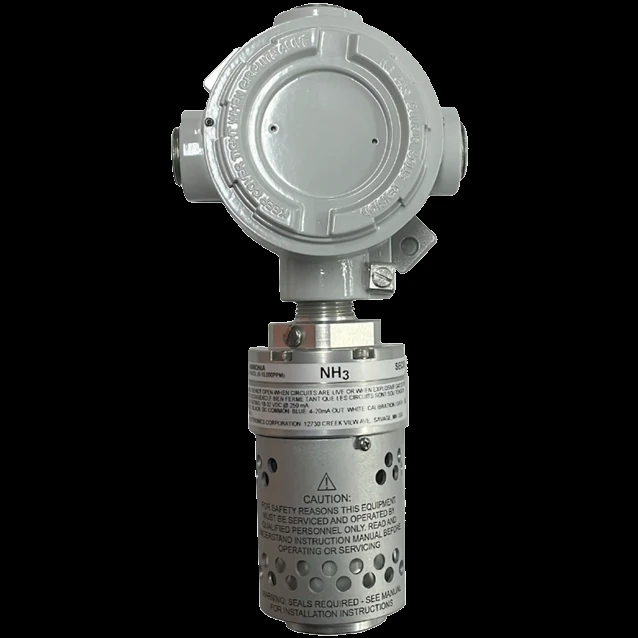
The ATi E12-15 is the infrared ammonia detector in the ATi line — a microprocessor detector that reads ammonia (NH₃) from ppm up to explosive levels using non-dispersive infrared (NDIR) absorption rather than an electrochemical cell. Collimated IR light passes through a waveguide holding the sample, and a multi-channel receiver compares the ammonia absorption band against a reference band to return a linear 4–20 mA signal across a field-coded range of 0–1% up to 0–15% by volume. The point of the IR approach is what it removes: it needs no routine calibration to stay operational, has no known poisons, tolerates silicone, and reads ammonia in oxygen-free or high-background atmospheres — which is why it is specified for ammonia engine rooms, emergency vents and other high-NH₃ areas where cell life is short. A continuous self-test flags faults and fails to safe, a multi-layered filter protects the optics, and the stand-alone detector pairs to a B14 receiver where display and alarms are needed.
Key Features & Benefits
- No routine calibration to keep it working — the IR measurement does not drift the way an electrochemical cell does, so the detector needs no routine recalibration to stay operational, and a continuous self-test flags any fault and fails to safe. Far less recurring maintenance in a high-ammonia area.
- Immune to the poisons that kill cells — there are no known poisons for this IR technology, and it shrugs off silicone and other agents that shorten electrochemical sensor life — the reason it is chosen for engine rooms and emergency vents. It lasts where a cell-based detector keeps dying.
- Reads ammonia even without oxygen — NDIR measures absorbed light, not an electrochemical reaction, so the detector works in oxygen-free or high-background-gas atmospheres where an electrochemical cell cannot. For inert or oxygen-displaced spaces, IR is the only honest option.
- Straight optical path, protected optics — a straight waveguide needs no mirrors or beam splitters to misalign, and a multi-layered filter keeps dirt and water off the optics — robustness aimed at dirty industrial ammonia service. Fewer ways for the measurement to wander.
Specifications
- Detection principle
- Non-dispersive infrared (NDIR) absorption — collimated IR light passes through a waveguide holding the gas sample, and a multi-channel receiver compares the measuring band (where ammonia absorbs) against a reference band to quantify concentration. A straight optical path is used, with no mirrors or beam splitters.
- Target gases
- Ammonia (NH₃) — from ppm levels up to explosive concentrations. A single-gas detector dedicated to NH₃; for other toxic or combustible gases see the B12, D12 or C12-17.
- Measuring range
- Field-coded full scale of 0–1%, 0–2%, 0–5%, 0–10% or 0–15% by volume, with the output reportable as % volume or ppm.
- Accuracy / repeatability
- ±3% of full scale for applied concentrations up to 50% of full scale, and ±5% of full scale above 50% of full scale.
- Response time
- T50 < 15 seconds, T90 < 30 seconds.
- Outputs
- Linear continuous 4–20 mA (current source), 1000 Ω max load at 24 VDC, representing 0 to full scale. The detector is stand-alone; pair it with a B14 receiver where display and alarm relays are needed.
- Sensor holder / mounting options
- Ordered with or without an explosion-proof junction box (order suffix F) for field wiring termination.
- Area classification
- Explosion-proof housing for harsh environments, CSA performance-tested for –40 to +50°C operation. CSA Class I, Division 1, Groups B/C/D and IECEx Zone 1 listings are shown as pending on the datasheet — confirm the current certification status with us before specifying for a classified area.
- Power
- 18–32 VDC, 5.1 W max; average draw 210 mA (400 mA peak) at 24 VDC.
- Enclosure / rating
- 316 stainless steel (SEC 5000 housing). A multi-layered filtering system protects the optics from dirt and water ingress.
- Operating temperature / humidity
- –40 to +70°C at 0–99% RH (non-condensing).
- Calibration
- No routine calibration required to keep it operating, and a continuous self-test flags a fault with fail-to-safe operation — the maintenance argument for IR over electrochemical in high-NH₃ service.
- Dimensions / mounting
- 5.5 in. long × 2.5 in. dia.; 3.7 lb.
Common Applications
- Ammonia refrigeration — engine rooms, machinery rooms and emergency vents where NH₃ can reach explosive levels
- SCR and DeNOx systems — ammonia-slip and storage monitoring on combustion emissions control
- Fertilizer and chemical processing — high-level ammonia leak detection around storage and reactors
- Oxygen-free and inert atmospheres — ammonia monitoring where an electrochemical cell cannot operate
- Silicone-laden environments — areas that poison electrochemical sensors but not infrared optics
Design & Selection Considerations
- Choose IR here because cell life is short — an electrochemical ammonia cell is the cheaper, ppm-accurate choice at ordinary exposure limits, but in a high-NH₃ engine room or emergency vent it gets consumed quickly and is vulnerable to silicone and other poisons. The E12-15 trades the ppm resolution for an NDIR measurement that does not drift, has no known poisons, and reads in oxygen-free or high-background air. Pick the E12-15 when concentrations and cell turnover — not low-ppm sensitivity — drive the decision.
- Code the full-scale range to the hazard — the range is set at order time (order suffix DD) to 0–1%, 0–2%, 0–5%, 0–10% or 0–15% by volume, and the reading reports as % volume or ppm. A tighter span gives finer resolution across the alarm band; a wider span follows the gas to explosive levels without pinning the output. Use the input form to tell us the alarm and shutdown setpoints you have to cover and the right full-scale code follows.
- Decide the junction box and the wiring — the only field order option besides range is the explosion-proof junction box (order suffix F) for wiring termination. Mind the area classification: the housing is explosion-proof and CSA performance-tested, but the Class I Division 1 / IECEx Zone 1 listings read as pending on the datasheet, so a formal classified-area job needs the current certification confirmed first. Use the input form to send us the area classification and we confirm what is certified before it is specified.
- Add a B14 only where you need display and alarm — the E12-15 is a stand-alone 4–20 mA transmitter that wires straight into a PLC, DCS or existing alarm panel — no controller is required to get a signal. Where you need a local digital readout and alarm relays, pair it with a single- or multi-channel B14 receiver. Existing alarm system → wire the loop in; standalone point → add a B14.
To spec the right E12-15 ammonia detector:
Use the input form to tell us the target gas and its range, the background atmosphere, the area classification, and how many points you need to watch — and we’ll spec the sensor chemistry, transmitter, holder and controller for your application.
Gas Detection Application Sheet ›Talk to an engineer directly — Scott Prater, Principal · 917-580-0878 · scott@pratertechnical.com
Specifications compiled by Prater Technical Partners from Badger Meter ATi / GasSens gas-detection product literature.