Product Overview
The ATi B14 is the compact single-point receiver in the GasSens controller line — a DIN-rail module that gives one gas transmitter a local display, staged alarms and a clean retransmit. It accepts a 2-, 3- or 4-wire 4–20 mA transmitter up to 10,000 ft away (powering a 2- or 3-wire unit from its own 24 VDC supply), shows the concentration on a 4-digit programmable LED, and drives three assignable setpoints (Caution / Warning / Alarm) through three assignable relays plus a fail-safe trouble relay. An optically-isolated 4–20 mA retransmit feeds a PLC, recorder or DCS without a ground loop. It is the right controller when one analog point — displayed, alarmed and retransmitted — is the whole job; the loop-powered B12 two-wire transmitter pairs naturally to it. For more points or a network, step up to the A14/A11 or the GasSens Midi.
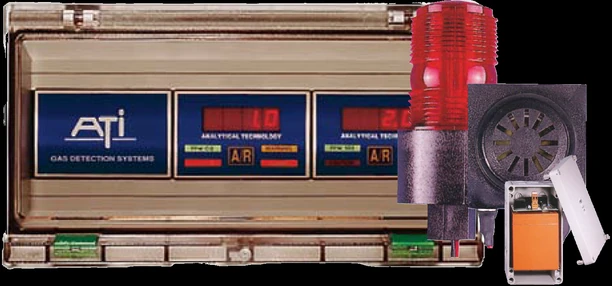
Key Features & Benefits
- Reads any 4–20 mA transmitter, up to 10,000 ft — the B14 takes a 2-, 3- or 4-wire 4–20 mA input from any ATi toxic or combustible transmitter as far as 10,000 ft away, and powers a 2- or 3-wire transmitter from its own 24 VDC supply. One standard analog point, a long way off.
- Three setpoints, three assignable relays — Caution, Warning and Alarm setpoints each drive an LED bar and a relay, and any relay can be assigned to any setpoint — so a single point can stage a horn, a shutoff and a telemetry contact independently. Layered alarm response from one module.
- Isolated retransmit, ground-fault clean — the 4–20 mA retransmit output is optically isolated from the input, so feeding a PLC, recorder or DCS will not create a ground loop with the transmitter. Use the input form to send the reading on without coupling the grounds.
- Build it up or drop it in someone else’s panel — modules clip to DIN rail in NEMA 4X enclosures from 1 to 12 points, with battery-backup and horn/strobe options, or integrators mount them on their own rail. A single point today, a small array later.
Specifications
- Function
- Compact single-point alarm, display and signal-retransmission receiver — a DIN-rail module that reads one 4–20 mA gas transmitter, displays the concentration, drives alarm setpoints, and retransmits an isolated 4–20 mA copy of the reading. The single-point entry to the GasSens controller family.
- Sensor / transmitter inputs
- Any 2-, 3- or 4-wire 4–20 mA transmitter — suited to any ATi toxic or combustible gas transmitter. The module supplies 24 VDC internally to power a 2- or 3-wire transmitter.
- Channels / capacity
- One point per module. Modules ship in single or multi-unit NEMA 4X enclosures (up to 12 modules); system integrators can DIN-rail-mount them in their own panel.
- Sensor-to-receiver distance
- The transmitter locates up to 10,000 ft from the receiver.
- Display
- 4-digit LED, user-programmable range — reads directly in ppm, ppb, % or %LEL. A front-panel LED bar with gas-symbol overlay identifies the gas.
- Alarm levels / setpoints
- Three adjustable setpoints — Caution, Warning and Alarm, each settable from 5–100% of span, with LED-bar indicators; Caution and Warning non-latching, Alarm latching. A separate trouble alarm activates on loss of input or if the 4–20 mA input drops below a set value.
- Relay / analog outputs
- Three assignable alarm relays (7 A @ 120 VAC / 4 A @ 220 VAC resistive), each assignable to any of the three setpoints and configurable normal/fail-safe, latching/non-latching, with 2 s or 10 s delay or an external-horn function; a fourth SPDT trouble relay (7 A) is factory-set fail-safe. An optically-isolated 4–20 mA retransmit output (1,000 Ω max) avoids ground-fault problems. Front-panel and remote reset acknowledge alarms.
- Power
- 12–28 VDC, 400 mA max. An optional small DC supply powers up to three modules (two if battery backup is used); an optional 65 W supply feeds up to 12 modules for a full enclosure; or a customer-supplied 12–28 VDC supply may be used instead.
- Enclosure / rating
- Module: Noryl, 2.8 × 3.6 × 2.3 in (70 × 90 × 58 mm). System enclosures: NEMA 4X in single-, two-, three-, six-, nine- and twelve-module sizes, with battery-backup and horn/strobe options.
- Mounting
- Clips to 35 × 7.5 mm DIN rail; all connections land on quick-disconnect plug-in terminal blocks.
Common Applications
- Single-point chlorine or chlorine-dioxide alarm at a water-treatment feed room
- Ammonia leak alarm at a refrigeration machine room with horn and shutoff
- Combustible-gas %LEL point at a remote boiler or compressor room up to 10,000 ft from the panel
- Carbon-monoxide or toxic point in a parking structure or enclosed bay
- Retrofit display and alarm for an existing 4–20 mA gas transmitter
What to Pair It With
The B14 is a receiver — it displays and alarms one 4–20 mA gas transmitter. Match the transmitter to the gas and the area:
- B12 / B12 Wet two-wire transmitter — the B12 loop-powered toxic transmitter is the natural single-point pairing — the B12 Wet, with sensors rated for 100% RH, suits permanently saturated streams where the B14 reads and alarms at the panel.
- C12-17 combustible transmitter — for a combustible %LEL point the explosion-proof C12-17 catalytic-bead transmitter feeds the B14 the same 4–20 mA way a toxic point does — set the display to %LEL.
- D12 / F12 for classified or full-feature points — where the point needs the explosion-proof full-feature D12 or the F12 family with its own local display, the B14 still serves as the remote alarm and retransmit receiver back at the panel.
- Power supply, battery backup and horn/strobe options — add the 12 VDC supply (three modules, or two with backup), the battery-backup unit and 12 VDC horn or xenon strobe so the point keeps alarming through a power loss.
Design & Selection Considerations
- Match the controller tier to your point count — the B14 carries one 4–20 mA point — no network and no per-channel analog beyond its single retransmit — so it fits where a remote transmitter just needs display, staged alarms and a clean hand-off to a PLC. When points multiply and each needs its own control relays, the modular A14/A11 scales better; for a large addressable plant the GasSens Midi networks 64 sensors on one cable. One point, far away, with staged alarms → B14.
- Pick the transmitter wiring (2/3/4-wire) before you size the run — the B14 supplies 24 VDC to run a 2- or 3-wire transmitter, or accepts a separately-powered 4-wire transmitter; the wiring count, conductor gauge and the 10,000 ft ceiling together set the voltage drop on the run. A two-wire B12 drawing its loop power from the B14 keeps the field wiring to a single pair. Use the input form to tell us the transmitter, the run length and the wire and the loop is checked for drop.
- Lay out the three setpoints and relay assignments — Caution / Warning / Alarm setpoints each run 5–100% of span, and any relay can be reassigned to any setpoint with normal/fail-safe, latching/non-latching and 2 s or 10 s delay — decide which level silences-only versus latches-until-reset, and whether contacts are fail-safe so a power or wiring loss alarms. The trouble relay is factory fail-safe and also trips if the input falls below a set value. Settle the alarm matrix and the module is configured to it.
- Plan power and backup across grouped modules — a small DC supply powers three B14s (two with battery backup), a 65 W supply feeds a full 12-module enclosure, and a customer 12–28 VDC supply works too; group the B14s by enclosure and size the supply and battery to the point count and required ride-through. Use the input form to tell us how many points share an enclosure and the supply and battery are sized for the group.
To spec the right B14 gas receiver:
Use the input form to tell us the target gas and its range, the background atmosphere, the area classification, and how many points you need to watch — and we’ll spec the sensor chemistry, transmitter, holder and controller for your application.
Gas Detection Application Sheet ›Talk to an engineer directly — Scott Prater, Principal · 917-580-0878 · scott@pratertechnical.com
Specifications compiled by Prater Technical Partners from Badger Meter ATi / GasSens gas-detection product literature.