Product Overview
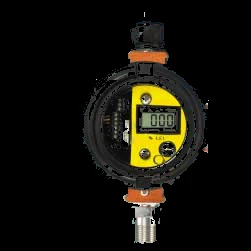
The ATi C12-17 is the dedicated combustible-gas point in the ATi line — a catalytic-bead transmitter that reports combustible gas as 0–100% LEL, the warning measurement a classified-area safety case is built around. Combustible gas burns on a heated active bead and unbalances a Wheatstone bridge against a matched passive bead; that imbalance becomes a 4–20 mA signal, factory-calibrated for methane unless another gas is ordered. It is built for the spaces combustibles collect in: an explosion-proof Class I, Division 1, Groups B/C/D housing, a 316 stainless sensor assembly with a sinter-bonded flame arrestor, poison-resistant beads good for two years or more, and a 10-second T90. The blind transmitter ties straight to a PLC or DCS; the display build adds a 3-digit LCD behind glass and a latching alarm relay for a local trip you reset through the window with a magnetic tool. Where a catalytic bead would be poisoned or oxygen is absent, route the job to the infrared D12Ex-IR instead.
Key Features & Benefits
- Built for the combustible-LEL job specifically — a catalytic bead reads combustibles as a percentage of the lower explosive limit — the threshold a fire-and-gas interlock is set against — rather than the ppm number an electrochemical cell returns. The right measurement for "is this getting close to explosive?"
- A sensor hardened for the hazardous area — 316 stainless construction and a sinter-bonded flame arrestor keep the assembly flame-proof and corrosion resistant, and the beads resist catalytic poisons for a typical service life of two years or more. It survives the dirty, wet, classified spaces combustibles collect in.
- A local trip without a separate panel — the display build carries a single latching SPDT relay (5 A @ 220 VAC) that fires a horn or beacon right at the point, reset with a magnetic tool through the glass — no opening the box and no controller needed for a one-point alarm. A standalone trip where you only need one.
- Ten-second response in the field — a T90 of 10 seconds means the transmitter sees an accumulating combustible atmosphere quickly, and the 4–20 mA output drives 675 Ω straight into the plant system. Fast detection, simple wiring.
Specifications
- Detection principle
- Catalytic-bead sensing — a matched pair of heated elements (one active, one passive) forms two legs of a Wheatstone bridge; combustible gas oxidizes on the active bead, raises its temperature and resistance, and the bridge imbalance reads out as a fraction of the lower explosive limit.
- Target gases
- Combustible gases and hydrocarbon vapors — methane, propane, butane, gasoline, toluene, hydrogen and many others. The bead is factory-calibrated for methane unless another gas is ordered.
- Measuring range
- 0–100% LEL standard, or 0–50% LEL ordered as a range option — the warning band below an explosive mixture, not a ppm exposure reading.
- Sensor (H-Series smart module)
- Explosion-proof 316 stainless steel assembly with a sinter-bonded flame arrestor that passes gas to the beads while keeping flame-proof integrity; the elements are built for poison resistance, with typical sensor life of two years or more.
- Accuracy / repeatability
- Generally ±5% of value (limited by the available calibration-gas accuracy), with electronic repeatability ±1% and linearity ±0.5%. Zero drift runs under 2% of full scale per month and span drift under 3% per month.
- Response time
- T90 = 10 seconds — fast enough to catch an accumulating combustible atmosphere in a pump station or compressor building.
- Outputs
- Powered 4–20 mA into up to 675 Ω at 24 VDC, wiring straight to a PLC, DCS or computer-based alarm system. Display units add a single latching SPDT alarm relay (5 A @ 220 VAC, non-inductive) for a local trip.
- Sensor holder / mounting options
- Standard close-coupled sensor or a remote sensor with junction box where the bead must sit away from the electronics; a sensor flow assembly is available for pumped sampling.
- Area classification
- Explosion-proof, Class I, Division 1, Groups B, C, D — the housing and the 316 stainless sensor assembly are rated for the classified areas where combustibles collect.
- Power
- Three-wire, 12–30 VDC at 100 mA maximum — the catalytic bead needs heater current, so this is a powered transmitter rather than a 2-wire loop point.
- Display
- Optional 3-digit LCD behind the glass window of the explosion-proof housing for local %LEL readout; the magnetic reset switch resets the latching alarm relay without opening the enclosure.
- Operating temperature / humidity
- –40 to +70°C — suited to outdoor and unconditioned compressor and pump station installations.
- Calibration
- Zero, span and alarm setpoint are set on potentiometers; a calibration adapter and an optional splash guard / remote calibration adapter apply gas to the bead in place.
- Dimensions / mounting
- Roughly 3 lb (1.3 kg) in the cast explosion-proof housing.
Common Applications
- Gas compressor and pump stations — methane and natural-gas leak detection at classified equipment
- Analyzer houses and process buildings — hydrocarbon-vapor accumulation in enclosed spaces
- Fuel and solvent handling — gasoline, propane, butane and toluene vapor monitoring near storage and transfer
- Hydrogen systems — battery rooms, electrolyzers and fuel-cell areas where H₂ can reach %LEL
- Wastewater digesters and confined spaces — methane build-up warning ahead of an explosive mixture
Design & Selection Considerations
- Match the sensor chemistry to the gas — the target gas sets the detection principle: electrochemical for toxic gases (chlorine, ammonia, H₂S, ozone and ~30 others, ppb–ppm), catalytic-bead for combustibles as %LEL (the C12-17), and infrared (NDIR) where a catalytic bead would be poisoned, where oxygen is absent, or for CO₂ and high-level ammonia (the D12Ex-IR and E12-15). Electrochemical for toxics, catalytic for routine combustible-LEL, infrared for poison-prone or oxygen-free service.
- Plan around the H-Series interchangeable smart sensor — the sensor, its amplifier, and a calibration memory live in one plug-in H-Series module, so a freshly calibrated sensor swaps into a live transmitter in the field with no recalibration and no downtime — keep a calibrated spare on the shelf and rotate it on a schedule, and re-task a transmitter to a different gas by fitting a different sensor. The H-Series swap is the single biggest reason the maintenance burden on an ATi system stays low.
- Specify the area classification up front — a classified area drives the protection method and the holder: the explosion-proof D12 installs in classified areas, and the F12 family covers both schemes — the F12iS is intrinsically safe and loop-powered, the F12/D line-powered with display and datalogger. Intrinsic safety depends on the right barrier and wiring on your side. Use the input form to tell us the Class / Division or Zone and gas group and the transmitter, holder and documentation are specified to suit.
- Build the sampling train for a wet or remote stream — gas that will not reach the sensor on its own needs help: the A21 diaphragm pump draws a sample from a duct or remote point and alarms on loss of flow, and the C21 Dri-Gas dehumidifies it so a saturated stream does not blind the cell; for a permanently wet stream the B12 Wet uses sensors rated for 100% RH. Use the input form to tell us the stream temperature, humidity and distance and the sampling train is built around it.
- Size the controller to points and distance — match the readout tier to how many points you have and how far they sit: the B14 receiver handles one 4–20 mA point up to 10,000 ft; the A14/A11 modular system distributes display, relay and analog modules with sensors up to 1,000 ft; and the GasSens Midi networks up to 64 sensors over CANbus, to 1,024 points with Modbus. One point or a few → B14; a mid-size relay/analog system → A14/A11; a large networked plant → Midi.
To spec the right C12-17 combustible-gas transmitter:
Use the input form to tell us the target gas and its range, the background atmosphere, the area classification, and how many points you need to watch — and we’ll spec the sensor chemistry, transmitter, holder and controller for your application.
Gas Detection Application Sheet ›Talk to an engineer directly — Scott Prater, Principal · 917-580-0878 · scott@pratertechnical.com
Specifications compiled by Prater Technical Partners from Badger Meter ATi / GasSens gas-detection product literature.