Product Overview
The ATi C21 Dri-Gas answers the problem that ends most humid-service sensors: water condensing on the cell surface or inside the flame arrestor, which blinds the sensor and causes premature failure. The C21 is a sample-draw system that also conditions the sample — a diaphragm pump draws gas from a humid vent stack, duct or wet well, and a cold plate condenses the water vapor out before the sample reaches the sensor, pumping the condensate to a drain. What arrives at the cell is a dry, representative sample, so an electrochemical or combustible sensor that would otherwise fail in saturated air runs reliably. If the inlet or outlet line blocks, a pressure switch trips a door lamp and an SPDT remote contact. Like the A21, the C21 carries no sensor of its own — it delivers the dried sample to a sensor on a fixed transmitter such as the F12, D12 or B12. Where the source is dry, the simpler A21 does the draw without the dehumidifier.
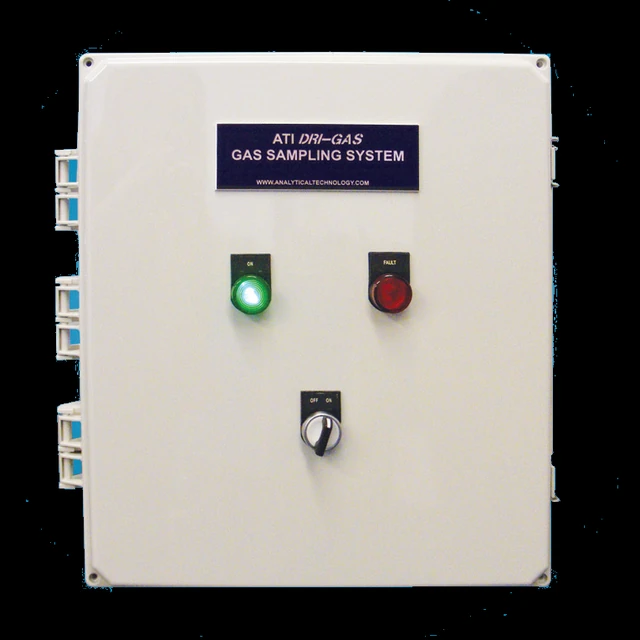
Key Features & Benefits
- Stops the sensor going blind in wet gas — a cold plate condenses water vapor out of the sample before it ever reaches the sensor, and ATi removes that moisture continuously — the water that would otherwise wet the cell and the flame arrestor, and cut sensor life short in humid service, never gets there. Wet ducts and saturated stacks become monitorable.
- Drains itself, runs itself — the water it pulls out is pumped straight to a bottom drain fitting, and ATi describes the system as virtually maintenance-free — it manages the condensate rather than holding it for you to empty. No standing condensate to babysit.
- Blocked-line alarm built in — a differential-pressure switch across the pump trips a door lamp and an SPDT remote contact if the inlet or outlet blocks — the same fail-loud philosophy as the A21, so a sampling fault is visible rather than silent. A blockage announces itself.
- Feeds the transmitter you already use — the dried sample drives standard ATi electrochemical and combustible sensors on an F12, D12, B12 or A11 — the C21 is the conditioning front end, not a replacement for your transmitter. Same sensors, now fed dry gas.
Specifications
- Function
- Sample-draw system with integral water-vapor removal — draws a gas sample from a humid vent stack, duct, wet well or other moist location and delivers a dehumidified sample to toxic- or combustible-gas monitoring equipment, eliminating the sensor “blinding” that condensing moisture causes.
- Sample draw
- Diaphragm pump with a brushless DC motor, rated for over 10,000 hours of operation; pulls up to 10 in. Hg of inlet vacuum (for negative-pressure ducts) and delivers up to 4 PSIG on the outlet.
- Sample flow
- Adjustable rotameter on the pump outlet, 300–800 cc/min (500 cc/min recommended).
- Sample conditioning
- Cold-plate water-vapor removal — the sample contacts a cold plate that condenses out moisture, and excess condensate is pumped to a drain fitting on the bottom of the enclosure (optionally collected). The result is a dry sample suitable for an electrochemical cell, with sensor blinding eliminated. An optional inlet filter assembly handles dusty or debris-laden streams; a plugged filter raises a fault indication.
- Flow / fault alarm
- A differential-pressure switch across the pump alarms if the inlet or outlet line becomes blocked — a door-mounted alarm lamp gives local indication and an SPDT contact is available for remote indication.
- Compatibility
- Push-to-connect fittings for 1/4 in. O.D. tubing; Teflon-lined PVC inlet/outlet tubing is recommended to minimize loss of reactive gases. The dried sample can feed a variety of ATi gas sensors — F12, D12 / D12IR, B12 or A11 systems. Tubing is not supplied (each application needs its own lengths).
- Power
- 120 VAC, 50/60 Hz standard, 230 VAC optional, 35 VA max — field-ordered by suffix.
- Enclosure / rating
- NEMA 12 / IP-52 polycarbonate enclosure (V-0 flammability); 15 in. W × 17 in. H × 9 in. D (380 × 430 × 200 mm), 18 lb (8.2 kg). Operating 2–45°C.
- Mounting
- Wall-mount panel enclosure with a condensate drain fitting on the bottom; suitable for indoor or outdoor-protected installation (shield from wind-driven rain and direct sunlight). Ships with replacement pump tubes and fan/inlet-grill filters.
Common Applications
- High-humidity vent stacks and exhaust ducts — sampling a saturated discharge without condensing moisture reaching the cell
- Wet wells and sump headspace — H₂S and toxic-gas monitoring above standing water where the air is at or near saturation
- Scrubber and odor-control discharge — verifying a treated, water-laden exhaust meets exposure limits
- Outdoor and seasonal humidity swings — keeping a fixed monitoring point reliable through condensing ambient conditions
What It Pairs With
The C21 Dri-Gas is the conditioning front end — it draws, dehumidifies and delivers the sample, but carries no sensor. The dried output drives an ATi sensor mounted on a fixed transmitter, which does the measurement and signaling.
- A fixed gas transmitter to read the dried sample — the dehumidified sample drives the sensor on an F12 toxic-gas transmitter (the datasheet’s reference pairing), a D12 explosion-proof transmitter or a B12 2-wire transmitter — the transmitter reports concentration on 4–20 mA, relays and digital comms.
- A controller for alarms and distribution — route the transmitter signal and the C21 blocked-line contact into an ATi controller — the B14 receiver for one point or the A14/A11 modular system — so gas and sampling-fault alarms land together.
- The A21 where the stream is already dry — if the source carries no condensing moisture, the simpler A21 does the sample-draw job without the cold-plate dehumidifier — spec it instead and save the conditioning stage.
Design & Selection Considerations
- Choose the C21 over the A21 the moment the stream is wet — the A21 draws and meters a sample but removes no moisture; the C21 adds the cold-plate dehumidifier. If the source is a humid vent stack, a wet well, a saturated duct or any condensing stream, the C21 is the right tool — an A21 there would deposit water on the cell and shorten its life. Dry source → A21; wet or condensing source → C21.
- Plan the condensate drain and the install environment — the C21 pumps condensate to a bottom drain fitting that needs somewhere to go (open drain or a customer-supplied collection container). It is rated NEMA 12 / IP-52, so outdoor installs must be protected from wind-driven rain and kept out of direct sun to limit solar heating of the interior — heat works against the cold plate. Give the water a path and keep the box cool and dry outside.
- Lined tubing, kept short, for reactive gases — Teflon-lined PVC inlet and outlet tubing minimizes loss of reactive gases, and the outlet run to the sensor flowcell should be as short as practical. Tubing is not supplied — order the total inlet plus outlet length your layout needs. The conditioning is wasted if the gas is lost in the tubing on the way.
- It conditions — it does not measure — the C21 has no sensor of its own; the dehumidified output is piped to a sensor on a fixed transmitter — an F12, D12 or B12 — which does the detection and signaling. Spec the transmitter and the sensor chemistry alongside it, and match the outlet tubing to the gas. The C21 prepares the sample; the transmitter reads it.
To spec the right gas sampling system:
Use the input form to tell us the target gas and its range, the background atmosphere, the area classification, and how many points you need to watch — and we’ll spec the sensor chemistry, transmitter, holder and controller for your application.
Gas Detection Application Sheet ›Talk to an engineer directly — Scott Prater, Principal · 917-580-0878 · scott@pratertechnical.com
Specifications compiled by Prater Technical Partners from Badger Meter ATi / GasSens gas-detection product literature.