Product Overview
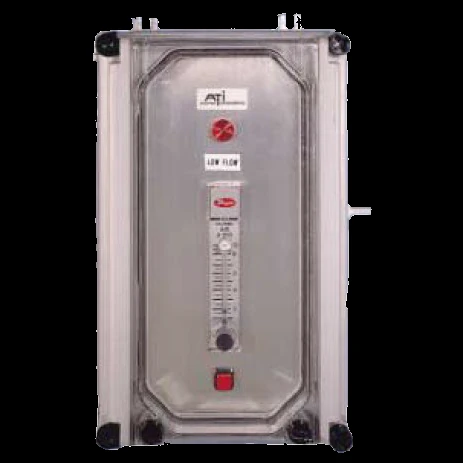
The ATi A21 Gas Sampler solves a placement problem: the gas is in one place and the sensor needs to be in another. It is a self-contained sample-draw pumping system — a brushless-motor diaphragm pump pulls a continuous sample from a duct, stack or remote point and delivers it to a gas sensor mounted where it can be reached and serviced. A front-panel flowmeter sets the rate (300–1000 cc/min), and a built-in loss-of-flow detector — lamp plus SPDT relay — makes sure a sampling fault cannot leave a dead sensor reading clean air. The pump draws against up to 10 in. Hg of inlet vacuum, so negative-pressure ducts are in scope, and it is rated past 10,000 hours with field-replaceable diaphragms. The A21 carries no sensor of its own — it serves whatever electrochemical sensor you place on a fixed transmitter such as the D12 or B12. For a wet or condensing stream that would blind the cell, the C21 Dri-Gas adds water-vapor removal.
Key Features & Benefits
- Brings the gas to the sensor — a brushless-motor diaphragm pump draws the sample from a duct or remote point and delivers it to a sensor mounted where it can be reached — the answer when the gas will not migrate to the sensor on its own, or when the sensor cannot live where the gas is. Put the readout where you can service it; sample from where the gas is.
- A sampling fault cannot hide — an internal loss-of-flow detector lamps locally and trips an SPDT relay remotely — so a kinked line, a plugged filter or a failed pump announces itself instead of letting the monitor sit on stale air. The AC version adds an SPDT power-fail relay as well. No flow, no measurement, no silence.
- Pulls against duct vacuum — the pump draws against up to 10 in. Hg of inlet vacuum, so it samples negative-pressure duct and stack systems that a passive diffusion sensor could never reach. Negative-pressure ducts are squarely in scope.
- Adjustable flow, replaceable wear parts — a front-panel flowmeter sets the rate from 300–1000 cc/min, the pump is rated past 10,000 hours, and the pump diaphragm changes out easily in the field (the optional inlet filter takes a pack of 10 replacement elements) — long service life with simple, in-the-field maintenance. A wear item you can change, not a unit you replace.
Specifications
- Function
- Integrated sample-draw pumping system — draws a continuous gas sample from a duct or a hard-to-reach point and delivers it to a gas sensor located in a more convenient area, with a standard loss-of-flow alarm so a sampling fault cannot quietly disable the measurement.
- Sample draw
- Diaphragm pump driven by a brushless DC motor, rated for over 10,000 hours of continuous operation; pulls against up to 10 in. Hg vacuum on the inlet (for negative-pressure duct systems) or 4 PSIG on the outlet at 500 cc/min. Pump diaphragms are field-replaceable.
- Sample flow
- Front-panel flowmeter with variable adjustment, 300–1000 cc/min (500 cc/min recommended). Sample-transport time depends on tubing bore at 500 cc/min — ~29 s per 100 ft on 1/8 in. I.D., ~65 s on 3/16 in., ~116 s on 1/4 in.
- Sample conditioning
- None — the A21 draws and meters the sample but does not dehumidify it. For a condensing or moisture-saturated stream that would blind the cell, step up to the C21 Dri-Gas, which removes water vapor before the sensor.
- Flow / fault alarm
- Internal loss-of-flow detector with a front-panel low-flow alarm lamp and an SPDT relay for remote indication; the AC version adds an SPDT power-fail relay on the DC supply.
- Compatibility
- Inlet and outlet are quick-disconnect hose-barb fittings for 1/4 in. I.D. flexible tubing — reactive gases (chlorine, SO₂, acid gases) require Teflon or fluorocarbon tubing, non-reactive gases can use PVC. Locate the sensor on the inlet (vacuum) side so the sample is read before it contacts pump components.
- Power
- 85–265 VAC, 50/60 Hz, 1 A, or a 12 VDC, 1 A max DC version — field-ordered.
- Enclosure / rating
- NEMA 4X fiberglass enclosure with a clear polycarbonate window; operating −10 to +45 °C.
- Mounting
- Wall-mount panel enclosure; supplied with a quick-disconnect inlet fitting and a 25 ft length of PVC tubing. An inlet filter assembly (with 10 replacement filters) is an option for dusty or debris-laden streams.
Common Applications
- Negative-pressure ducts and exhaust stacks — drawing a representative sample from a moving air stream a diffusion sensor cannot see
- Remote or inaccessible leak points — valve galleries, pits and equipment areas where the sensor is better placed elsewhere for service access
- Reactive-gas monitoring (chlorine, SO₂, acid gases) — sensor on the vacuum side, Teflon-lined sample line, sample read before it touches the pump
- Scrubber and ventilation discharge checks — confirming a treated exhaust meets exposure limits at a fixed sample point
What It Pairs With
The A21 is a sample-delivery front end — it has no sensor of its own. It conditions and delivers the sample to an ATi electrochemical (or other) sensor mounted on a fixed transmitter or controller, which does the actual measurement and signaling.
- A fixed gas transmitter to read the sample — the drawn sample feeds a sensor on a D12 explosion-proof transmitter or a B12 loop-powered 2-wire transmitter — mount the sensor on the A21’s inlet (vacuum) side and the transmitter reports the concentration on 4–20 mA, relays and digital comms.
- A controller for alarms and distribution — route the transmitter signal and the A21 loss-of-flow contact into an ATi controller — the B14 receiver for a single point, or the A14/A11 modular system — so the gas alarm and the sampling-fault alarm land in one place.
- The C21 Dri-Gas where the stream is wet — for a condensing or saturated source, the C21 Dri-Gas does the same sample-draw job but adds a cold-plate dehumidifier ahead of the sensor — specify it instead of the A21 when moisture would blind the cell.
Design & Selection Considerations
- Put the sensor on the vacuum (inlet) side — mount the gas sensor on the inlet side of the pump so the sample is measured before it touches pump or flow-detection components that could absorb or alter it — critical for reactive gases such as chlorine, sulfur dioxide and acid gases. The A21 conditions nothing and adds no sensor of its own; it serves whatever electrochemical sensor you place on a fixed transmitter such as the D12 or B12. The sample must reach the cell unaltered — order of components matters.
- Match the tubing to the gas, and keep the run short — reactive gases need Teflon or fluorocarbon tubing; non-reactive gases can run PVC. Transport lag scales with length and bore — about 29 s per 100 ft on 1/8 in. I.D. tubing at 500 cc/min — so a long line means a slower alarm. Keep the sample line as short as the geometry allows. Wrong tubing loses the gas; long tubing delays the alarm.
- Reserve the A21 for dry streams — condensing streams need the C21 — the A21 has no water-vapor removal. A saturated or condensing stream will deposit moisture on the cell and flame arrestor and blind it, shortening sensor life. For wet ducts, stacks or wet wells use the C21 Dri-Gas instead, which dehumidifies the sample first. Dry stream → A21; wet or condensing stream → C21.
- Pick AC or DC at order time, and size the enclosure rating — the A21 is built either for universal 85–265 VAC mains or for 12 VDC service, and ships in a NEMA 4X fiberglass enclosure — suited to washdown and outdoor-protected locations but not a rated substitute for an explosion-proof transmitter housing. Use the input form to tell us the available power and the area, and the version and accessories are matched to it.
To spec the right gas sampler:
Use the input form to tell us the target gas and its range, the background atmosphere, the area classification, and how many points you need to watch — and we’ll spec the sensor chemistry, transmitter, holder and controller for your application.
Gas Detection Application Sheet ›Talk to an engineer directly — Scott Prater, Principal · 917-580-0878 · scott@pratertechnical.com
Specifications compiled by Prater Technical Partners from Badger Meter ATi / GasSens gas-detection product literature.