Product Overview
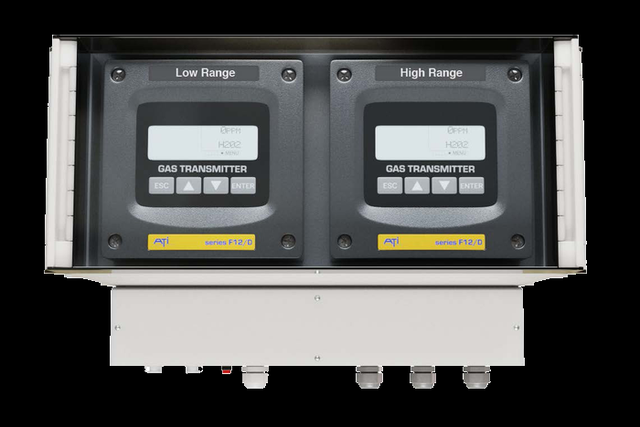
The ATi IsoMon is a dual-channel hydrogen-peroxide (H₂O₂) vapor monitor built for one job: validating an isolator or chamber decontamination cycle from start to finish. Vaporized H₂O₂ spans a huge range — a heavy charge of hundreds to thousands of ppm during fogging, then a long aeration tail down to the few-ppm endpoint that lets staff re-enter — and no single cell reads both well. IsoMon solves that with two cells: a high-range channel (0–2000 ppm) and a low-range channel (0–100 ppm), fed from a common inlet by a two-channel pump. An integral solenoid, driven by the high channel, switches the low cell to ambient air while the charge is heavy so it is not saturated, then puts it back on sample as levels fall — so the low cell is accurate exactly at the aeration endpoint that matters. Each channel uses a pre-calibrated H-Series smart sensor, logs independently, and reports on its own 4–20 mA and RS-232 outputs, giving validation-grade records that the cycle reached its charge and returned to a safe level. Where the job is hand-carried H₂O₂ spot checks rather than cycle validation, the portable D16 PortaSens III fitted with an H₂O₂ sensor is the tool.
Key Features & Benefits
- One instrument follows the whole cycle — a high-range cell and a low-range cell, sharing one inlet, let the IsoMon read the heavy vapor charge and the ppm aeration endpoint with a single instrument — no swapping ranges or units mid-cycle to cover decontamination start to finish. Charge to clearance on one box.
- Protects the low cell automatically — a solenoid controlled by the high channel admits ambient air to the low cell during the high-charge phase (switching at 30 ppm, resetting at 28), so long exposure to high vapor does not saturate the sensitive low-range sensor — it is ready and accurate the moment levels fall to the aeration endpoint. The low cell is shielded exactly when it would otherwise be overwhelmed.
- Validation-grade records per channel — each channel logs independently — 12,000 points, with a storage interval selectable in fixed steps from 1 to 60 seconds, downloaded over RS-232 to Excel — so the high-charge peak and the timed decay to a safe ambient reading are both on record for the batch. The data that proves the cycle, captured per channel.
- Pre-calibrated smart sensors, swapped not rigged — each channel uses an H-Series smart sensor that stores its own calibration; a standby sensor with current calibration drops in with no on-site cal-gas rig, and returns to Badger Meter for recalibration. Calibration discipline without a calibration bench on the floor.
Specifications
- Function
- Dual-channel hydrogen-peroxide (H₂O₂) vapor monitor — pulls a sample from an enclosed space and delivers it to two separate measuring cells, one for high concentration and one for low, so a single instrument validates a complete decontamination cycle from the high vapor charge down to the ppm aeration endpoint.
- Channels
- Two channels with an internal two-channel sample pump (one pump head per cell) and a common inlet port. An integral solenoid valve, controlled by the high-concentration channel, gates sample to the low-concentration cell — it activates at 30 ppm (resets at 28 ppm), drawing ambient air to the low cell to keep it from saturating during the high-charge phase, then re-admits sample as levels fall back. Channel 1 watches the charge; Channel 2 watches the aeration tail.
- Measuring ranges
- Channel 1 (high): H₂O₂ 0–2000 ppm; Channel 2 (low): H₂O₂ 0–100 ppm. As shipped, Channel 1 is set to a 0–1000 ppm logging range (display still reads to 2000 ppm) for better low-level resolution, and Channel 2 to a 0–20 ppm logging range; each channel can be programmed to any full-scale logging range within its sensor limits.
- Sensor
- H-Series electrochemical smart sensor with integral calibration memory in each channel (the H10 sensor) — calibration data is stored on the sensor, so a standby sensor with up-to-date calibration drops straight into a channel with no on-site calibration rig. Sensors return to Badger Meter for recalibration. Response 90% in 60 s; accuracy generally ±10% of value (limited by available cal-gas accuracy); repeatability ±20 ppm on the 0–2000 range and ±1 ppm on the 0–100 range; electronic linearity ±0.5%; zero drift <1% FS per month, non-cumulative.
- Sampling
- Draws sample through Teflon-lined tubing via the internal two-channel pump from an isolator or chamber to the common inlet.
- Outputs
- Two 4–20 mA DC analog outputs (one per channel) for remote display, plus two RS-232 outputs for stored gas values. Three concentration alarms per channel (adjustable setpoints; settable high, low or off — default off), shown on the LCD and signaled by an audible beeper.
- Communication
- RS-232 per channel — logged data downloads to a PC for use in Excel or other tools.
- Display
- Backlit graphics liquid-crystal display. Each channel logs independently — 12,000 data points per channel, storage interval selectable in fixed steps from 1 to 60 seconds, giving a typical 8 days of storage at a 1-minute interval.
- Power
- 120 VAC or 230 VAC — external power is required (the IsoMon is transportable but not battery-operated).
- Enclosure / rating
- Transportable instrument, 10 lb (4.5 kg); operating −5 to 45°C, 0–95% non-condensing humidity.
Common Applications
- Pharmaceutical and aseptic isolator decontamination — validating vaporized-H₂O₂ (VHP) cycles in isolators, RABS and pass-throughs from charge to clearance
- Cleanroom and chamber bio-decontamination — confirming surfaces and equipment reached sterilizing vapor levels and returned to safe ambient
- Aeration-endpoint clearance for re-entry — demonstrating H₂O₂ has dropped to a safe level before staff re-enter the space
- Food-packaging, biological and defense decontamination — the same dual-range validation outside pharma
Design & Selection Considerations
- Set the logging ranges to your cycle, not just the defaults — the channels ship with a 0–1000 ppm (high) and 0–20 ppm (low) logging range to favor resolution, but each is programmable to any full-scale within its sensor limits (2000 ppm high, 100 ppm low). Match the high-channel logging span to your peak charge and the low-channel span to your release threshold so the record has resolution where the cycle actually lives. The default favors resolution; confirm it brackets your charge and your endpoint.
- The aeration endpoint is the number that releases the room — IsoMon exists to prove H₂O₂ has fallen from the decontamination charge to a safe, ambient level before staff re-enter — the low channel and its alarm setpoint define that release point. Set the low-channel concentration alarm to your facility’s clearance limit, and treat its log as the validation evidence. The low cell is the gatekeeper; its setpoint is your re-entry policy.
- Plan tubing and inlet placement for a representative sample — the sample is pulled through Teflon-lined tubing from inside the isolator or chamber, so inlet position governs what the cells see — place it where it represents the decontaminated volume, and keep the run short and lined to avoid losing reactive H₂O₂ vapor on the way to the cells. The reading is only as representative as where and how you draw it.
- It needs external power and lives near the chamber — the IsoMon is transportable but not battery-powered — it requires 120 or 230 VAC and is suited to −5 to 45°C, non-condensing. Plan a mains drop near each isolator it serves, or move it between chambers on a validated procedure. For hand-carried spot checks of H₂O₂ vapor instead, the D16 PortaSens III takes an H₂O₂ smart sensor. Fixed-power bench validation here; battery spot checks on the D16.
To spec the right H₂O₂ vapor monitor:
Use the input form to tell us the target gas and its range, the background atmosphere, the area classification, and how many points you need to watch — and we’ll spec the sensor chemistry, transmitter, holder and controller for your application.
Gas Detection Application Sheet ›Talk to an engineer directly — Scott Prater, Principal · 917-580-0878 · scott@pratertechnical.com
Specifications compiled by Prater Technical Partners from Badger Meter ATi / GasSens gas-detection product literature.