Product Overview
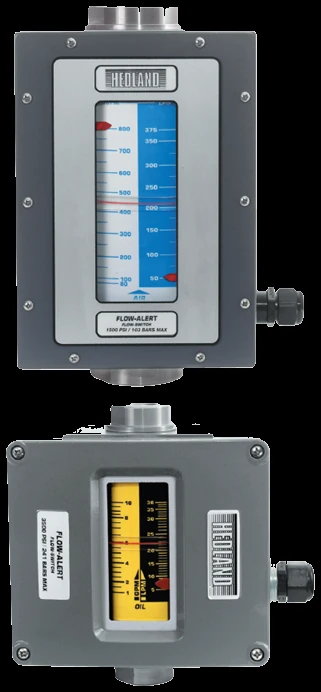
Hedland Flow-Alert combines a direct-reading variable-area meter with adjustable electrical contacts that trip at a customer-set flow — so the operator still sees the flow and the contact alarms or interlocks when it crosses the set point. Choose the SPDT microswitch (UL Recognized, 250 V AC, 10 A) to drive a line-voltage relay, solenoid or pilot light, or the reed switch (10 W max) to feed a low-power PLC input, in single- or dual-switch form for one or two set points. The switch is sealed in a NEMA 12 / 13 (IP52/54) enclosure and rides on a standard Hedland meter body — aluminum, brass or 316 stainless matched to the fluid, liquid or gas, in ¼ to 1½ in. ports. The meter is unidirectional (no reverse-flow by-pass). For a continuous analog signal instead of a trip, use the MR transmitter.
Key Features & Benefits
- Meter and switch in one — a direct-reading flow meter plus a built-in trip contact — local indication at the machine, with an alarm or interlock at the set flow
- Microswitch or reed switch — a UL Recognized, CSA-certified SPDT microswitch (250 V AC, 10 A) for line-voltage loads, or an SPST reed switch (10 W max NO / 5 W max NC) for low-power PLC inputs
- Single or dual set points — one switch for a single alarm, or two for high / low or warning-plus-trip logic
- Field-adjustable trip point — the set point adjusts along the meter scale to the flow the application requires
- Sealed enclosure — NEMA 12 and 13 (IP52/54) seals the switch against industrial contamination
- Built on the right body for the fluid — the meter body is anodized aluminum for petroleum and air, brass for water, or 316 stainless for caustic and corrosive service — liquid or gas
Specifications
- Function
- A direct-reading variable-area flow meter combined with adjustable electrical contacts that signal operators or a PLC when flow crosses a set point
- Measurement principle
- Variable area — a spring-loaded piston and orifice meter the flow and drive a magnetically coupled indicator; switch actuators track the indicator position
- Compatible fluids
- Liquid or gas service (meter body selected for the fluid — aluminum, brass or 316 stainless)
- Switch types
- Microswitch (single or double, pre-wired SPDT, UL Recognized and CSA certified) or reed switch (single or double, SPST, normally-open or normally-closed)
- Contact rating
- Microswitch SPDT: 250 V AC, 10 A (125 V DC, 0.5 A). Reed switch SPST: 10 W max normally-open / 5 W max normally-closed, 50 V DC, 0.5 A
- Setpoint adjustment
- Field-adjustable trip point set along the meter scale; single or dual switches for one or two set points
- Meter accuracy
- Meter ±2% of full scale; repeatability ±1%
- Flow ranges
- Per the meter family and port size — liquids to 150 US GPM, air / gas to 1,000 SCFM (¼–1½ in.)
- Port / line sizes
- ¼ to 1½ in.
- Body material
- Anodized aluminum, brass or 316 stainless steel — matched to the fluid
- Wetted materials
- Per the selected meter family (aluminum / brass / 316 stainless body, piston and cone; Viton or EPR seals)
- Temperature range
- −20 to +240°F (−29 to +116°C)
- Pressure rating
- Liquids: aluminum / brass 3,500 psi, stainless 6,000 psi (¼–½ in.) / 5,000 psi (¾–1½ in.). Gases: aluminum / brass 1,000 psi, stainless 1,500 psi
- Enclosure
- NEMA 12 and 13 (IP52/54) — does not apply to the ¼ in. strap version
- Flow direction
- Unidirectional — no reverse-flow by-pass option (the meter acts as a check valve against reverse flow)
- Calibration
- Scale factory-calibrated to the fluid’s specific gravity (0.876 petroleum, 1.0 water / water-based); special scales available for off-standard gravity, pressure or temperature
Common Applications
- Bearing- and gearbox-lubrication low-flow alarms
- Pump-protection and no-flow shutdown interlocks
- Coolant-flow proving on gun-drills, welders and process equipment
- Case-drain and seal-flush flow monitoring on hydraulic systems
Design & Selection Considerations
- Pick the switch for the load — the SPDT microswitch (UL Recognized and CSA certified) carries line-voltage loads at 250 V AC, 10 A — a relay coil, solenoid or pilot light directly; an SPST reed switch (10 W max, 50 V DC, 0.5 A) suits a low-power PLC or DCS digital input but cannot switch a line-voltage load. Use the input form to tell us what the contact drives and we’ll set the switch type.
- One set point or two — a single switch gives one trip; dual switches give two independent set points for high / low or warning-plus-shutdown logic. The trip adjusts along the scale to the flow the application needs. Use the input form to tell us the alarm flow(s) and we’ll configure single or dual switches.
- Plan for unidirectional flow — Flow-Alert meters are unidirectional with no reverse-flow by-pass — reverse flow makes the meter act as a check valve and can damage internals. Pipe it with the flow arrow and avoid fast-acting valves upstream. Confirm the flow is one-way before specifying.
- Match the meter body to the fluid — the switch rides on a standard Hedland meter, so the body alloy and seals follow the fluid — aluminum or brass for oil, water and air, 316 stainless for corrosive service. Use the input form to give us the fluid with the alarm flow and we’ll build the meter under the switch to suit.
To size & select the right Flow-Alert:
Use the input form to send the fluid, the alarm flow(s) and the line size, with the working pressure and temperature and what the contact drives — a relay or solenoid, or a PLC / DCS digital input — and we’ll spec the meter body, the switch type (microswitch or reed) and single or dual set points for your application.
Flow Meter Application Sheet ›Talk to an engineer directly — Scott Prater, Principal · 917-580-0878 · scott@pratertechnical.com
Specifications compiled by Prater Technical Partners from Badger Meter Hedland variable-area flow-meter product literature.