Product Overview
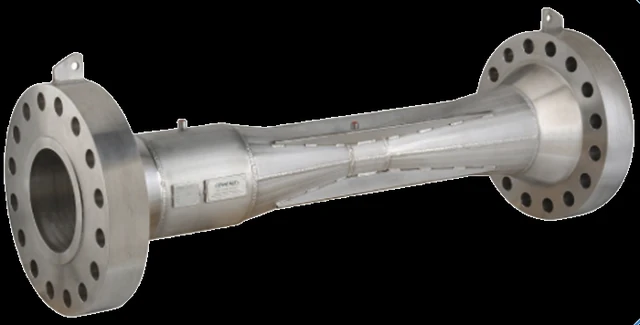
The Preso Venturi line is Badger Meter’s high-accuracy, pressure-recovering DP element for clean liquid, gas and steam. A converging-diverging throat creates a differential proportional to flow and then hands most of that differential back downstream through the exit cone, so the element keeps high accuracy while leaving only a few percent of the generated DP as permanent loss. Three full-bore styles cover the trade-off between accuracy and loss — the SSL classical / Herschel tube (±0.75% uncalibrated, ±0.25% calibrated, 6% max loss), the SSM hydraulic nozzle (±1.0% / ±0.5%, 6% max loss) and the LPL low-pressure-loss nozzle (±3.0% / ±0.5%, 3% max loss with a 35-plus-year field history). All three carry ±0.1% repeatability over a 10:1 turndown and run to 1500°F and 9000 psi. VILPL / VISSL / VISSM short-form inserts add only flange thickness to retrofit a line — VILPL to 60 in., VISSL / VISSM to 36 in. — and the CV commercial series serves lighter liquid / gas duty (2–16 in., to 250°F / 300 psig). SSL and SSM use standard 0.35 / 0.49 / 0.63 / 0.75 beta or exact custom, in carbon steel or 316 / 316L stainless, sized 0.5–60 in. and larger.
Key Features & Benefits
- Strong pressure recovery — the diverging exit cone returns most of the throat differential to the line, so permanent loss runs just 3–6% of the generated DP and the element draws little pump energy in continuous service
- Accuracy to ±0.25% calibrated — the SSL classical / Herschel tube reaches ±0.25% when flow calibrated (±0.75% as built)
- Optional NIST-traceable wet-flow calibration — for custody-transfer duty the element is wet-flow tested by an independent NIST-certified lab at the design operating and piping conditions
- Three full-bore choices — LPL low-loss nozzle, SSM hydraulic nozzle and SSL classical tube — pick by accuracy versus permanent loss
- Short-form insert retrofit — VILPL / VISSL / VISSM models slip between existing flanges — no spool piece or extra laying length — sized through 60 in. (VILPL) and 36 in. (VISSL / VISSM)
- Proven LPL nozzle — the lowest-loss style, with a 35-plus-year field record at its 3% loss ceiling
- Liquid, gas or steam — one full-bore element technology across all three phases, sized 0.5–60 in. and larger to 1500°F and 9000 psi
Specifications
- Measurement principle
- Full-bore Venturi tube or flow nozzle — a converging-diverging throat that creates a differential pressure proportional to flow, then recovers most of that pressure downstream; a permanent in-line element with high accuracy and low loss.
- Accuracy
- By model — SSL classical / Herschel ±0.75% uncalibrated, ±0.25% calibrated; SSM hydraulic nozzle ±1.0% / ±0.5%; LPL low-pressure-loss nozzle ±3.0% / ±0.5% (calibrated values are flow-lab figures)
- Repeatability
- ±0.1% (LPL / SSL / SSM full-bore)
- Turndown (rangeability)
- 10:1 (full-bore LPL / SSL / SSM)
- Line sizes
- 0.5–60 in. (13–1524 mm) and larger; CV commercial series 2–16 in.
- Max pressure / temperature
- Full-bore LPL / SSL / SSM to 1500°F (816°C) and 9000 psi; CV commercial series to 250°F (121°C) and 300 psig
- Compatible fluids
- Full-bore — liquid, gas or steam; CV commercial series — liquid or gas
- Model variants
- Full-bore LPL (low-pressure-loss nozzle), SSM (hydraulic nozzle), SSL (classical / Herschel); short-form inserts — VILPL 3–60 in., VISSL / VISSM 3–36 in.; CV commercial series (2–16 in.)
- Connection styles
- Full-bore NPT, flanged (RF 150–2500#), butt-weld or socket-weld; short-form inserts add only flange thickness to the line; CV series RF 150# flange, NPT (3 in. and under), grooved or butt-weld
- Materials
- Full-bore carbon steel or 316 / 316L stainless (CS body / 316L throat available); short-form inserts 316 / 316L; CV series carbon steel
- Beta ratio
- Full-bore SSL / SSM standard 0.35 / 0.49 / 0.63 / 0.75, or exact custom; LPL flow-code throats (−10 / −20 / −38 / −65); CV series Normal-Flow (−38) and High-Flow (−65) throats
- Straight-run requirement
- 5D upstream / 2D downstream
- Permanent pressure loss
- Of the generated DP — LPL nozzle 3% max, SSL classical and SSM nozzle 6% max (SSM exit cone holds the unrecovered loss under 10% of the generated DP)
Common Applications
- High-accuracy flow on clean liquid, gas and steam
- Large, hot or high-pressure lines (to 1500°F and 9000 psi)
- Custody-grade and billing measurement (NIST wet-flow calibrated)
- Lines where strong pressure recovery and low pumping energy matter
- Retrofit into existing flanged lines via short-form inserts
- Commercial and lighter-duty liquid / gas service (CV series, 2–16 in., to 250°F / 300 psig)
Design & Selection Considerations
- A primary element, paired with your transmitter — Preso supplies the DP primary element — the shaped obstruction that creates a pressure drop proportional to flow (flow tracks the square root of ΔP). You pair it with the DP transmitter and readout of your choice. One technology covers liquid, gas and steam, with no moving parts in the line.
- Choose the element by fluid, size, loss and straight run — the Ellipse averaging pitot is the low-loss insertion choice for clean fluids in large lines; a Venturi gives high accuracy with strong pressure recovery; the Coin segmented wedge handles dirty, abrasive and slurry service; the Gemini cone conditions the flow itself for tight piping. Start from the fluid and the pipe, not the model number.
- Mind the permanent pressure loss — every DP element leaves some unrecovered pressure loss that costs pumping energy over the life of the line. The averaging pitot has the lowest loss (it only samples the flow); a Venturi recovers most of its pressure; segmented-wedge and orifice-type elements run higher. Use the input form to tell us how much loss you can give up and it steers the choice.
- Match the element to the straight run you have — averaging-pitot and Venturi elements need upstream straight run to settle the flow profile. Where the piping is cramped, the Gemini cone conditions the flow as it passes and holds accuracy in as little as 0–3 pipe diameters upstream. If straight run is short, say so up front and the selection moves toward the cone.
- DP excels on steam, high temperature and high pressure — with no moving parts in the line, a DP element is often the most practical primary device for large, hot or high-pressure lines and for steam. The Ellipse handles up to about 800°F and 800 psi with dedicated steam variants; Venturi tubes and nozzles suit large high-pressure liquid, gas and steam. For saturated or superheated steam and process gas in big or hot lines, DP earns its place.
- Dirty, abrasive or slurry service → the segmented wedge — the Coin segmented wedge’s V-shaped restriction sweeps solids through instead of trapping them, staying accurate at low Reynolds numbers (down to about 300) and to 800°F — conditions that foul or erode a pitot or orifice. Averaging-pitot and Venturi elements are for cleaner fluids.
- Specify calibration and certifications up front — every element can ship with a factory 6-point ±0.5% flow calibration, 3- or 5-valve instrument manifolds, hardcoating for abrasive duty, and traceable material certifications — NACE MR-0175 / MR-0103, PMI, hydrostatic, and radiographic / magnetic-particle / dye-penetrant (NDE) examination, specified at time of quote. List the certs your project requires and they are built into the order.
To size & select the right Preso Venturi Tubes, Nozzles & Inserts:
Use the input form to tell us the line size, fluid, temperature and pressure, the straight run you have, and any material or NDE certifications — and we’ll spec the element, factory 6-point calibration, instrument manifolds and certifications for your application. Preso DP elements are engineered to your line, so each is quoted to specification.
Flow Meter Application Sheet ›Talk to an engineer directly — Scott Prater, Principal · 917-580-0878 · scott@pratertechnical.com
Specifications compiled by Prater Technical Partners from Badger Meter Preso differential-pressure flow-element datasheets.