Product Overview
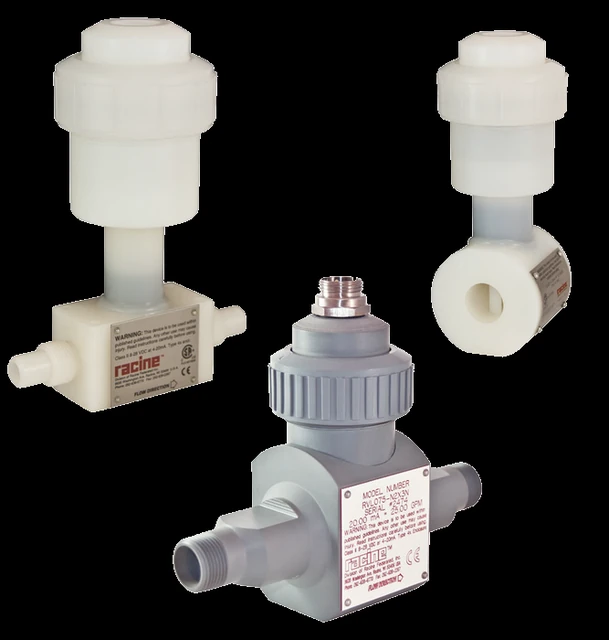
The RVL is the non-metallic vortex meter in the Vortex line — a liquid-only meter whose flow path is solid CPVC or PVDF with no metallic wetted parts, gaskets, or elastomers, so it neither contaminates an ultra-pure stream nor corrodes in an aggressive one. It suits ultra-pure water distribution, RO/DI skids, chemical injection, cooling water, and nonabrasive slurries, in NPT, butt-end, or wafer bodies from 1/4 to 3 in. It reads ±1% of full scale on its 4–20 mA output (±2% on pulse), has no moving parts, and can be recalibrated and reprogrammed in the field. Because it is non-metallic it runs at modest conditions — to 150 psig and, on the high-temperature option, to 203°F — and carries a NEMA 4X (IP66) enclosure. It is not a steam or gas meter and has no mass-flow or BTU option; for those, use the stainless VN2000.
Key Features & Benefits
- No metal ever touches the fluid — the flow path is solid CPVC or PVDF with no metallic parts, gaskets, or elastomers, so the meter neither contaminates an ultra-pure stream nor corrodes in an aggressive one. The right meter where a stainless body is the problem.
- No moving parts, recalibrate in the field — vortex shedding means nothing spins or wears, and the unit can be recalibrated and reprogrammed in place — the 4–20 mA output is field-configurable for span, damping, and units with the optional software kit. Set it and adjust it without pulling the meter.
- Simple wiring in a washdown enclosure — a two-wire 4–20 mA loop or a three-wire frequency pulse drives a PLC, batch controller, or rate/total display, all in a NEMA 4X (IP66) corrosion-resistant housing. Drops onto the readout you already run.
- Sized for clean and aggressive duty alike — from 1/4 in micro-flow to 3 in process lines, with PVDF the tougher choice for nonabrasive slurries and strong acids and CPVC the economical body for many waters and chemicals. One family covers UPW, RO/DI, and chemical feed.
Specifications
- Measurement principle
- Vortex shedding — a piezoelectric crystal in the sensor tube reads the pressure fluctuations as vortices shed alternately off a fixed strut at a frequency proportional to flow. No moving parts.
- Measured fluids
- Liquids only — clean, ultra-pure, or aggressive fluids and nonabrasive slurries. Not a steam or gas meter.
- Line sizes
- 1/4–3 in — 1/4–2 in on NPT, 1/2–2 in butt-end, 1–3 in wafer.
- Flow range
- 0.6–300 gpm across the sizes — from 0.6–5 gpm on the 1/4 in up to 30–300 gpm on the 3 in wafer.
- Turndown
- 10:1 on most sizes (8:1 on the 1/4 in) at 1 cSt.
- Accuracy
- ±1% of full scale on the 4–20 mA output; ±2% of full scale on the frequency pulse.
- Repeatability
- ±0.25% of actual flow.
- Viscosity
- Best near 1 cSt; above that the readable range narrows (about 12:1 at 1 cSt falling toward 2:1 at 6 cSt). Particles and bubbles are generally tolerated.
- Response time
- 2 seconds minimum to a step change in flow.
- Process / fluid temperature
- To 203°F (95°C) with the high-temperature option (standard rating is lower — pressure derates with temperature).
- Maximum pressure
- To 150 psig (10.3 bar) at 70°F; the limit derates with temperature and body material (e.g. 40 psig PVDF / 24 psig CPVC at 203°F).
- Wetted materials
- No metallic wetted parts, gaskets, or elastomers — the body material is the only thing the fluid touches, so there is no ionic contamination.
- Body / housing materials
- CPVC or PVDF — precision-machined, homogeneous through the flow path, chosen by fluid chemistry (see Considerations).
- Process connection
- NPT (male) thread, butt-end, or wafer (mounted between flanges).
- Outputs
- 4–20 mA (two-wire) or a frequency pulse (three-wire, source–sink driver) — no fieldbus.
- Display
- Optional local display, top- or right-mounted (not available with the 3-pin pulse connector option).
- Enclosure / rating
- NEMA 4X (IP66), corrosion-resistant.
- Power
- 13–30 V DC.
- Approvals & certifications
- CE (EN 50082-1:1992).
Common Applications
- Ultra-pure water distribution where a metal meter would add ionic contamination
- RO/DI skids and high-purity water loops
- Chemical injection and metering of acids and bases
- Cooling-water lines in corrosive environments
- Nonabrasive slurries (PVDF body)
Design & Selection Considerations
- Choose the body material by the chemistry — CPVC and PVDF cover different fluids: PVDF handles concentrated and oxidizing acids, hydraulic and fuel oils, and nonabrasive slurries that CPVC cannot, while CPVC is the economical body for many acids, bases, and waters. In a thermoplastic piping system, match the meter body to the pipe where you can, for compatibility and bonding. Use the input form to tell us the fluid, its concentration, and the temperature and we confirm CPVC vs PVDF.
- It is liquid-only, at modest pressure and temperature — the RVL is a liquid meter — it does not measure steam or gas, and there is no mass-flow or BTU option (for those, or for hot or high-pressure service, use a stainless VN2000). Its ceiling is 150 psig at room temperature and 203°F on the high-temperature option, and the pressure limit falls as the fluid warms. Use the input form to give us the operating pressure and temperature and we check the body holds them.
- Mind viscosity and rangeability — a vortex meter needs the flow to stay turbulent, so the readable range shrinks as the fluid thickens — roughly 12:1 at 1 cSt narrowing toward 2:1 by 6 cSt — and a specific gravity above 2.0 limits how far it can over-range. Particles and bubbles are usually fine, but grit can wear the bluff body over time in a slurry. Use the input form to send the viscosity, specific gravity, and the minimum flow and we confirm the turndown at your conditions.
- Plan the output and the readout — pick 4–20 mA when you want a field-configurable analog signal and the option of a local display, or the frequency pulse for a counter or flow computer (the pulse is not field-configurable, and the 3-pin pulse connector rules out an on-meter display). There is no Modbus or BACnet on the RVL. Use the input form to tell us the control system and we set the output and whether a display fits.
To size & select the right RVL non-metallic meter:
Use the input form to tell us the fluid (steam, gas, or liquid), the line size and schedule, the flow range, and the operating pressure and temperature, and we’ll size the meter on Badger Meter’s Vortex sizing software and confirm the measurement (volumetric, mass, or BTU/energy), the output and protocol, and the process connection — with programming and commissioning available as an optional, quoted service.
Flow Meter Application Sheet ›Talk to an engineer directly — Scott Prater, Principal · 917-580-0878 · scott@pratertechnical.com
Specifications compiled by Prater Technical Partners from Badger Meter Vortex product datasheets.