Product Overview
The VN2000 Inline is the full-bore vortex meter in the Vortex line — a one-piece, CNC-precision-machined stainless element you bolt straight into the pipe, from 3/4 to 8 in. It is the most accurate VN2000 at ±0.7% of reading, and with no moving parts, no internal O-rings, and sensors that never touch the fluid it needs no recalibration after startup. It measures saturated and superheated steam, compressed air, wet or dirty gas, and clean liquids; an embedded RTD adds temperature-compensated mass flow, and a second external RTD adds BTU/energy across a heat exchanger — the basis for steam submetering and chilled-water BTU. It comes two ways on one datasheet: a flanged body (ANSI 150/300, with optional bore reducers) and a slim wafer body for tight spots (see Variants). Outputs are 4–20 mA, scalable pulse, and Modbus RTU or BACnet MS/TP, with the transmitter on-meter or remote to 30 ft.
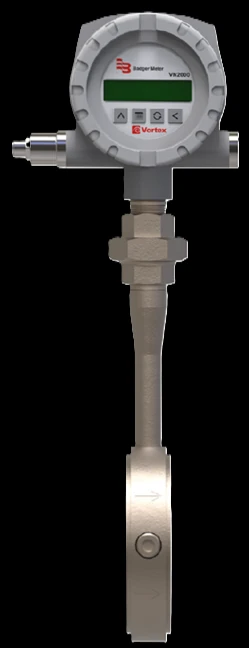
One datasheet, two bodies
The VN2000 Inline is the same vortex element in two body styles — same one-piece CNC stainless element, dual piezo sensors, ±0.7% of reading, and the same transmitter and options. The body sets how it meets the pipe and the size range.
- Flanged body bolts between the line flanges; sizes 3/4 to 8 in
- ANSI Class 150 or 300 (DN flanges PN40 available)
- Optional bore reducers fit the meter into oversized piping; pressure set by the flange rating
- Slim wafer sandwiches between existing flanges — the shortest lay length for tight spots
- Sizes 3/4 to 6 in
- Rated to 1000 psi (68.9 bar)
Key Features & Benefits
- One machined element, nothing to wear out — the sensing element is cut from a single piece of stainless and the piezo crystals are sealed inside it — no rotor, no bearings, no internal O-rings, and the sensors never see the fluid. The result is an almost unlimited element life and no recalibration after startup. Install it and leave it.
- One body for steam, air, gas, and water — a single VN2000 reads superheated steam, plant compressed air, particulate-laden or wet gas, and DI or chilled water — services that foul a moving-part meter pass straight through it. One meter type covers a plant’s utility lines.
- Volume, mass, and energy from one meter — beyond volumetric flow the inline meter can return temperature-compensated mass flow and, with the energy build, total heat across a heat exchanger — so a steam or chilled-water line is submetered without a separate computer and pair of meters. Fewer instruments on the wall.
- Drops onto the building or process network — a 4–20 mA loop, a scalable pulse, a local display with totalizer, and an EIA-485 port for Modbus RTU or BACnet MS/TP cover almost any host, and the transmitter mounts on the meter or up to 30 ft away for a readable location. Wire it to what you already run.
Specifications
- Measurement principle
- Vortex shedding — flow past a fixed bluff body (the shedder bar) sheds vortices alternately off each side at a frequency proportional to velocity; dual ceramic piezoelectric sensors bonded inside a one-piece CNC-precision-machined stainless element count them. No moving parts.
- Measured fluids
- Steam (saturated and superheated), gas (compressed air, wet or dirty process gas), and liquids.
- Line sizes
- 3/4–8 in flanged; 3/4–6 in wafer (see Variants).
- Accuracy
- ±0.7% of reading on volumetric, mass, and heat flow, for liquids, steam, and gas alike — the most accurate meter in the VN2000 line.
- Repeatability
- ±0.25% of reading.
- Velocity range
- Liquid to 32 ft/s (9.75 m/s); gas to 300 ft/s (91 m/s).
- Reynolds range
- 10,000–7,000,000, depending on fluid density.
- Process / fluid temperature
- −250 to 400°F (−120 to 204°C).
- Maximum pressure
- Wafer to 1000 psi (68.9 bar); flanged is set by the ANSI 150 or 300 flange rating (see Variants).
- Straight-run requirement
- Upstream 10 pipe diameters, downstream 5; at most a single 90° elbow ahead of the inlet.
- Wetted materials
- Stainless steel 303; O-ring-free element — no internal O-rings or seals, and the piezo and temperature sensors never touch the process fluid.
- Process connection
- ANSI Class 150 or 300 flanges (DN flanges PN40 available; optional bore reducers for oversized piping), or a slim wafer body bolted between existing flanges — see Variants.
- Mass-flow option (internal RTD)
- Optional. An RTD embedded in the sensor (100 Ω, 3-wire) corrects for temperature so a steam or gas line reports true mass, not just volume.
- BTU / energy option (2nd external RTD)
- Optional. A second external 100 Ω RTD lets the meter total BTU/energy across a heat exchanger — for campus / building steam submetering and chilled-water BTU.
- Outputs
- One 4–20 mA (24-bit, 10–36 V max load) plus a scalable pulse (opto-isolated, max 12.5 Hz).
- Digital communication
- EIA-485 — Modbus RTU or BACnet MS/TP (one or the other, ordered with the meter).
- Display
- 2×16 reflective, rotatable; 6-digit rate with totalizer; 4-button membrane keypad.
- Transmitter / mounting
- On-meter (integral) or remote to 30 ft (10 m) from the pipe; multi-pole plug-in connector (no internal field wiring).
- Enclosure / rating
- General purpose.
- Power
- 14–36 V DC.
Common Applications
- Saturated and superheated steam for process heating, and campus / building steam submetering
- Chilled-water BTU / energy measurement across heat exchangers
- Compressed-air auditing and distribution monitoring
- Wet or dirty process gas where a moving-part meter would foul
- Deionized water and other clean utility liquids in tight pipework (slim wafer body)
What to Pair It With
Mass-flow needs nothing extra — the RTD is embedded in the sensor. The BTU/energy option is what needs a companion: a second temperature point on the return side of the loop.
- Badger Meter External RTD probe (VNA-RTD) — the BTU/energy build reads the supply temperature from the RTD inside the VN2000 sensor and the return temperature from this insertion RTD, then totals heat from the ΔT and the mass flow. Order the matched VNA-RTD probe with the meter rather than sourcing a generic RTD, so the pair is calibrated and wired to the transmitter (manual VRX-UM-02292). Use the input form to tell us the loop and pipe size and we spec the probe and insertion length with the meter.
Design & Selection Considerations
- Pick the body by how the meter meets the pipe — the measurement principle is the same across the VN2000; the install is what differs. The Inline is a full-bore meter you bolt into the line (3/4–8 in) and it reads the tightest number, ±0.7% of reading; choose it when the line can be opened. The insertion meters tap one hole into a larger pipe at ±1.0%: the Hot-Tap goes in and comes out under pressure through an isolation valve, while the lower-cost Compact drops into a welded mounting assembly after the line is depressurized. For a clean or aggressive liquid that a stainless meter would contaminate or that would corrode it, the RVL is the non-metallic answer. Use the input form to tell us the pipe size, the fluid, and whether the line can be shut down and we point you to the right one.
- Give it a settled flow profile — like any meter that reads velocity, a vortex meter needs the flow profile to recover before it counts vortices — plan on 10 pipe diameters of straight run upstream and 5 downstream, with no more than one 90° elbow just before the meter. Short of that, accuracy drifts. Use the input form to send the piping layout around the meter location and we flag whether you need a flow conditioner or a different tap point.
- Keep it in the turbulent band — vortices only shed cleanly in turbulent flow, so the VN2000 holds its accuracy across a wide Reynolds band (roughly 10,000 to 7,000,000) but loses the bottom of its range at very low velocity, and a thick fluid that stays laminar will not register — the line is best on fluids under about 20 cP. The worst case is the low-flow / high-viscosity corner, not the high end. Use the input form to give us the minimum flow with the fluid viscosity and we confirm the meter still reads at your turndown.
- Mass flow and BTU are options — order them up front — the base VN2000 reads volumetric flow. Add the mass-flow option and an RTD embedded in the sensor temperature-compensates the reading to true mass flow for steam or gas; add the BTU/energy option and a second external RTD lets the meter total heat across a heat exchanger — the basis for campus and building steam submetering and chilled-water BTU. Neither is retrofit-friendly, so specify the measurement when you order. Use the input form to tell us whether you need volumetric, mass, or energy and we set the right configuration.
- Decide whether the line can come down to install — on a critical line that cannot be shut off, the Hot-Tap Insertion meter installs and is serviced live — it rides a stainless seal assembly on your isolation valve and, with the optional insertion/extraction tool, goes in and out under pressure (the element withstands 1000 psi, though insertion or removal is not recommended above 400 psi). When a shutdown is acceptable, the Compact Insertion meter is the lower-cost route, and a full-bore Inline meter needs the line open. Use the input form to tell us whether the process can be taken down and we steer the selection.
To size & select the right VN2000 Inline meter:
Use the input form to tell us the fluid (steam, gas, or liquid), the line size and schedule, the flow range, and the operating pressure and temperature, and we’ll size the meter on Badger Meter’s Vortex sizing software and confirm the measurement (volumetric, mass, or BTU/energy), the output and protocol, and the process connection — with programming and commissioning available as an optional, quoted service.
Flow Meter Application Sheet ›Talk to an engineer directly — Scott Prater, Principal · 917-580-0878 · scott@pratertechnical.com
Specifications compiled by Prater Technical Partners from Badger Meter Vortex product datasheets.