Product Overview
The WIKA-ST XPDL is the low-range, high-overrange differential build: 0–0.5 to 0–30 psid spans in a body that takes 1,500 psi of line pressure and overload. That combination is the whole point — filter elements, low-Δp flow, and clogged-line monitoring live at fractions of a psid but see full line pressure the moment something closes, and the XPDL is sized for both. 316 stainless wetted parts, mV/V output with an amplified option, and dedicated bleed ports for liquid service. Have a legacy tecsis part number for this measurement? Send it — WIKA acquired tecsis and now ships these under WIKA Sensor Technology, and we cross-reference the tecsis p/n to the current WIKA-ST equivalent at the same spec.
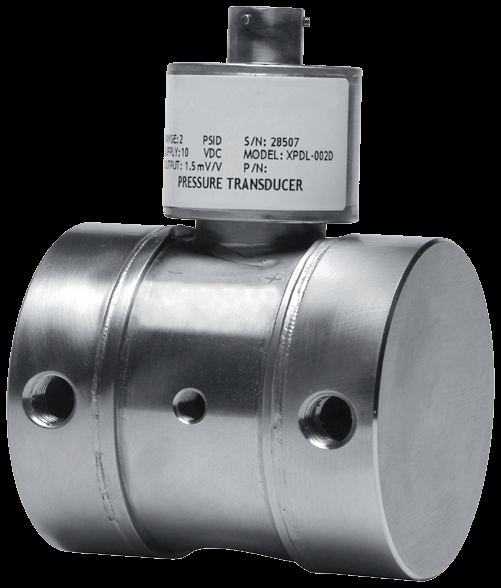
Key Features & Benefits
- Overrange protection three orders past the span — a 0.5-psid span in a body rated for 1,500 psi of line and overload — the pressure spike that would destroy an ordinary low-range sensor just passes through. The low-Δp sensor that survives the day something slams shut.
- Bleed ports built into the body — two dedicated 1/8 NPT bleed ports let you prime and vent a liquid-filled installation without cracking the process fittings. Wet/wet plumbing the installer will thank you for.
- Honest low-range resolution — linearity ±0.15% FSO with ±0.05% repeatability on spans down to half a psid, from a bonded-foil bridge in all-stainless construction. Small differences measured like they matter.
Specifications
- Sensing principle
- Bonded-foil strain-gauge differential sensing across two wet/wet process ports, built for low differential ranges that must survive high line pressure and overrange — the 1,500-psi-rated body protects a span as small as 0.5 psid.
- Pressure type
- Differential (Δp), wet/wet.
- Measuring range
- 0–0.5 to 0–30 psid (0.5, 1, 2, 5, 10, 15, 25, 30 psid).
- Accuracy
- ±0.25% FSO (linearity ±0.15% FSO, hysteresis ±0.10% FSO, repeatability ±0.05% FSO); high-accuracy option available.
- Thermal effects
- On zero ±0.50% FSO/100°F; on span ±0.50% reading/100°F.
- Output signal
- Ratiometric mV/V by range: 1.0 mV/V (0.5 psid), 1.5 mV/V (1–4 psid), 2.0 mV/V (5–30 psid); amplified voltage or current output optional.
- Excitation / supply
- 10 VDC (15 VDC max); bridge resistance 350 Ohms; insulation resistance 5,000 MOhms at 50 VDC.
- Electrical connection
- PTIH-10-6P (or equivalent) connector; other electrical connections optional.
- Wetted parts material
- 316 stainless steel wetted parts; stainless casing — all-stainless construction.
- Process connection
- Two pressure ports 1/8-27 NPT plus two 1/8-27 NPT bleed ports for priming a liquid-filled installation; other pressure ports optional.
- Overpressure / proof
- Safe overload 1,500 psi — the high-overrange capability that protects the low-Δp span through spikes and slammed valves.
- Line (static) pressure
- 1,500 psi maximum line (static) pressure.
- Operating temperature
- +30 to +190°F.
- Compensated temperature
- +30 to +130°F.
- Approvals & certification
- Options: low ranges, high accuracy, amplified output, alternative ports and electrical connections, high line pressure.
- Configuration & lead time
- Configured per the differential range, the line pressure, the output, and the ports. Quote-only, no public price list.
Common Applications
- Filter and strainer condition monitoring at fractions of a psid
- Low-Δp flow-element measurement with spike exposure
- Clogged-line and screen monitoring on pressurized systems
- Hydraulic and process systems where line pressure dwarfs the differential
Design & Selection Considerations
- Size the overrange to the worst transient, not the steady reading — a low-range differential sensor on a filter or flow element can see a momentary spike far above its span — a slammed valve, a clogged element, a pump start. The XPDL is built for exactly this; confirm the worst-case transient still lands under the 1,500 psi rating. The low-range sensor fails on the spike it never reads, not the pressure it does.
- The compensated band is narrower than the operating band — the XPDL operates +30 to +190°F but is compensated +30 to +130°F — outside the compensated band the ±0.50%/100°F thermal coefficients apply to a span that is already small. Keep the installation inside the compensated band or budget the drift. On a 0.5-psid span, temperature is a first-order error.
- FSO accuracy is a percentage of the range, not the reading — a ±0.25% FSO transducer rated for the full scale can be off by that fraction of full scale anywhere in its range — a larger relative error down at the low end. Size so the working pressure lands in the upper part of the range, and when you compare two sensors make sure both quote accuracy the same way. An oversized range quietly throws away resolution at the pressure you actually run.
- Respect the overpressure limit — the danger zone is below burst — proof / safe-overpressure is the pressure the sensor can see without losing calibration; burst is where it is destroyed. A unit driven past proof but short of burst keeps reporting plausible, wrong numbers. Size for the real worst case — including transients — and recalibrate after any suspected overpressure event. A spike that shifts calibration leaves no visible mark; the reading just drifts.
- Match the wetted material to the medium — the wetted parts see the process chemistry directly; the standard stainless suits most service, but corrosive, high-purity, or sour media want the right alloy specified up front. Use the input form to tell us the medium and we pick the wetted material to it. The wrong wetted alloy fails slowly and silently, not all at once.
To spec the right WIKA-ST low-range differential transducer:
To size and select the right transducer, send us: the pressure range and whether it is gauge, absolute, sealed, or differential; for a differential measurement, the maximum line (static) pressure as well as the differential range; the accuracy class you need (standard industrial vs. high-accuracy); the output the receiving device expects (4–20 mA, 0–5 V, 0–10 V, or raw mV/V) and the cable run; the process medium and temperature (so the wetted material and any extended temperature compensation are right); the process connection and electrical termination; and any area classification or agency approval (Ex / intrinsic safety, CSA, FM) and NACE / sour-service material requirement. For a fast transient, give us the rise time or frequency of the event so the natural frequency is sized above it.
Force & Pressure Application Sheet ›Talk to an engineer directly — Scott Prater, Principal · 917-580-0878 · scott@pratertechnical.com
Specifications compiled by Prater Technical Partners from WIKA product datasheets.