Product Overview
The Power Station is SunWize’s skid-mounted system for larger fixed installations — the array, battery bank, charge controls, and enclosure are integrated onto a hot-dipped galvanized steel skid so the whole power plant arrives as one unit, is set down with a forklift or crane, and is energized in place. It spans roughly the 600 W–4.5 kW range (larger AC configurations are available) in 12, 24, or 48 V, with fan-cooled MPPT charge controls on the higher-power builds. Choose the Power Station when the load is large and the install is fixed; for a relocatable 1 kW unit that deploys in minutes, see the Rapid Deploy.
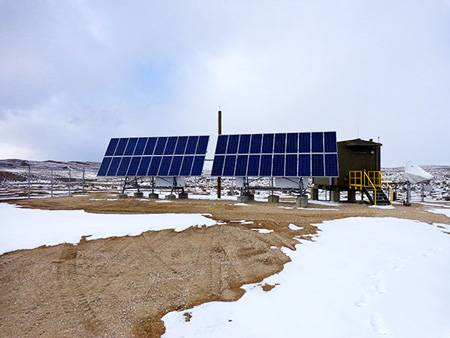
Key Features & Benefits
- Sized as one system, not a box of parts — array, charge controller, battery, and enclosure are engineered together against the site and the load, so the pieces are matched — the controller suits the array, the battery suits the autonomy, the wire suits the voltage. You get a power system, not a parts list to reconcile yourself.
- Engineered to the worst month, so it carries year-round — the design is run against the worst-case winter sun rather than the annual average, which is what keeps the load alive through the dark months. The failure you are buying your way out of is dead equipment in mid-winter.
- Built for long, low-attention service — the battery is the wear item; modules age slowly over decades, and cellular telemetry can report the system’s own state of charge so a remote site is checked on a schedule, not a guess. Designed to be left alone on a site nobody wants to drive to.
- Bought through one vendor of record — Prater Technical handles specification review, quoting, order processing, and status all the way through to delivery, so the system sets up cleanly on arrival. One point of contact from sizing to the loading dock.
Specifications
- System type
- Skid-mounted off-grid solar power system — array, battery bank, charge controls, and enclosure integrated onto a galvanized steel skid; set down and energized as one unit.
- Power / load class
- Roughly 600 W–4.5 kW for the standard fixed installs (larger AC configurations are offered).
- System voltage
- 12, 24, or 48 V DC; AC output via an inverter where required.
- PV array
- Multi-module PV array sized to the load and mounted on the skid or an integrated ground / A-frame structure.
- Charge controller
- Standard PV charge controls up to 60 A each (passively cooled); higher-power configurations use fan-cooled MPPT controls up to 320 A.
- Battery & autonomy
- Deep-cycle battery bank sized for the load and autonomy; the design targets a substantial no-sun reserve (the platform is built around multi-day autonomy). Sealed AGM or LFP per the application.
- AC output / inverter
- AC output via an inverter where the load is AC; DC delivered directly otherwise.
- Enclosure
- Powder-coated aluminum, steel, or stainless NEMA 3R enclosure for the battery and electronics.
- Mounting
- Hot-dipped galvanized steel skid / ground-mount structure (e.g. 60″ × 85″ with leveling feet and rear skid, or 80″ × 102″), hot-dipped galvanized or gray powder-coat over galvanized; the unit is forklift- and crane-set and energized in place.
- Hazardous area (Class I Div 2)
- Class I, Division 2 capable — C1D2-rated components and sealed enclosures for classified sites.
- Environment
- Outdoor-rated, galvanized structure engineered for local wind and snow loads.
- Sizing method
- Worst-month sizing from the daily load and the site insolation.
- Pricing
- Quote-only — the complete skid-mounted system is sized and priced per application.
- Fulfillment & lead time
- Engineered build — fulfilled by factory drop-ship with optional Prater kitting; the integrated skid is set down and energized as one unit.
Common Applications
- Larger fixed off-grid installations — multi-load remote sites that exceed a pole-mounted system
- Pipeline cathodic-protection rectifiers and gas-transmission monitoring at higher current
- Telecom and communications loads at a permanent site where a skid-mounted plant is set once and left
- Water/wastewater and environmental sites needing a multi-kilowatt array and a large battery bank in one forklift-set unit
- Hazardous-area (Class I Division 2) installations using sealed enclosures and rated components
Design & Selection Considerations
- The skid is the feature — plan the set-down, not the assembly — because the array, battery, and electronics arrive integrated on a galvanized skid, the site work is placing and energizing one unit, not building a system in the field. Plan forklift or crane access and a level pad. The labor moves from field assembly to a single set-down.
- Size the charge controls to the array, not just the load — standard controls handle up to 60 A each passively; the higher-power builds step up to fan-cooled MPPT to 320 A, which is what lets a multi-kilowatt array deliver its harvest. The array wattage, not only the load, sets the controller tier.
- Fixed-site economics favor the larger battery and the bigger array — a Power Station is set once and left, so the trade is up-front size against service visits — a generous array and battery bank ride through bad weather without a truck roll. On a permanent site, oversize the reserve before you plan to visit it.
- Pick the system voltage from the load and the wire run — a higher DC voltage carries the same power at lower current — smaller conductors, less voltage drop over distance — so longer cable runs and larger loads favor 24 V or 48 V, while a small instrument load is simplest at 12 V. Many SCADA, telemetry, and cathodic-protection loads come native in 12 or 24 V, and the system is often set to match. Use the input form to tell us the load voltage and where it sits relative to the array and battery.
- AGM vs LFP is a total-cost decision, not a price decision — sealed AGM is the proven value tier; lithium iron phosphate (LFP) costs more up front but earns it back where the battery cycles hard, the site gets cold, or a service visit is expensive — more cycles, better cold-weather behavior, longer life. On an arctic or hard-to-reach site that cycles daily, LFP often wins on total cost despite the sticker.
- PWM where the voltages match; MPPT where the harvest pays — a PWM controller is simple and economical when the array voltage is close to the battery voltage; an MPPT controller actively extracts the most available power, which pays off on larger systems, in cold weather (panel voltage rises), and where there is a voltage gap between array and battery. Small and voltage-matched calls for PWM; bigger or colder calls for MPPT.
To scope the right SunWize Power Station:
To scope a SunWize system we work from the load and the site. The two most useful numbers are the equipment’s daily energy in watt-hours per day and its duty cycle (continuous, or dawn-to-dusk, or intermittent). With those plus the site location (which sets the worst-month sun), the autonomy you need (how many no-sun days the battery must carry), the system voltage if the equipment dictates one, and the environment / area classification and mounting available, Prater sizes the array, battery, controller, and enclosure and returns a quote. Use the input form to send the load profile and we will tell you which SunWize system fits.
Remote Solar Power Application Sheet ›Talk to an engineer directly — Scott Prater, Principal · 917-580-0878 · scott@pratertechnical.com
Specifications compiled by Prater Technical Partners from SunWize Technologies published product literature.