Product Overview
Power Online is SunWize’s grid-connected battery-backup system — for a site that has utility power but can’t trust it to stay on. The grid is the normal source; a battery bank and charger hold the load through outages and brown-outs, the way a UPS does, sized for days of backup rather than minutes. It can be specified as a non-solar backup, or with a solar array added so the system rides through a grid outage on sun and storage together. Choose Power Online when the grid is present but unreliable; for a site with no grid at all, the off-grid Power Ready, Power Station, and hybrid systems generate and store all of their own power.
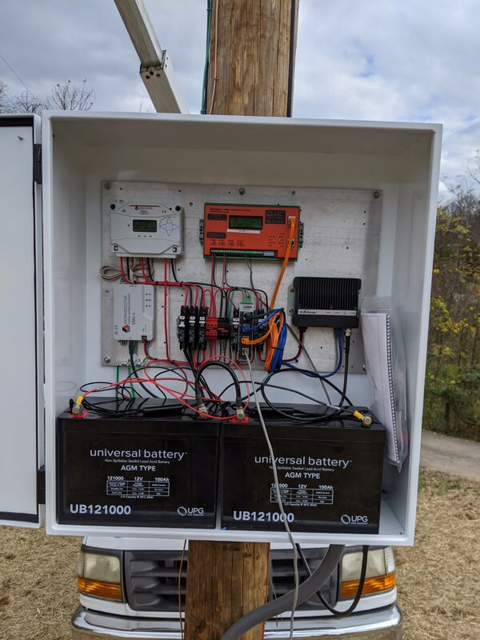
Key Features & Benefits
- Days of backup, not minutes — sized like an off-grid bank — where a conventional UPS rides a short bridge to a generator, Power Online carries the load through extended grid outages on a battery bank sized in days of autonomy. Built for sites where the grid can be down for a long time, not just a flicker.
- Grid keeps the battery topped — solar optional — utility power is the normal charging source and the battery sits ready; an optional PV leg lets the site recharge from sun during a prolonged outage. A backup bank that the grid maintains, with a solar hedge for the long failures.
- Runs whatever the site runs — AC or DC — the system is configured to the actual equipment, AC or DC, across the common service voltages, so it backs up the load as found rather than forcing a conversion. Matched to the gear already on site.
- One engineered, integrated package — not a parts list — array, charge controller, battery bank, disconnect, enclosure, and mounting arrive matched and documented as a system, so the site team installs and energizes rather than designs. Buy a system that is already specified to work together, not a box of parts to reconcile.
Specifications
- System type / role
- Grid-connected battery backup — a complete battery-backup system for a site that has utility power but needs it backed up; the grid is the normal source, and the battery carries the load through outages.
- System voltage
- Configured to the load, AC or DC — 12 / 24 / 48 V DC or 110–240 V AC (typically 120 V/60 Hz or 230 V/50 Hz via inverter), to back up the equipment as found.
- PV array
- Optional — a solar array can be added so the site also recharges from the sun and rides longer outages, configured as a solar-assisted hybrid; without it, the grid is the sole charging source.
- Charge controller
- PWM or MPPT where a solar array is included; selected by array-to-battery voltage gap and system size.
- Battery & autonomy
- Deep-cycle battery bank sized to the required autonomy — backup measured in hours-to-days, with custom builds extending to multiple days, rather than the minutes of a conventional UPS. AGM for rarely-cycled float duty; LFP where outages are frequent or a solar leg cycles the bank daily.
- Enclosure
- Weatherproof outdoor enclosure for the battery and electronics, suited to pole, wall, tower, or pad mounting per the site.
- Mounting
- Ground, pole, or cabinet mounting per the installation; solar array (where included) on pole, ground, or roof mounts engineered for site wind and snow load.
- Hazardous-location capability
- Class I, Division 2 components available where a grid-backed site sits in a classified area (C1D2 module and sealed enclosures).
- Environment & site
- For grid-connected sites across the Northeast & Mid-Atlantic where utility power is present but unreliable, brown-out-prone, or storm-exposed; remote telemetry of battery state can be built in.
- Pricing
- Quote-only — the backup system is sized per application (steady load and the longest outage it must survive).
- Fulfillment & lead time
- Authorized distributor — Prater Technical is the vendor of record; factory drop-ship with optional Prater kitting. Engineered build; lead time runs into weeks.
Common Applications
- Grid-connected SCADA, RTU, and telemetry sites that must keep reporting through utility outages
- Communications and control equipment at sites with weak, brown-out-prone, or storm-exposed grid power
- Safety, security, and surveillance systems that have to ride through a power failure
- Seismic and environmental monitoring stations on the grid in regions where outages are frequent or long
Design & Selection Considerations
- Decide the backup window first — it sizes the battery — how long the load must survive a grid outage sets the battery bank directly; SunWize sizes Power Online for multi-day autonomy the same way an off-grid system is sized. Use the input form to tell us the longest outage you must survive and the steady load, and the bank follows.
- Add solar when outages can outlast the battery — a non-solar bank is finite — once it’s spent, the load drops until the grid returns. Adding a PV array lets the site recharge during a prolonged outage, turning a fixed-duration backup into one that can ride indefinitely in good weather. Solar is the hedge against an outage longer than your autonomy.
- Match chemistry to how often the grid actually fails — a bank that floats on the grid and discharges rarely suits sealed AGM; one that cycles often — frequent outages, or a solar-assisted build that cycles daily — can justify LFP for its cycle life. Cycle frequency, not just capacity, picks the chemistry.
- Confirm the transfer is seamless for sensitive loads — monitoring, control, and communications gear can’t tolerate a gap when the grid drops; the system is configured so the battery picks up the load without interruption. Flag any load that must never see a break, and the transfer is specified to it.
To scope the right SunWize Power Online system:
Use the input form to send the load profile and we’ll scope the system to it. The most useful inputs are: the load in watt-hours per day (or the continuous wattage and duty cycle), the site location (which sets the available sun), the autonomy you need (2, 5, or 7 days of no-sun reserve, judged by how critical the load is), the system voltage (12 / 24 / 48 V DC, or AC via inverter), the environment and any area classification (Class I Division 2?), and the mounting the site allows (pole, ground, roof, or skid). With those, Prater Technical returns a system sized to carry your load through the worst month the site will see.
Remote Solar Power Application Sheet ›Talk to an engineer directly — Scott Prater, Principal · 917-580-0878 · scott@pratertechnical.com
Specifications compiled by Prater Technical Partners from SunWize Technologies published product literature.