Product Overview
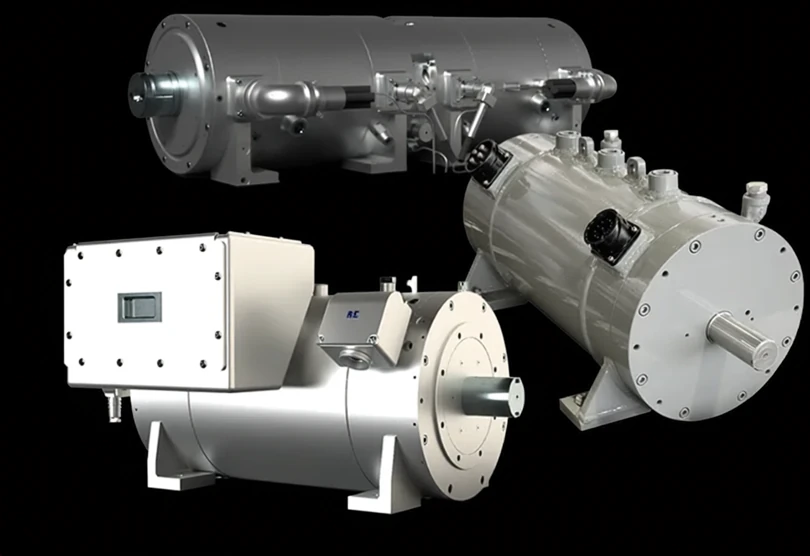
A permanent-magnet (PM) synchronous motor runs at exact synchronous speed under load — no slip — and is the most efficient and power-dense AC motor type, drawing less current than a conventional synchronous machine. A line-start PM build adds a die-cast cage so it starts directly across-the-line at utility power and then pulls into synchronism, combining across-the-line simplicity with PM efficiency. Reuland builds these to 50 HP air-cooled (200 HP water-cooled) and 12,000 rpm, on standard NEMA frames, engineered to order with no minimum quantity — the efficiency retrofit when you want to keep across-the-line starting but cut energy and improve power factor.
Key Features & Benefits
- Exact speed under load — zero slip — a synchronous machine locks to the supply frequency and holds rated speed regardless of load, where an induction motor always slips a few percent. The reason to choose synchronous: the process speed does not wander as the load changes.
- Built to your exact spec, not pulled off a shelf — every Reuland synchronous motor is engineered from the ground up to your electrical and mechanical requirements — voltage, speed, frame, mounting, shaft, enclosure — and built foundry-to-test in-house. No minimum quantity: one motor or a production run.
- Process synchronization and tension control — because every motor on a line holds the same exact speed, multiple drives stay in step section to section — the basis for web-tension and line-synchronization control in fiber, glass, wire, and converting. What you reach for when several drives must track one another precisely.
- High-speed-capable construction — M-19/M-36 laminations, hand-wound stators, Class H insulation, and ABEC-7 precision bearings give the platform the headroom for high-speed and high-duty service (the speed envelope is in the specifications). The same construction that serves test-stand and spindle duty.
Specifications
- Operating principle
- Synchronous AC machine — runs at exact synchronous speed under load (no slip). A line-start PM motor adds a die-cast cage so it starts across-the-line at utility power and then pulls into synchronism, holding high efficiency and high power factor.
- Rotor & excitation
- Permanent magnets in/on the rotor provide the field — no rotor excitation current and no slip. The line-start build combines the magnets with a squirrel-cage winding for across-the-line starting.
- Power range (HP)
- Up to 50 HP air-cooled; up to 200 HP water-cooled.
- Speed range
- Up to 12,000 rpm (higher speeds available — consult factory).
- Voltage
- Up to 600 V.
- Phase
- 3-phase.
- Frequency
- 50/60 Hz across-the-line; to nominal 1,000 Hz on an inverter.
- Poles
- 2, 4, 6, and 8-pole.
- Control method
- Across-the-line; V/Hz; open-loop and flux-vector.
- Drive / operation
- Operates across the line at utility power (line-start build) or on an inverter — specify which at order.
- Stator construction
- M-19 or M-36 electrical-steel laminations (other lamination grades on request), hand-wound for balanced, symmetrical windings.
- Rotor construction
- Permanent magnets with die-cast aluminum, copper, or copper-alloy cage; M-19 / M-36 electrical-steel laminations.
- Magnet material
- Samarium cobalt, neodymium iron-boron, or ceramic — selected to the temperature and performance required.
- Frame
- Standard NEMA frames 56–326 (air-cooled); custom frames available.
- Enclosure / cooling
- Fan-cooled (TEFC/DPFC), auxiliary-fan-cooled (A-TEFC/A-DPFC), non-ventilated (TENV/ODP), and water-cooled (TEWC).
- Insulation class
- Class H insulation throughout — the high-temperature class Reuland uses on its synchronous and high-speed machines for thermal headroom and for the voltage stress a fast-switching inverter waveform imposes.
- Bearings
- High-precision ABEC-7 — steel-ball, ceramic-ball, or roller bearings, selected to the speed and duty.
- Frame & end-bell construction
- Cast-iron or aluminum frame and end bells.
- Efficiency & power factor
- About 20% higher efficiency and 30% higher power factor than a conventional synchronous motor, drawing less current — the basis for an efficiency retrofit of an existing synchronous or induction drive.
- Build & lead time
- Every Reuland motor is custom-built to your exact electrical and mechanical requirements — foundry through final test in-house, with no minimum quantity (one motor or thousands). No published price list; quote-only, lead time set per job. Expedited lead times are available based on factory capacity.
Common Applications
- Textile and synthetic-fiber machinery — line synchronization and tension control
- Glass-manufacturing and converting machinery — precise, slip-free process speed
- Machine tools and spindles — exact speed for finish and repeatability
- Compressors and pumps — efficiency retrofit keeping across-the-line starting
- Process-automation and conveyor-line drives requiring synchronization process to process
Design & Selection Considerations
- Decide the start method before the rotor type — a line-start PM motor starts across-the-line on its die-cast cage and then pulls into synchronism; a pure-synchronous, IPM, or SPM machine needs an inverter to start and run. Settle whether the motor must start direct-on-line or will always run on a drive — it determines the class. The single question that picks PM line-start vs. inverter-driven.
- Inverter-fed windings see extra voltage stress — a VFD’s fast-switching waveform stresses winding insulation; Reuland’s Class H system is specified for it, and on a drive the motor can be wound for the drive’s actual output voltage rather than full line voltage to cut drive and feeder cost. Use the input form to tell us the drive model and how it will be operated.
- Protect bearings against VFD shaft currents — inverter operation can drive circulating currents through the bearings; bearing protection — and where needed insulated or ceramic bearings — addresses it, which is why the bearing option is specified with the drive. Easy to overlook on a high-speed PM machine, expensive to discover as fluting.
- Match the cooling to the power density — fan-cooled (TEFC/DPFC) and non-ventilated (TENV/ODP) builds suit the air-cooled NEMA-frame classes; water-cooled (TEWC) and oil-cooled (TELCW) builds are how the high-power IPM/SPM classes shed heat in a small frame. Power density and the available coolant set the enclosure, not the other way round.
- Rare-earth supply is a design input — PM classes depend on samarium-cobalt or neodymium magnets; where magnet supply, cost, or temperature is a concern, the synchronous-reluctance class gives exact speed with no magnets at all. If a magnet-free rotor matters to you, say so up front — it changes the class, not just the price.
To spec the right Reuland synchronous PM motor:
Use the input form to send your horsepower and speed (or poles), the voltage, phase and frequency available, the duty cycle, mounting and frame constraints, the enclosure environment, and how the motor will be driven (across-the-line or on a specific VFD/drive model) — plus any governing standards — and we’ll spec the right Reuland synchronous motor & control package for your application.
Specialty Motors Application Sheet ›Talk to an engineer directly — Scott Prater, Principal · 917-580-0878 · scott@pratertechnical.com
Specifications compiled by Prater Technical Partners from Reuland Electric published product specifications.