Product Overview
A NEMA Design D high-slip motor is a squirrel-cage AC induction motor engineered to a high-slip torque-speed curve — it develops high starting torque and, crucially, runs at 5–8% or 8–13% slip, which lets the motor speed drop under load instead of stalling or snapping the driveline. That makes it the across-the-line answer for shock and pulsating loads — punch presses, hoists, dam gates, and movable bridges, where the load hits hard and the motor needs to absorb it. It gets that shock tolerance from the rotor design alone, with no slip rings, resistor bank, or drive. Choose Design D for fixed-speed shock loads; where you also need controlled torque or stepped speed, the wound-rotor motor adds that.
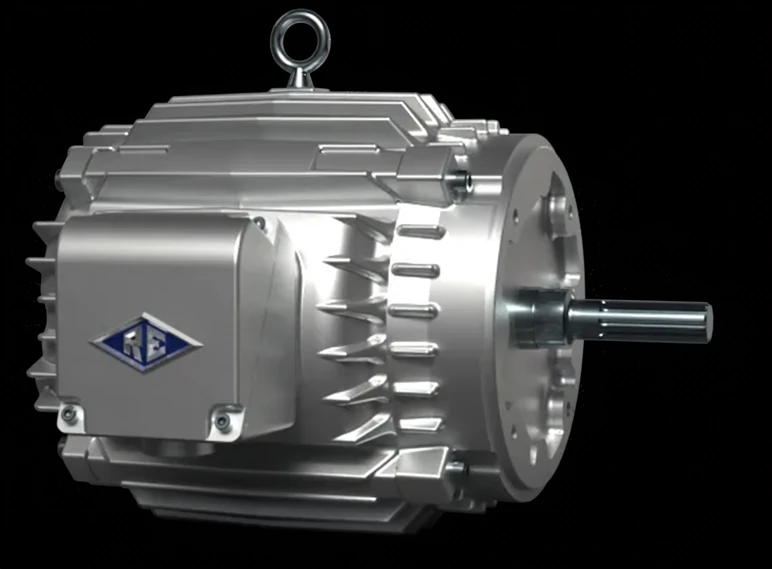
Key Features & Benefits
- Absorbs shock and pulsating loads instead of fighting them — the high-slip rotor lets the motor speed sag when the load hits hard, soaking up the impact rather than transmitting it into the gearing and structure. What you want under a punch press, a hoist, or a gate that loads the driveline in jolts.
- High starting torque, straight across the line — Design D develops strong starting torque from the squirrel-cage design alone — no external resistor bank, no slip rings, no drive. The simplest way to start a high-inertia load hard.
- Slip tuned to how hard the load hits — the 5–8% and 8–13% slip classes let the motor be matched to the load’s shock character — a harder, more pulsating load gets the higher slip. The torque-speed curve is fitted to the duty, not taken off a shelf.
- Built to fit the installation you already have — cast iron or aluminum, U- and T-frame, foundry through final test in-house with no minimum quantity, and able to match a discontinued OEM frame so a new motor drops in. The right answer when a stock motor will not fit the existing installation.
Specifications
- Operating principle
- AC induction motor with a fixed squirrel-cage rotor engineered to a NEMA Design D high-slip torque-speed curve — high starting torque and high slip from the rotor design alone, across the line, with no external rotor circuit.
- Torque-speed character
- Designed to accelerate high-inertia loads and to develop high starting torque at startup. Under shock or pulsating load the high slip lets the motor speed drop instead of stalling, so the motor absorbs the load rather than transmitting the shock into the driveline.
- Slip class
- Built to either a 5–8% slip or an 8–13% slip NEMA Design D characteristic, selected to the load — higher slip absorbs a harder, more pulsating shock.
- Power & speed
- Up to 300 HP; speeds 1800, 1200, 900, 600, 450, and 300 rpm, with custom speeds available.
- Voltage / phase / frequency
- Up to 600 V, 3-phase, 60 Hz.
- Frame sizes
- NEMA frames 56 through 449, including U-frame and T-frame configurations.
- Frame & end-bell construction
- Cast iron or cast aluminum frame and end bells.
- Stator / rotor laminations
- M-19, M-36, or M-45 electrical-steel laminations; rotor construction in die-cast aluminum, copper, or copper alloy.
- Enclosure types
- Totally enclosed fan-cooled (TEFC) · totally enclosed auxiliary fan-cooled (A-TEFC) · totally enclosed non-ventilated (TENV) · open drip-proof (ODP).
- Insulation system
- Class B, F, or H, with VPI (vacuum-pressure impregnation) for a void-free, moisture- and contamination-resistant winding.
- Bearings & lubrication
- Heavy-duty steel ball, ceramic ball, or roller bearings; pre-lubricated sealed or shielded, or re-greasable open.
- Mounting configurations
- Foot or footless; precision bracket; conventional C or D flange; metric DIN flanges.
- Duty cycle ratings
- Intermittent and continuous duty; intermittent at 15-, 30-, or 60-minute ratings.
- Accessories & options
- Temperature sensors, brakes, vibration mounts and sensors available; built to order against drawing review and specified per job.
- Approvals & documentation
- Built to order under Reuland’s in-house ISO 9001:2015 quality system, foundry through final test, with no minimum quantity — one motor or a production run.
- Build & lead time
- Custom build-to-order — pricing is quote-only and lead time is set per job. Expedited lead times are available based on factory capacity.
Common Applications
- Punch presses, shears, and forming presses with a hard, repeated impact stroke
- Cranes and hoists started and reversed under load
- Movable bridges and other across-the-line lifting and travel drives
- Elevator-industry drives needing high starting torque
- High-inertia loads that must be accelerated hard from a standstill
Design & Selection Considerations
- Pick the slip class to the load’s shock character — the 5–8% class suits a firm shock; the 8–13% class a harder, more pulsating one. Higher slip absorbs more impact but runs warmer and a touch less efficient. Describe how the load hits and the slip class follows.
- High slip means more heat — size the duty honestly — slip is energy turned to heat in the rotor, so a high-slip motor on a hard cycle needs its duty rating chosen to the real on/off pattern (15-, 30-, 60-minute, or continuous) to shed it. Use the input form to give us the duty cycle, not just the horsepower.
- Design D vs. wound rotor — do you need control, or just shock tolerance? — a Design D motor gets its shock tolerance from the rotor with nothing external; a wound-rotor adds slip rings and a resistor bank when you also need controlled starting torque or stepped speed. If you only need to ride out shock at a fixed speed, Design D is the simpler, lower-maintenance machine.
- Watch the speed regulation under load — high slip means the running speed drops noticeably as the load rises — that is the point on a shock load, but it makes Design D a poor fit where tight speed holding matters. For a constant-speed need, this is the wrong design; for a load that should give under impact, it is the right one.
- Match the enclosure to the environment — TEFC is the industrial default for dust, moisture, and outdoor exposure; A-TEFC for low-speed operation that needs forced cooling; TENV where no fan is wanted; ODP for clean indoor service. Enclosure to the environment, insulation class to the thermal duty.
To spec the right Reuland Design D high-slip motor:
Use the input form to send the load and what it drives, how hard and how often it shocks the driveline, the horsepower and speed, the duty cycle (continuous or 15/30/60-minute), the supply voltage and phase, the enclosure environment, and the mounting and frame constraints — and we’ll match the slip class and the rest of the motor to the application. For a replacement, send the old motor’s nameplate and photos from 5 feet away.
Specialty Motors Application Sheet ›Talk to an engineer directly — Scott Prater, Principal · 917-580-0878 · scott@pratertechnical.com
Specifications compiled by Prater Technical Partners from Reuland Electric published product specifications.