Product Overview
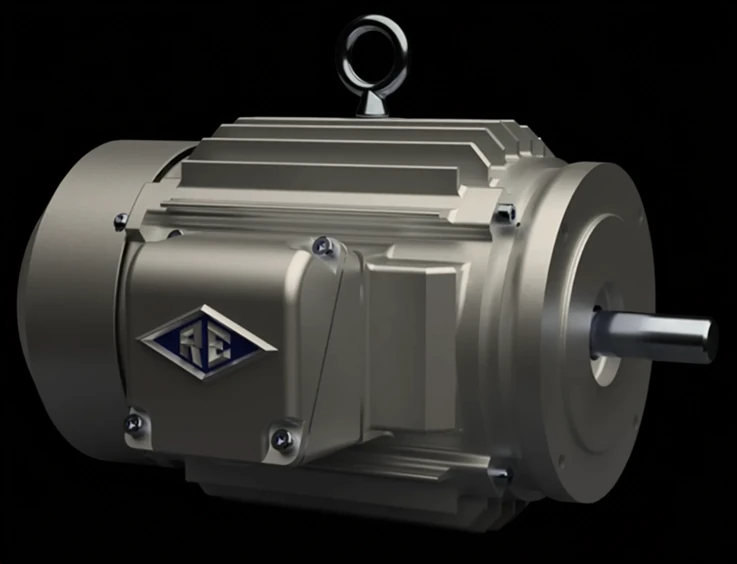
A Reuland overhead crane & hoist motor is a high-duty intermittent AC motor built to start, stop, and reverse under load repeatedly — it is rated by duty cycle (15-, 30-, 60-, or 120-minute, or continuous blower-cooled), not just horsepower. Spanning 1/10 to 350 HP and widely recognized by CMAA and HMI, it serves as the bridge, gantry, trolley, and travel drive of an overhead crane or hoist, in across-the-line, wound-rotor, or SS-100 inverter/vector-duty form, with an optional integral holding brake. Reuland also builds these as drop-in replacements for obsolete Yale, P&H, Shaw-Box, and Detroit Hoist motors. Choose this motor to drive the crane or hoist; for the fail-safe hold that keeps the load from drifting on power loss, the companion spring-set brake motor is the answer.
Key Features & Benefits
- Built for the start-stop-reverse-under-load life of a crane — a crane or hoist motor works on a hard intermittent cycle, and these are designed around that pounding rather than borrowed from a continuous-duty catalog. Sized for the duty the drive actually sees, so it survives the cycle.
- Duty-rating and cooling matched to the work cycle — short-cycle jobs take a 15-, 30-, or 60-minute rating; the heaviest continuous service takes a blower-cooled build — the cooling is chosen to the duty rather than over-built across the board. The motor is rated to the cycle, not guessed.
- Recognized by the crane and hoist industry bodies — the motors are widely recognized by both CMAA and HMI, so they specify cleanly into crane and hoist designs built to those duty classes. Speaks the language your crane builder and inspector already use.
- Drops into an obsolete frame — Reuland builds these as direct replacements for the discontinued crane and hoist motors of the major legacy OEMs (named in the specifications), reproducing the original mechanical and electrical fit. Re-power an aging crane without re-engineering the drive around a new motor.
- Across-the-line, VFD, or wound-rotor — and brake-ready — the same family covers across-the-line starting, the SS-100 inverter/vector-duty version, and wound-rotor speed-and-torque control, with an integral spring-set holding brake available. One source for the whole drive, whatever the control scheme.
Specifications
- Operating principle
- AC motor built for the high-duty intermittent service of lifting and traversing drives — it starts, stops, and reverses under load repeatedly, so it is engineered for that thermal and mechanical pattern rather than for continuous steady running. Available as the bridge, gantry, trolley, and travel drives of an overhead crane or hoist.
- Duty cycle
- Rated for intermittent crane/hoist duty: 15-, 30-, and 60-minute designs, with 120-minute fan-cooled or non-ventilated builds and continuous blower-cooled designs for heavy service such as scrap-handling cranes. The duty rating is selected to the work cycle.
- Power range
- 1/10 to 350 HP across the design range.
- Speed / poles
- 1800, 1200, 900, 600, and 300 rpm; variable-speed builds available.
- Motor type & NEMA design
- AC induction Design B, C, or D and wound rotor; variable-speed (inverter) builds available. Design D (high-slip) and wound-rotor options suit the shock and controlled-acceleration demands of lifting and traversing loads.
- Frame size
- NEMA U frames 145 through 365 and NEMA T frames 56 through 449 — including obsolete U-frame builds for drop-in replacement.
- Enclosure / cooling
- Totally enclosed fan-cooled (TEFC), totally enclosed auxiliary-fan cooled (A-TEFC) with a constant-velocity blower, totally enclosed non-ventilated (TENV), and open drip-proof (ODP). The cooling method is matched to the duty cycle — an A-TEFC blower cools the motor regardless of running speed, which reduces frame size and extends the duty cycle on the heaviest service.
- Mounting
- Foot, footless, bracket, C-face / D-flange, or Metric DIN flange — the mounting is built to the crane builder’s drive, including drop-in mounting for an obsolete frame.
- Voltage / phase / frequency
- 230 / 460 V 3-phase standard, up to 600 V 3-phase, 60 Hz (to 133 Hz on an inverter, 4- or 6-pole). Wound to order for other service voltages, and can be wound for a drive’s actual output voltage.
- Integrated brake option
- Available with an integral spring-set magnetic disc brake for a fail-safe power-off hold — see the companion Reuland brake-motor build. Specify whether the drive needs a built-in holding brake with the order.
- Inverter / VFD duty (SS-100)
- Offered in an inverter / vector-duty version — the SS-100 (Super Series 100) — for VFD-controlled bridge and trolley drives, with a 2000:1 speed range, reinforced rotor for high-torque cycling, VFD-rated insulation and bearing protection, and optional shaft-mounted incremental encoder for closed-loop vector control. Available alongside the across-the-line and wound-rotor builds.
- Drop-in OEM replacement
- Built as a drop-in replacement for obsolete Yale, P&H, Shaw-Box, and Detroit Hoist motors — and for ACCO Wright, Dresser, Lift-Tech, and Robbins & Myers crane/hoist frames — matching the mounting, shaft, and electrical characteristics so the new motor fits the existing installation. Obsolete Pre-U-Frame, U-frame, and one-off configurations are reverse-engineered from the old motor where drawings are lost, with custom transition bases supplied where a frame cannot be matched exactly.
- Insulation class
- Class H insulation with Class F temperature rise typical on the SS-100 inverter-duty build (200 °C magnet wire, NOMEX phase insulation); the class is specified per job to the duty cycle and enclosure.
- Construction & manufacture
- Built in the USA — cast-iron or aluminum frame (in-house aluminum foundry), with machining, winding, assembly, and test in-house, and no minimum quantity (one motor or thousands), all engineered to order.
- Standards & recognition
- Widely recognized by the Crane Manufacturers Association of America (CMAA) and the Hoist Manufacturers Institute (HMI).
- Build & lead time
- Custom build-to-order against drawing review — quote-only, lead time set per job. Expedited lead times are available based on factory capacity.
Common Applications
- Overhead bridge, gantry, and jib crane drives — steel mills, foundries, ports, fabrication
- Main and auxiliary hoist drives lifting and lowering suspended loads on intermittent duty
- Trolley and travel drives traversing the load across the bridge or runway
- Monorail hoists, deck cranes, container handlers, and bulk-material movers
- Scrap- and refuse-handling cranes on continuous blower-cooled, heavy service
- Re-powering an existing crane whose original motor is obsolete or discontinued
- VFD-controlled bridge and trolley drives using the SS-100 inverter-duty build
Design & Selection Considerations
- Spec the duty cycle, not just the horsepower — a crane motor lives or dies on its duty rating — a 15-minute motor on a continuous scrap-handling crane overheats, while an over-rated motor is heavier and costlier than the cycle needs. Use the input form to tell us how often it starts, stops, and reverses. The duty cycle is the design input, not a footnote to the HP.
- Wound-rotor vs. VFD vs. high-slip is a control decision — controlled starting and speed on a heavy intermittent load can come from a wound-rotor with external resistance, an SS-100 inverter-duty motor on a VFD, or a high-slip Design D across-the-line — each fits a different control philosophy and existing infrastructure. Pick the control strategy before the motor, because it changes the motor.
- A hoist needs a holding brake — decide where it lives — a suspended load must be held when power is removed, which means a fail-safe spring-set brake somewhere in the drive; it can be integral to the motor or a separate brake on the gearbox. Settle the holding-brake architecture with the crane builder up front.
- Match the cooling to the worst-case ambient and cycle — a fan-cooled motor relies on its own shaft-driven fan, which loses airflow at low speed; auxiliary-blower or continuous blower cooling holds up under heavy, slow, or sustained duty where a self-fan cannot. Slow, heavy, sustained work usually wants separate cooling.
- On a drop-in, send the old nameplate and photos — matching an obsolete frame means matching the mounting, shaft, and electricals exactly — the old motor’s nameplate, frame dimensions, and photos from a few feet back are what make the replacement actually drop in. The more data on the old motor, the cleaner the fit.
- On a VFD, protect the winding and the bearings — a drive’s fast-switching waveform stresses winding insulation and pushes induced shaft currents through the bearings, where they cause pitting, frosting, and fluting; the SS-100 inverter-duty build answers both with high-spike Class H magnet wire and a shaft-grounding bearing protector. VFD duty is engineered to the drive, not assumed from a line-duty motor.
To spec the right Reuland crane or hoist motor:
Use the input form to send the drive and its work cycle — what it moves (bridge, trolley, or hoist), the horsepower and speed, the duty cycle (how often it starts, stops, and reverses, and for how long), the control scheme (across-the-line, VFD/SS-100, or wound-rotor), whether a fail-safe holding brake is needed, the CMAA or HMI duty class, the available voltage and phase, the enclosure environment, and — for a replacement — the old motor’s nameplate, frame, and photos. We’ll spec the right Reuland crane/hoist motor and brake package, including a drop-in for an obsolete OEM frame.
Specialty Motors Application Sheet ›Talk to an engineer directly — Scott Prater, Principal · 917-580-0878 · scott@pratertechnical.com
Specifications compiled by Prater Technical Partners from Reuland Electric published product specifications.