Product Overview
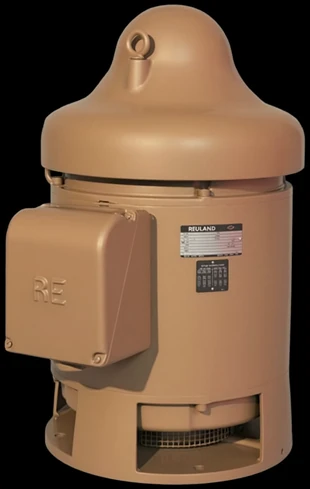
A dam / sluice-gate hoist (lift) motor is a high-slip AC induction motor built with one deliberate difference: its locked-rotor and breakdown torque are capped at 190–210% of full-load torque. Left at a general-purpose high-slip rating, the same frame can develop enough torque to snap a gate cable on a bind or hard start; the ceiling is engineered in so it cannot. It otherwise carries the high-slip family’s strengths — high starting torque to free a heavy, long-idle gate, and an intermittent-duty thermal pattern for the lift-hold-lower cycle — in an enclosure chosen for the wet, outdoor water-control environment. For a maximum-torque shock load, the standard NEMA Design D series is the answer; for a gate, the torque is capped on purpose.
Key Features & Benefits
- Torque limited so it cannot break the gate — the motor is built to a torque ceiling instead of the maximum a high-slip frame could deliver, so the lift cannot develop enough force to over-stress the cable and mechanism. The protection is in the motor, not bolted on as a clutch or a hope.
- High starting torque for a heavy gate that has been sitting — a high-slip design pulls a stuck or silted gate into motion, holding torque as it slows rather than dropping out. The right torque character for a gate that may not have moved in months.
- Built for the start-stop life of a gate hoist — intermittent duty and the high-slip thermal pattern suit a machine that lifts, holds, and lowers on demand rather than running continuously. Sized for how a gate actually operates.
- Drops into an existing gate hoist — a new motor can replace an obsolete gate-hoist motor without re-engineering the drivetrain — built to the original’s mechanical interface (see Specifications). A path forward when the original motor is no longer built.
- Made for the wet, outdoor dam environment — enclosure and construction are chosen for a water-control location rather than a clean plant floor. The environment the gate lives in is the design point.
Specifications
- Motor type
- AC high-slip (NEMA Design D-family) induction motor, intermittent-duty, built to lift and lower a dam or sluice gate — a hoist drive whose torque is deliberately limited (below) so it cannot overpower the gate mechanism.
- Torque limiting
- Locked-rotor and breakdown torque are deliberately capped at 190–210% of full-load torque — a ceiling set so the motor cannot over-stress the lift cable, sheaves, and gearing. A general-purpose high-slip motor develops well above this; on a gate hoist that surplus is the hazard, not a benefit.
- NEMA design & slip
- NEMA Design D high-slip family — Reuland builds 5–8% slip and 8–13% slip machines that let speed drop under load instead of stalling, the right character for freeing a heavy gate.
- Duty cycle
- Intermittent duty (gates are raised and lowered on demand, not run continuously); continuous-duty ratings are also available where the service requires them.
- Power range
- Sized to the gate load and lift mechanism — specified per job from the required lifting force, gate weight, and duty.
- Voltage / phase
- Wound to the project service voltage and phase — specified with the order.
- Mounting / frame
- Built to the gate-hoist drivetrain and frame — mounting, shaft, and frame are matched to the installation (including drop-in replacement of an obsolete gate-hoist motor).
- Drive / control
- Available across-the-line or VFD-duty; on a gate hoist the torque limit is the controlling design point regardless of the starting method. Specify the drive and control scheme with the order.
- Enclosure
- High-slip family enclosure options — non-ventilated (TENV), open drip-proof (ODP), and fan-cooled (TEFC); selected for the dam / water-control environment (a wet, often outdoor location).
- Approvals & listings
- Engineered to the project and the governing water-control / structure standards; qualification and documentation are matched to the job and specified per order.
- Build & lead time
- Custom-engineered and built foundry-through-final-test in the USA with no minimum quantity. Pricing is quote-only and lead time is set per job; expedited lead times are available based on factory capacity.
Common Applications
- Dam spillway and flood-control gate hoists
- Sluice-gate and water-control gate lifts
- Movable-bridge and structure drives
- Replacement of obsolete gate-hoist motors
Design & Selection Considerations
- The torque limit is the whole point — do not substitute a stock high-slip motor — an off-the-shelf NEMA Design D motor develops well above the gate’s safe torque; dropped onto a hoist it can snap the cable on a bind or a hard start. The 190–210% ceiling exists precisely to prevent that. This is the failure mode the whole design is built around — the limited torque is a feature, not a derate.
- Size from the gate load and the lift mechanism, not a horsepower guess — the lifting force, gate weight, sheave / gearing, and required raise rate set the motor — horsepower falls out of those, and the torque ceiling is set relative to the mechanism’s safe limit. Use the input form to give us the gate and the hoist drivetrain. The mechanism, not a round HP number, defines this motor.
- Spec for the wet, outdoor, infrequent-use environment — a gate motor sits in a damp water-control location and may run only occasionally, so enclosure choice and protection against moisture and corrosion matter as much as the rating. Choose the enclosure for where it lives, not for how often it runs.
- Decide the starting method, but the limit governs either way — across-the-line is simple and rugged; a VFD adds controlled lift / lower and soft start. Either way the torque ceiling is the controlling design point on a gate hoist. Pick the control for the operation you want; the torque limit is non-negotiable.
To spec the right Reuland gate-hoist motor:
Use the input form to send the gate load and lift mechanism (gate weight, lifting force, sheave / gearing, raise rate), the duty and how often the gate operates, the service voltage and starting method, and the dam environment — and we’ll work the torque-limited gate-hoist motor up with Reuland against your installation.
Specialty Motors Application Sheet ›Talk to an engineer directly — Scott Prater, Principal · 917-580-0878 · scott@pratertechnical.com
Specifications compiled by Prater Technical Partners from Reuland Electric published product specifications.