Product Overview
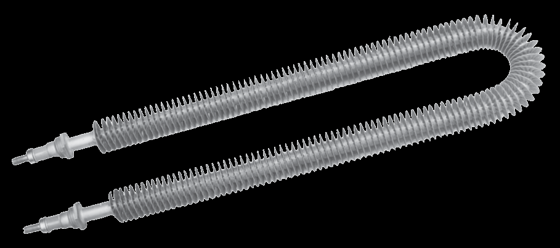
An Accutherm finned-tubular marine heater is a high-surface finned-tubular element built for marine air and space heating — cabin, compartment, and enclosed-space heating aboard ship and offshore, where salt-laden air corrodes an ordinary heater. The deviation is the construction: corrosion-resistant marine materials — Monel for aggressive chloride service, copper for cooler service — with marine-grade gasketing and bronze hardware, and a helically wound fin that delivers the heat at a cooler sheath temperature. Choose it for warming marine air and space; for heating a marine fluid in seawater or brine service, the Monel marine-duty circulation heater is the answer.
Key Features & Benefits
- Built to survive salt air, not just tolerate it — the marine line is constructed of corrosion-resistant materials — Monel where chlorides are aggressive, copper for cooler service — with marine-grade gasketing and bronze hardware, so the heater lasts in the salt-laden air that pits a standard unit (the material picks are in the specifications). The wetted and exposed parts are chosen for the sea, not the catalog.
- High finned surface for low-temperature marine air — a helically wound fin multiplies the surface, so the element heats a cabin, compartment, or enclosed space by convection while running a cooler sheath. The right construction when the job is warming marine air and space, not heating a fluid.
- A cooler sheath where surface temperature matters — spreading the wattage over the finned surface keeps the sheath temperature down — an advantage in the close quarters of a shipboard space where a low surface temperature is a safety and comfort consideration. More surface, lower sheath temperature, longer life.
- Sealed against the moisture that kills MgO elements — a moisture-resistant housing and the right terminal seal — up to a hermetic seal — keep salt spray and condensation out of the magnesium-oxide insulation, the slow death of a marine element. The terminal end is engineered for the wet, salty environment it lives in.
- Matched to the vessel, the service, and the governing spec — every marine heater is built to the application — the platform, the service, the available power, and the naval or offshore spec that governs it, with the traceability defense work needs. Engineered and documented to your vessel, not pulled from stock.
Specifications
- Operating principle
- Electric resistance (Joule) heating — current passes through a high-grade nickel-chrome resistance coil centered in a metal sheath packed with compacted magnesium oxide, which insulates electrically while transferring heat to the sheath. On a finned-tubular marine heater the sheathed element carries a helically wound fin and heats the surrounding air by convection — the basis for cabin, compartment, and space heating aboard ship.
- Marine-duty construction
- Built for shipboard and offshore service — salt, humidity, and vibration. The Accutherm marine line uses corrosion-resistant exposed and wetted materials together with marine-grade gasketing and bronze hardware; defense work adds the traceability and documentation the governing spec requires. Identify the vessel or platform, the service, and the governing spec at the quote, because marine and Navy qualification is matched to the specific application and documented.
- Salt-air / corrosion materials
- Monel — a nickel-copper alloy — resists chloride pitting and crevice corrosion far better than stainless steel, which is exactly what salt-laden marine air, seawater, and brine attack; it is specified where the chloride exposure justifies it. Copper suits cooler, milder service. For service that does not see chlorides, the standard stainless or Incoloy sheaths apply. The material is matched to the marine environment and the service at the quote.
- Finned construction
- A corrugated metal fin is helically wound onto the tube to extend surface area for air and gas heating, so the element delivers its rated wattage at a cooler sheath temperature — what makes finned-tubular the preferred construction for low-temperature, low-pressure air and natural convection in enclosed shipboard spaces.
- One-pass / two-pass construction
- One-pass (a terminal at each end) or two-pass (both terminals at one end, U-bent coil, the opposite end sealed) — both available straight, formed, finned, or unfinned. A one-pass straight element needs a flexible connection at one end to absorb thermal expansion; two-pass anchors at a single end. Bends are recompacted after forming to restore magnesium-oxide density.
- Sheath diameters
- Round metal sheath, configured to the heater and the air path. The diameter, fin density, sheath length, and formed shape are set to the kW, the airflow, and the space the heater serves — specified at the order.
- Sheath materials & max temperature
- The alloy is chosen for the marine environment and the air temperature, not cost alone, and every alloy carries far more temperature headroom than low-temperature marine air asks of it — so for this duty the pick is driven by corrosion, not temperature. That is why the selection turns on chloride exposure (see above) rather than on a maximum-temperature table.
- Voltage & current ratings
- Voltage and phase are matched to the shipboard or platform power available and wired by the assembly that incorporates the element. Use the input form to send the available voltage and phase with the request; the heater is built to it.
- Watt density
- Watt density — the wattage spread over the element surface (watts per square inch) — is the single most important life factor: drive too much wattage through too little surface and the sheath overheats. The finned surface lets the same wattage run at a lower watt density and a cooler sheath, which is why finned-tubular is used for low-temperature marine air. The density is set at the quote so the sheath stays within its design temperature.
- Sheath temperature (air)
- Sheath temperature rises with watt density and falls with airflow; the finned surface holds the sheath cooler at a given wattage, which suits enclosed marine spaces where a low surface temperature matters for safety and comfort. Where required, thermal insulation or guarding is provided to prevent contact with hot surfaces (per the IOM warnings). A classified shipboard space requires an explosion-proof build rather than this one (see Design & Selection Considerations).
- Terminals
- Threaded stud, quick-connect, or weld-nut terminations are available; the terminal insulator and seal are matched to the terminal-end temperature, voltage, and the wet, salt-laden atmosphere. Field wiring is torqued per the IOM — hold the terminal against rotation when wiring a threaded stud, and do not over-tighten a hermetic seal.
- Moisture seals
- Element ends are sealed against moisture, which rapidly degrades the magnesium-oxide insulation — the central concern in a marine atmosphere. A moisture-resistant housing is required in outdoor and marine service; for an absolute moisture seal a hermetic terminal seal is available. The seal is selected for the maximum temperature set by the temperature-limiting controls — consult the factory if the seal temperature limit is unclear.
- Installation methods
- Mounted for air heating — finned or unfinned, forced or natural convection — with the heated section supported and the element free to expand. Protect the terminals from dripping, condensation, fumes, and spray; in outdoor and marine applications a moisture-resistant housing is required. Keep the area below and around the heater clear of combustible materials per the IOM.
- Mounting accessories
- Mounting plates and brackets locate the element in the air stream or the space heater frame for non-immersed service; bronze and corrosion-resistant hardware is used on the marine build. The bracket and fastener detail is matched to the heater frame at the order.
- Terminal enclosure
- A moisture-resistant terminal housing is required for the marine and outdoor environment to keep salt spray, condensation, and fumes off the terminations. Provide proper ground-fault protection as required by local codes — contaminant build-up or sheath corrosion can cause a ground fault to the sheath (per the IOM warnings).
- Approvals & listings
- All elements are dielectric-tested per UL 1030 before shipment unless you specify a different criterion. Marine and defense work adds the traceability and documentation the governing spec requires — identify the governing spec at the quote. Never approximate a marine or hazardous-area rating; it is matched to the specific application and documented.
- Build & lead time
- Custom build-to-order — no published price list, quote-only. Lead times typically run about 3 to 14 weeks depending on configuration, hazardous-area documentation, and code-stamp requirements.
Common Applications
- Shipboard cabin, compartment, and space heating — finned convection in enclosed marine spaces
- Marine and offshore air heating where salt-laden air corrodes a standard heater
- Freeze protection and warm-up of shipboard and platform spaces
- Naval and defense shipboard air heating built to the governing spec with traceability
Design & Selection Considerations
- Spec the material to the chloride exposure — chloride pitting of an under-specified sheath is the classic marine failure — stainless that is fine inland pits in salt air and seawater. Monel resists chlorides far better and is the pick where the exposure is aggressive; copper or the standard alloys suit milder, chloride-free service. Use the input form to tell us the environment and the service, and the material is chosen to it rather than guessed.
- Set the watt density by the air, and keep the sheath cool — too high a watt density runs the sheath hot, shortening element life and raising the surface temperature in an occupied space. The finned surface is the lever — more surface at the same wattage gives a lower density and a cooler sheath. Size the density to the airflow and the maximum sheath temperature, not to the smallest element that fits.
- Keep moisture out of the MgO — the marine constant — the magnesium-oxide insulation is hygroscopic, so salt spray and condensation reaching the terminal end will drop the insulation resistance and lead to a ground fault. A moisture-resistant housing is required, and a hermetic seal is available where the exposure demands it. In marine service the seal and the housing are not optional extras.
- Megger and bake after storage or a layup — an element off the shelf or out of a damp layup can read low insulation resistance from absorbed moisture. Megger it with a 500 VDC tester; if it reads under 1 megohm, bake at 250°F or energize at reduced voltage in air until it recovers before putting it in service. A “bad” new element is usually just damp MgO.
- The safety controls are the integrator’s job — the element on its own carries no thermostat, high-limit, or ground-fault protection; the equipment builder adds a disconnect, branch-circuit and short-circuit protection, backup temperature limiting, ground-fault protection, and proper grounding per the IOM and the applicable codes. The element is a component; the protected heater is built around it.
- Keep it clear of combustibles — and out of classified atmospheres — the IOM is explicit: do not mount or operate the element in an atmosphere containing combustible gases, vapors, dusts, or fibers, and keep the area below and around it free of combustible material. A classified shipboard space needs an explosion-proof build, not this one. Confirm the space classification before you pick the heater.
To spec the right Accutherm finned-tubular marine heater:
Use the input form to send the vessel or platform and the space being heated, the heat load or space volume and the target air temperature, the marine environment and service (salt air, chloride exposure, any classified-area requirement), the available voltage and phase, the mounting and terminal environment, and the governing marine or defense spec — and we’ll spec the right Accutherm finned-tubular marine heater for your application.
Electric Heating Application Sheet ›Talk to an engineer directly — Scott Prater, Principal · 917-580-0878 · scott@pratertechnical.com
Specifications compiled by Prater Technical Partners from Aspeq Heating Group product datasheets.