Product Overview
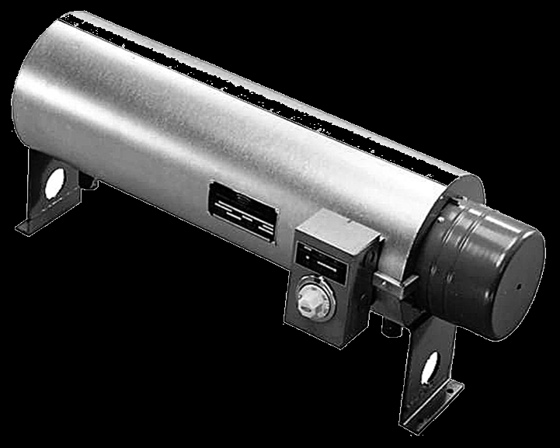
The Accutherm Monel marine-duty circulation heater is the standard circulation (inline) platform — an immersion element bundle welded into an insulated pressure vessel the fluid is piped through — built with Monel 400 wetted parts for chloride service. Monel, a nickel-copper alloy, resists the chloride pitting and crevice corrosion that attack a stainless sheath, which makes it the wetted material of choice for seawater, brine, and salt-laden marine fuel, oil, and water systems. Marine builds add marine-grade gasketing and bronze hardware. Specify the Monel build where the chloride exposure justifies it; for milder service the standard stainless or Incoloy circulation heater applies.
Key Features & Benefits
- Monel wetted parts survive what kills a stainless heater — chlorides — seawater, brine, salt-laden marine fuel and water — pit and crack a stainless sheath; the nickel-copper Monel build resists that pitting and crevice corrosion, so the heater lasts in the service that fails ordinary immersion heaters. The right metal for salt water, specified only where the chloride exposure earns it.
- Built for the ship: marine gasketing and bronze hardware — beyond the Monel sheath, the marine build carries marine-grade gasketing and bronze hardware so the whole assembly — not just the element — stands up to salt, humidity, and shipboard service. A heater assembled for the marine environment end to end.
- Heats a flowing stream without putting a heater in the tank — the heating happens inline, inside the vessel the fluid is piped through, so a marine fuel, oil, or water loop leaves at setpoint while the tank stays clear of any heater. The answer for heating what moves through the pipe.
- A welded pressure vessel with the marine paperwork in mind — the vessel is rated and stamped to a specific pressure and temperature and takes the required outlet relief valve, so it drops into a shipboard or offshore pressurized loop as a qualified component. The documentation naval and offshore work expect, built in.
- Specified to your fluid, not pulled off a shelf — sheath material, watt density, vessel, enclosure, hazardous-area marking, and control are engineered per job from the fluid and its chloride content — the way marine and mil-spec heating has to be done. Use the input form to give us the service and the heater is built to it.
Specifications
- Operating principle
- Electric resistance (Joule) heating — AC current passes through a nickel-chromium resistance coil in compacted magnesium-oxide insulation inside a tubular metal sheath. On this build the immersion element bundle is welded into an insulated pressure vessel with inlet and outlet connections; the process fluid is piped through the vessel in a closed loop and leaves at a controlled outlet temperature, so no heater is placed in the tank.
- Mounting / installation
- Inline (circulation) — the welded vessel is plumbed into the process line through inlet and outlet nozzles, marked “Inlet” and “Outlet” on the heater. The heater is built for a specific mounting orientation (horizontal or vertical per the order); it must be installed in that orientation, plumb in both planes, to assure proper flow and venting. Customer piping must be supported to minimize nozzle loading, with expansion joints or flex hoses at the slotted (free) end to absorb thermal growth.
- Pressure vessel & nozzles
- A welded pressure vessel with inlet and outlet connections and a low-point drain plug for draining and maintenance. Vessels of 3″ pipe and larger use a pipe-flange-mounted immersion heater; vessels of 2½″ pipe and smaller use a pipe-thread (screw-plug) mounted heater. The shell is normally insulated with a sheet-metal jacket; large horizontal vessels are furnished with lifting lugs.
- Relief valve & safety
- On a pressurized system a relief valve must be installed at the heater outlet, set no higher than the vessel design pressure and sized to relieve the rate at which the heater can thermally expand trapped fluid against a downstream blockage. It is connected as close as possible to the outlet and must stay accessible. No shutoff of any type may be placed between the relief valve and the heater, or on the discharge between the valve and atmosphere; the discharge is directed to prevent scalding.
- Element construction
- Tubular immersion elements with a nickel-chromium resistance coil electrically isolated by compacted magnesium-oxide insulation. One or more factory-installed sheath high-temperature sensors are typically fitted near the outlet to de-energize the heater before the maximum sheath temperature is reached. Element surface temperature — and therefore element life — is set by the outlet temperature, watt density, and flow velocity together.
- Sheath materials
- Monel is the marine wetted material on this build — a nickel-copper alloy that resists chloride pitting and crevice corrosion far better than stainless steel, which makes it the sheath of choice for seawater, brine, and salt-laden marine fuel, oil, and water service. Where the chloride exposure does not justify Monel, the standard sheath menu applies — copper, steel, stainless (304/316/321), or Incoloy (800/840). The sheath is selected to the process fluid’s chemistry and maximum temperature (see the maximum-sheath-temperature table below).
- Process / fluid temperature
- Outlet temperatures up to 1200°F across the design range, depending on the fluid, sheath material, and vessel construction. Because outlet temperature, watt density, and flow velocity together set the element surface temperature, the heater design is closely matched to the application at these temperatures — on a liquid system, the fluid film temperature must not exceed the value the fluid manufacturer recommends.
- Process / vessel pressure
- The vessel is a welded pressure vessel rated to a specific maximum pressure and temperature stamped on the nameplate; the heater must not be operated above those values. The relief-valve opening pressure is set no higher than the marked design pressure. Specify the maximum design pressure with the quote.
- Watt density
- Element watt density (W/in² of sheath surface) is matched to the fluid and the outlet temperature, because watt density — with flow velocity — sets the sheath surface temperature, and element life is directly tied to that surface temperature. Too high a watt density on a heat-sensitive or viscous fluid overheats the sheath and shortens element life. Inadequate flow has the same effect, so the heater must not run at flow rates that let the sheath or process exceed its limits.
- Fluid & sheath compatibility
- It is the user’s responsibility to verify the wetted construction materials suit the process fluid — corrosion in particular must be reviewed. For chloride-bearing marine service that points to Monel; the sheath maximum-temperature limits below bound the thermal envelope for each material.
Maximum sheath temperature by material
| Sheath material | Maximum sheath temperature |
|---|---|
| Copper | 350°F (177°C) |
| Steel | 750°F (399°C) |
| Stainless steel (304 / 316 / 321) | 1400°F (760°C) |
| Incoloy (800 / 840) | 1700°F (927°C) |
| Monel and other alloys | Per UL 1030 / CSA C22.2 No. 72 |
- Marine / chloride service
- Monel 400 (nickel-copper) wetted parts are specified where chloride attack would pit or crack a stainless sheath — seawater, brine, and salt-laden marine fuel, oil, and water systems aboard ship and offshore. Marine builds add marine-grade gasketing and bronze hardware. Monel costs more than stainless, so it is specified where the chloride service justifies it; for milder service the standard stainless or Incoloy options apply. Use the input form to give us the fluid and its chloride content and the wetted materials are chosen to it.
- Circuiting
- Immersion heaters with multiple circuits, cross-baffles, or over-temperature thermocouples are oriented to match the vessel — the heater is not rotated in the vessel without consulting the factory. Three-phase line current is figured as KW × 1000 ÷ (1.732 × line voltage); single-phase as KW × 1000 ÷ line voltage.
- Thermostat options
- Temperature-regulating and temperature-limiting controls — plus low-liquid-level and low-flow controls — are recommended on every circulation heater to hold the process at setpoint and to safeguard the heater against overtemperature. The factory fits one or more sheath high-temperature sensors near the outlet for the limit function; a manual-reset high-limit thermostat is an option.
- Control integration
- The heater is powered and controlled by a matched heater control panel providing the over-temperature, fluid-level, and flow-rate safety interlocks the installation requires; on a hazardous-area heater the control panel must supply those interlocks to keep the approval valid, and may sit in the classified area or in an adjacent non-classified area with code-compliant interconnection. The user is responsible for ensuring the limit, level, flow, and pressure controls operate as needed for a safe installation.
- Terminal enclosure
- Field wiring connects in a terminal box (enclosure) sized to the service; an extended terminal box is provided where the process temperature would otherwise exceed the enclosure service rating, to allow element moisture seals, or to avoid costly high-temperature wire. Review the heater’s NEMA / Type / IP rating on the nameplate and do not install it in an environment inconsistent with that rating.
- Hazardous-area rating
- Circulation heaters can be specially built for hazardous areas per Article 500–516 of the National Electrical Code, Section 18 of the Canadian Electric Code, and UL / CSA / EN / IEC 60079. North-American markings may include Class I, Divisions 1 & 2, Groups B and/or C & D and Class II, Division 1, Groups E, F & G. A hazardous-area heater must be powered and controlled by a control panel supplying the required over-temperature, level, and flow interlocks; the user determines the actual area classification. Consult the factory with the Class, Division, Group, and T-code.
- Approvals & listings
- Construction is matched to the hazardous-area classification when one applies (UL / CSA or EN / IEC 60079 schemes). The user is responsible for the outlet relief valve, process over-temperature protection, and a low-liquid-level / low-flow interlock that de-energizes the heater before the maximum sheath temperature is reached and whenever the elements are not fully immersed.
- Build & lead time
- Custom build-to-order — no published price list, quote-only. Lead times typically run about 3 to 14 weeks depending on configuration, marine / hazardous-area documentation, and the governing spec.
Common Applications
- Marine fuel-oil heating and preheat aboard ship and offshore — chloride-laden service
- Seawater and brine heating in a circulation loop where stainless would pit
- Shipboard lube- and hydraulic-oil heating in salt-air, salt-water service
- Naval and defense systems where the governing spec calls for corrosion-resistant wetted parts
- Offshore and coastal process loops handling salt-laden water, oil, or fuel
Design & Selection Considerations
- Spec Monel to the chloride content — and only where it earns it — Monel buys chloride-corrosion resistance at a real cost premium, so the call is economic as much as technical: specify it where seawater, brine, or salt-laden fuel attacks a stainless sheath, and step down to stainless or Incoloy for milder service. The deciding input is the chloride level of the fluid, so send it. The marine sheath decision is a corrosion decision, not a temperature decision.
- Qualify the whole wetted path, not just the sheath — on a Monel build the sheath, the vessel’s wetted surfaces, and the hardware all contact the fluid, and the manufacturer places final material-suitability on the user. Salt water finds the weakest wetted surface, so the gasketing and hardware are specified to the service alongside the sheath. Qualify every wetted surface, not only the element.
- No flow is as dangerous as no fluid — starve a circulation heater of flow and the sheath overheats — it shortens element life, nuisance-trips the thermal safeties, and can drive the vessel shell past its design temperature. A low-flow / low-level interlock that de-energizes the heater (and never energizing it until the vessel is full) is not optional. Prove flow before you apply power.
- Plumb the relief valve correctly — and never valve it off — a pressurized loop has to carry an outlet relief valve, and the failure mode to design out is anything that can isolate it: no shutoff may sit between it and the heater, or between it and atmosphere, and the discharge is aimed clear of personnel. The relief path has to stay open at all times.
- Plan the orientation and the pull space at layout — because the assembly is fixed to one mounting orientation, the layout has to honor it — plumb in both planes so the loop vents and drains, since trapped air damages the heater. Leave clearance to withdraw the immersion bundle equal to the nozzle-to-nozzle length plus two feet. Easy to miss on the layout, expensive to discover at the first service call.
- Match the control package to the hazardous-area approval — a classified-area heater stays compliant only when its control panel carries the safety interlocks the approval depends on — lose them and the marking no longer applies. Confirm the Class / Division / Group / T-code up front so the panel and its enclosure suit the area. The approval covers the heater and its controls together.
- Megger and bake out after storage — the magnesium-oxide insulation is hygroscopic and draws moisture over long storage; a shelf heater can read low insulation resistance (below 1 Meg Ohm on a 500 Vdc tester). Bake the moisture out at reduced voltage with the terminal-box lid open before service. A “bad” new heater is usually just damp MgO.
To spec the right Accutherm Monel marine-duty circulation heater:
Use the input form to send your service fluid and its chloride content, target outlet temperature and temperature rise, flow rate range (min / max), maximum design pressure, the area classification and T-code if the location is hazardous, the governing marine or defense spec, and the voltage and phase available — and we’ll spec the right Accutherm Monel marine-duty circulation heater and control package for your application.
Electric Heating Application Sheet ›Talk to an engineer directly — Scott Prater, Principal · 917-580-0878 · scott@pratertechnical.com
Specifications compiled by Prater Technical Partners from Aspeq Heating Group product datasheets.