Product Overview
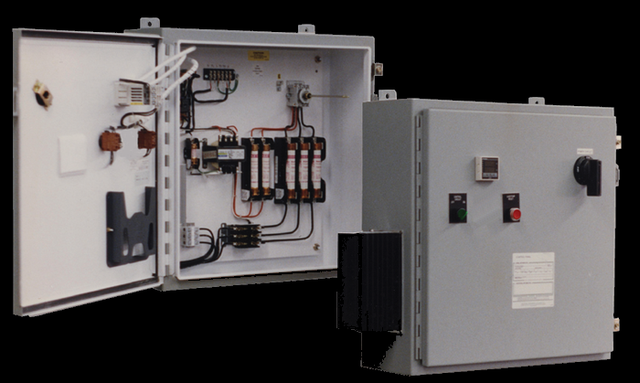
A heater control panel is the pre-engineered, factory-mounted-and-wired electrical assembly that powers, regulates, and protects an electric process heater. It holds the heater to setpoint and trips it safe on a fault — the part of the system that turns a bank of elements into a controlled, code-compliant process. The Aspeq platform spans three control modes — ON/OFF contactor, fully proportional SCR, and Vernier (stepped + SCR trim) — with matched process and over-temperature controllers, sensor inputs, safety interlocks, and enclosures rated from standard indoor through classified hazardous locations. Standard catalog panels ship assembled and tested; custom panels are engineered to the application. Buy the control with the heater so the two arrive as one matched, code-compliant system.
Key Features & Benefits
- Picks up where the heater leaves off — the panel is the brains and the muscle — it reads the process temperature and switches or modulates power to hold setpoint, so the heater you bought actually does its job safely and on-spec. Buy the heater and its matched control as one engineered system, not two parts to reconcile in the field.
- Three control modes, matched to the tolerance you need — a forgiving load runs on simple ON/OFF; a tight setpoint or a heat-sensitive process takes proportional SCR; the Vernier middle ground splits the difference on cost. You pay for the precision the process needs and not for precision it does not.
- Ships pre-wired and tested, or engineered to the job — catalog Quick-Ship panels arrive assembled, wired, and bench-tested for fast, trouble-free installation; when the application is unusual, the same shop builds a custom panel to it. Stock speed when the standard fits, a clean engineered build when it does not.
- Independent over-temperature protection, built in — a separate manual-reset high-limit channel watches the process or sheath temperature apart from the process controller, so a single controller failure cannot run the heater away. The protection your insurer and your inspector expect, wired in at the factory.
- Safety interlocks the heater needs, on one subpanel — flow switches, low-liquid cutoff, pump motor starter, remote shutoff, and alarms land on the panel as ordered options, so the heater is protected against no-flow and dry-fire from day one. The interlocks that keep an electric heater alive, integrated rather than improvised.
- Rated for the room it goes in — indoor, washdown, corrosive, cold-outdoor, and classified hazardous locations each have a matched enclosure and construction. Use the input form to tell us the environment and the panel arrives already suited to it.
Specifications
- What it is
- A factory-mounted and pre-wired electrical assembly — not a heater itself, but the switchgear and controls that drive one. It takes a temperature sensor signal and switches or proportions line power to the heater elements to hold a setpoint, with the disconnect, fusing, contactor, and high-limit safety devices interlocked around it. Standard catalog designs ship pre-assembled and tested; custom-engineered panels are built to the application.
- Control method
- Three control modes, from coarse to precise: ON/OFF contactor (simple, for loads that tolerate cycling), fully proportional SCR (tight, continuous power modulation for precise temperature control), and Vernier — a microprocessor sequencer that steps contactors and uses one SCR controller to fill in the gaps between stages, more accurate than step control and less costly than full SCR. Custom logic from simple ON/OFF up to fully proportional SCR, multi-channel, and ramp/soak with computer interface is available.
- Power / amp rating
- Quick-Ship 873 Series rated to 96 A (one circuit at 48 A, or two circuits at 48 A each). Assembled 870 Series rated to 576 A, in stages of 48 A per circuit up to 12 circuits. SCR power controllers are offered to 50 A (101 Series) and 70 A (M&S Series) per device.
- Voltage / phase
- Standard voltage codes 208 V, 240 V, 480 V, 575 V, and 600 V, single- and three-phase; the M&S power controllers add 120 V and 277 V. A 120 VAC control transformer powers the control circuit. Custom service voltages are built to order.
- Circuits & stages
- Single- or three-phase loads, 1 to 12 circuits on the 870 Series. Multi-stage systems use the electronic step sequencer to stage the circuits in sequence, minimizing load cycling while holding good temperature control.
- SCR power controller
- Solid-state, zero-cross-fired proportional power controllers switch line voltage 0–100% linearly with the input signal. The 101 Series uses a 1-second time base; the M&S Series a 4-second time base and is line-powered (no external control transformer). An LED indicates commanded output, and the output shuts off if the input signal is disconnected or shorted. A master can run alone or drive up to 4 slaves (101) for multiple loads. UL Recognized, file E52105.
- Power contactors
- 50 A definite-purpose magnetic contactors for resistive loads, one per circuit, disconnect the load on the SCR panels and serve as the switching element on the contactor panels. The contactor isolates incoming power from the load for ON/OFF control or as a safety device.
- Step / stage sequencer
- The S10 Series is a 24 VAC microcomputer-based step controller: 10 stages plus a pulsed 12 VDC Vernier stage (rated 100 mA), expandable to 20 stages with two units in master/slave. It switches 24, 120, or 240 VAC loads (relay outputs to 90 VA), supports linear and progressive operation modes, has field-adjustable independent stage on/off delays, and cycles to full OFF if the input leads open, reverse, or short. A 24 VDC, 200 mA supply is available for an external sensor. UL Recognized, file E52105.
- Process temperature controller
- A PID self-tuning process temperature controller holds the setpoint. The Quick-Ship panels offer a digital indicating thermostat (°F, 32–999°F range) or a 1/16 DIN digital process controller (°F or °C, 0–1600°F range); the 870 Series ships with a PID self-tuning controller with a standard Type J thermocouple input.
- Over-temperature (high-limit) control
- A separate over-temperature (high-limit) controller with manual reset breaks the control circuit when the measured process or element-sheath temperature exceeds its setpoint — an independent protective channel from the process controller. Offered as a digital indicating limit control (°F, 32–999°F) or a 1/16 DIN limit controller (°F or °C, 0–1600°F).
- Sensor / signal inputs
- Type J thermocouple standard; Type K thermocouple and RTD inputs optional. The SCR power controllers also accept process-signal inputs — 4–20 mA, 0–10 VDC, and fixed-resistance (2200 Ω / 135 Ω) boards, field-changeable to reconfigure the controller.
- Communications
- A 1/16 DIN digital process controller with RS-485 communications is available where the panel must report to or take setpoints from a plant control system.
- Safety interlocks
- Terminals for a customer-supplied remote interlock are standard. Optional safety packages: control relays driven by a flow switch or remote shutoff, a low-liquid cutoff (relay mounted, probe shipped loose), a pump motor starter, an audible-alarm package (horn, latching relay, silence pushbutton), and additional status indicator lights. Temperature-limiting and low-liquid controls are recommended on every electric-heater panel.
- Enclosure & NEMA rating
- Standard NEMA 4 / 12 painted-steel (870/873 SCR) or NEMA 4X fiberglass (873 contactor) enclosures, with a wiring diagram permanently affixed inside the cover. Options include a stainless-steel NEMA 4X enclosure for corrosive environments, a door-interlocking disconnect switch, a pilot light, and a thermostatically controlled panel heater to prevent condensation in cold outdoor installations (recommended below 32°F ambient).
- Hazardous-area construction
- Panels for classified areas are built per NEC Article 500–516. An explosion-resistant cast-aluminum enclosure is rated Class I, Groups C & D and Class II, Groups E, F & G (NEMA 7, 9); purged enclosures are offered as Type Z for Class I, Division 2 and Type X for Class I, Division 1 areas. Specify the full area classification, Group, and T-code with the order.
- Short-circuit current rating
- Standard short-circuit current rating of 5 kA; a 100 kA interrupting rating is available as a special option. NEC requires a disconnecting means within sight of the heater and power fusing on panels above 48 A.
- Enclosure dimensions
- Quick-Ship enclosures run 16″H × 14″W × 8″D (one circuit) to 24″H × 20″W × 8″D (two circuits). The 870 Series scales by amperage from a 24″ single-circuit panel up to double-door floor-standing enclosures on the largest builds; full dimension and weight tables travel with the quote.
- Agency listings
- UL Listed and/or CSA Approved; components are mounted and wired in compliance with the National Electrical Code. The 101 / M&S / S10 power and step controllers are UL Recognized (file E52105, guide XAPX2). Hazardous-area panels carry the construction and labeling required for their NEC classification.
- Build & lead time
- Custom build-to-order — no published price list, quote-only. Lead times typically run about 3 to 14 weeks depending on configuration, hazardous-area documentation, and code-stamp requirements.
Common Applications
- Controlling immersion, flanged, and circulation process heaters to a setpoint
- Multi-stage duct-heater and process-air control with sequenced stages
- Electric boiler and industrial process-heater control
- Industrial ovens and autoclaves requiring precise, repeatable temperature
- Tight-tolerance or heat-sensitive processes needing fully proportional SCR power
- Heaters in classified areas requiring explosion-resistant or purged panels
Design & Selection Considerations
- Pick the control mode by the tolerance, not by habit — ON/OFF contactor control cycles the load and swings the temperature; SCR holds a tight band but costs more and makes heat at the panel; Vernier is the cost-effective middle for staged loads. Decide the band you actually need before you pick the panel. Over-buying SCR on a forgiving load wastes money; under-buying it on a sensitive process wastes product.
- Size the over-temperature channel as protection, not a backup setpoint — the high-limit controller is an independent safety, not a second process controller — it has its own sensor path and manual reset so a runaway trips and stays tripped until someone checks the heater. Specify it on every electric-heater panel. The high-limit is the line between a tripped breaker and a fire.
- Interlock the panel to proven flow and liquid level — an electric heater energized against no flow or a dry vessel overheats fast; the flow-switch, low-liquid-cutoff, and pump-starter options exist precisely to interlock that. Wire them in — they are not optional on a circulation or immersion system. No-flow and dry-fire are the two field failures these interlocks are built to prevent.
- Match the enclosure to the worst day, including the cold start — a NEMA 4 outdoor panel below freezing wants the thermostatic panel heater to keep electronics above 32°F and off condensation; a corrosive room wants the stainless 4X; a classified area wants the explosion-resistant or purged build. Rate it for the environment, not the average day. Condensation and corrosion kill more panels than load ever does.
- Mind the disconnect and fusing the code requires — the door-interlocking disconnect and power-fusing options exist to satisfy the NEC rules that apply to an electric-heater panel; whether each is mandatory depends on the panel amperage and the heater location. Confirm them at quote time so the install passes inspection. Easy to leave off the spec, expensive to add after the panel ships.
- Confirm the short-circuit current rating against the service — the standard 5 kA SCCR suits many installations, but a stiff service or a long feeder may demand the 100 kA option — the available fault current at the panel decides it. Use the input form to give us the available fault current so the SCCR is right the first time.
- Match the sensor input to the temperature range and accuracy — Type J is the default; Type K reaches higher; an RTD gives finer resolution at lower temperatures. The process and high-limit controllers must read the same family of sensor the heater is fitted for. Spec the sensor with the heater and the panel together, not separately.
To spec the right Indeeco heater control panel:
Use the input form to send the heater’s kW, voltage, and phase, the number of heating stages, the control mode you need (ON/OFF, proportional SCR, or Vernier), the sensor type (Type J / Type K thermocouple or RTD), the required temperature range and precision, the enclosure environment (indoor / washdown / corrosive / cold-outdoor / classified hazardous area with its Class, Division, and Group), the available short-circuit current, and any communications or interlock needs — and we’ll spec the matched Aspeq control panel for your heater.
Electric Heating Application Sheet ›Talk to an engineer directly — Scott Prater, Principal · 917-580-0878 · scott@pratertechnical.com
Specifications compiled by Prater Technical Partners from Aspeq Heating Group product datasheets.