Product Overview
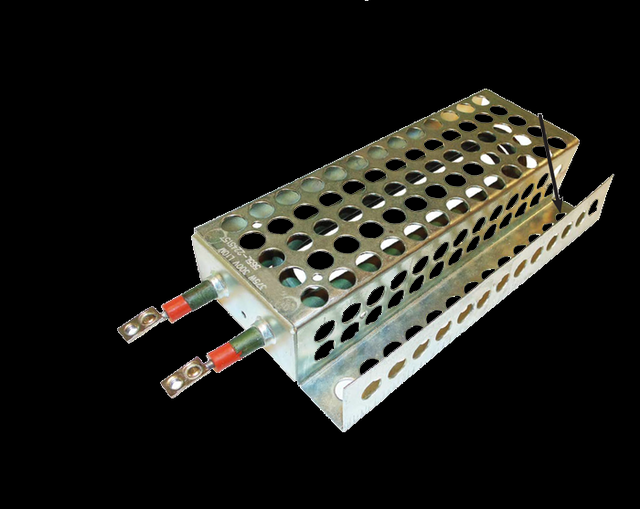
An enclosure (anti-condensation) heater is a small, self-contained convection heater that bolts inside an electrical enclosure or control cabinet and holds the interior a few degrees above ambient — enough to keep relative humidity below the threshold where condensation forms on relays, bus bar, transformers, and circuit boards. A sealed tubular element in a perforated, corrosion-resistant shroud mounts on a pre-punched bracket with no standoffs or special hardware, and a thermostat or humidistat cycles it only when the panel needs drying. Choose it to protect a closed panel from condensation, corrosion, and freezing; for a process air stream or a fluid, the process-air and immersion lines are the answer.
Key Features & Benefits
- Stops condensation before it kills the panel — holding the cabinet a little warmer than ambient keeps the air dry enough that moisture never settles on relays, bus bar, or boards — the corrosion and flashover failures that down a control panel start with condensation. Cheap insurance against the most common cause of enclosure component failure.
- Drops in without drilling or standoffs — it arrives complete with a bracket full of pre-punched holes and mounts horizontally or vertically on existing panel hardware — no standoffs, no insulation, no special mounting. An afternoon retrofit, not a fabrication job.
- Sealed tubular element outlasts seamed heaters — the element is a sealed tube, not a seamed sheet-metal strip, so the magnesium-oxide insulation cannot pull in moisture and fail early. The construction that gives an enclosure heater its long service life.
- Touch-safe and self-protecting — the perforated corrosion-resistant shroud guards against accidental contact while letting air keep circulating, and an optional terminal shield finishes the job — no field-built guard to fabricate. Safe to work around with the panel open.
- One footprint across the wattage range — the same bracket and shroud carry a span of wattages, so a higher-wattage unit drops into the same holes if the load grows — the mounting footprint never changes. Spec once; resize later without re-tooling the panel.
- Off the shelf, not build-to-order — because the catalog ratings are stocked rather than custom-built like the immersion lines, a panel build is not held up waiting on a heater (see Build & lead time). Availability when the schedule is tight.
Specifications
- Operating principle
- Electric resistance (Joule) heating — AC current passes through a nickel-chromium resistance coil in compacted, grade “A” magnesium-oxide insulation inside an alloy / stainless tubular sheath. The element warms the surrounding air by natural convection, raising the enclosure interior a few degrees above ambient; no fan is required.
- What it protects against
- Holds the enclosure interior above the dew point so condensation never forms on relays, bus bar, transformers, and circuit boards. Keeping the interior about 10°F above ambient holds relative humidity below the ∼60% threshold where moisture and atmospheric corrosion begin; it also provides freeze protection and steadies the panel temperature so components are not cycled through condensation.
- Mounting / installation
- Bolts inside the electrical enclosure or control cabinet. The element is supported in a mounting flange so it expands independently of the shroud — no standoffs, insulation, or special hardware are required, and the air circulates freely past it.
- Mounting bracket & holes
- Supplied complete with a corrosion-resistant mounting bracket carrying a multitude of 3/8″-diameter pre-punched holes, so it lands on existing panel hardware without drilling. The same bracket / shield carries a range of wattages — the mounting footprint stays constant as wattage changes.
- Orientation & location
- Mounts horizontally or vertically. For best performance, locate the heater (and its controlling thermostat) near the bottom of the enclosure so convection carries heat up through the cabinet. Keep heat-sensitive components at least 2 inches from the heater.
- Element construction
- Alloy / 304 stainless-steel tubular element, filled with grade “A” magnesium oxide and the highest-quality nickel-chromium resistance wire, sealed at the ends. The sealed tubular element resists the moisture absorption that shortens the life of seamed sheet-metal heaters — the hygroscopic insulation stays dry over the life of the heater.
- Shroud / contact protection
- Perforated, plated-steel (corrosion-resistant) shroud surrounds the element, giving maximum protection from accidental contact while letting air circulate continuously. A terminal shield for touch-safe protection is available.
- Electrical terminals
- Compact (Type 1) styles use #8-32 screw-tab terminals for convenient field wiring; larger (Type 2 / Type 3) styles use #10-32 threaded stud terminals. A special moisture-resistant vulcanized terminal with lead wire is available for damp locations.
- Wattage range
- Standard catalog ratings span roughly 100 W to 500 W depending on model; custom wattages are available. To raise the wattage the element length is increased and formed to fit the existing shroud, so the footprint does not change.
- Voltage
- Standard catalog voltages include 120 V, 125 V, 208 V, 240 V, and 250 V; custom voltages are available. Operate only at the marked rating — excess voltage shortens heater life.
- Temperature rise & sizing
- Size the heater to the temperature rise needed (minimum expected ambient to desired interior temperature) and the enclosure’s exposed surface area; the Indeeco selection chart gives required wattage versus surface area and rise. Double the chart wattage in locations with extreme wind, and account for whether the cabinet is insulated.
- Footprint & sizing
- Compact, low-profile form factor; the mounting footprint stays constant across the wattage range, so a higher-wattage swap drops into the same holes. Catalog dimension tables give the exact length and bracket spacing per rating.
- Thermostat / hygrostat
- A heater should be controlled by a thermostat (or a humidistat / hygrostat) sensing the enclosure interior. The thermostat is available factory-mounted (built-on) or sourced separately and field-mounted; locate the control in a neutral spot that reads an average interior temperature, not the direct heat off the heater.
- Control wiring
- For direct-wired heaters the thermostat is wired in series with the heater. For larger loads a pilot-duty thermostat switches the coil of a contactor that breaks all conductors to the heater. Size the branch-circuit fuses at least 25% above the heater full-load amperage, with a service disconnect and proper grounding per the National Electrical Code.
- Approvals & listings
- Built as a UL Recognized / CSA Listed Component; every unit is dielectric tested as defined in UL 1030 before shipment. Install ground-fault protection as required by local code; the installer is responsible for verifying the suitability of the installation.
- Build & lead time
- Standard catalog wattages and voltages ship from rotating stock in about a week — enclosure heaters are stocked parts, not the custom build-to-order of the immersion lines. Custom wattages, voltages, dimensions, mounting brackets, or a factory-mounted thermostat are built to order on a short lead. No published price list; quote-only.
Common Applications
- Anti-condensation in outdoor and unconditioned control panels, switchgear, and motor-control centers
- Freeze protection and humidity control for instrumentation and PLC enclosures
- Guarding electrical and electronic components against atmospheric corrosion and flashover
- Telecom, utility, and remote-site cabinets exposed to wide ambient temperature swings
- Steadying the interior temperature of unconditioned panels in damp or outdoor environments
- Switchgear space heating in electrical and mechanical equipment enclosures
Design & Selection Considerations
- Size to the temperature rise and surface area — do not guess — required wattage scales with the enclosure’s exposed surface area and the rise you need from the coldest expected ambient; under-size it and the panel still dews over on the worst night. Use the selection chart, and tell us the cabinet size, the minimum ambient, and whether it is insulated. The coldest night, not the average, sets the wattage.
- Outdoor and windy locations need extra wattage — wind strips heat off an exposed cabinet, so the selection chart calls for doubling the wattage in extreme-wind locations — an outdoor enclosure with wide ambient swings is the most demanding case. An indoor sizing on an outdoor cabinet is the classic under-spec.
- Place the thermostat to read the room, not the heater — mount the heater and its control near the bottom of the enclosure, but keep the thermostat far enough from the element that it senses average interior temperature rather than direct heat — a sensor in the hot plume short-cycles and leaves the rest of the cabinet cold. Where you put the sensor matters as much as the wattage.
- Keep heat-sensitive parts clear of the element — the sheath runs hot in service, so keep heat-sensitive components at least two inches away and never crowd wiring against it. A burn risk to the hand and to nearby plastics if it is buried in the panel.
- Control with a thermostat or hygrostat — do not run it raw — a heater wired straight to power runs continuously and wastes energy (and can overheat a small sealed cabinet); a thermostat or humidistat cycles it only when the panel actually needs drying. The control is what makes it efficient, not just the element.
- Megger and bake out after long storage — the magnesium-oxide insulation is hygroscopic, so a unit off the shelf can read low insulation resistance. Megger it with a 500 VDC meter; if it reads under 1 megohm, bake it out (or energize at reduced voltage) before putting it in service. A “bad” new heater is usually just damp MgO.
- Fuse and ground it like any branch circuit — give the heater a service disconnect, branch-circuit overcurrent protection (sized per the spec table), and a solid ground on both the panel and the heater — and add ground-fault protection where local code requires it. Standard NEC practice; easy to skip on a small accessory load.
To size the right Indeeco enclosure heater:
Use the input form to send your enclosure dimensions (and whether it is insulated, indoor or outdoor), the minimum expected ambient and the interior temperature you need to hold, the voltage available, any wattage you already have in mind, the mounting orientation and space, and whether you want a built-on thermostat or humidistat — and we’ll size the right Aspeq enclosure heater and control for the panel.
Electric Heating Application Sheet ›Talk to an engineer directly — Scott Prater, Principal · 917-580-0878 · scott@pratertechnical.com
Specifications compiled by Prater Technical Partners from Aspeq Heating Group product datasheets.