Product Overview
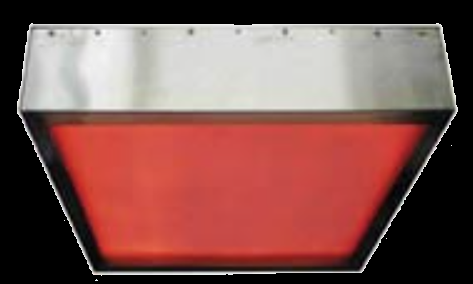
A legacy panel retrofit replaces aged, failed, or obsolete infrared panels in an existing oven bank with new built-to-order Solar Products panels. Because the panels are built to drawing, a replacement can match the dimensions, wattage, wavelength, and mounting of the panels it replaces — so it drops into the existing fixture and controls without rebuilding the oven. It is also the moment to re-tune: if the original panels were the wrong wavelength or watt density for the substrate, or the material or process has changed, the replacement can be re-specified to fix it. Use the input form to send the existing panel dimensions, wattage, and mounting (and the substrate and process if you want it re-optimized), and we match or improve on it.
Key Features & Benefits
- Drops into the existing fixture and controls — because the panel is built to drawing, the replacement matches the dimensions, wattage, wavelength, and mounting of the panel it replaces — no rebuilding the oven or re-engineering the controls. A true drop-in, not a redesign.
- Matches obsolete panels you can no longer source — an aged or discontinued panel can be reproduced to its dimensions and ratings, so a single failed heater in a working bank does not force replacing the whole oven. Keep a good oven running past its panels’ availability.
- A chance to fix what was wrong the first time — if the originals were the wrong wavelength or watt density for the substrate — or the material has since changed — the replacement can be re-specified to the current process instead of copying a compromise. Replace and re-optimize in one step.
- Any of the seven faces, to the original or a better spec — the replacement can keep the original quartz-composite, opaque-quartz, quartz-tube, metal, glass, or stamped-element face, or move to a face better matched to the material. Match it, or improve it.
- Built by the IR-OEM specialist behind custom panels — the same Solar Products build process that produces engineered OEM panels reproduces the legacy ones, with (per the manufacturer) over 60 years of infrared experience behind it. Replacement panels held to the same build standard as new designs.
Specifications
- Operating principle
- Electric radiant heating — a panel with an electrically heated emitter face radiates infrared energy directly onto the product or web, rather than warming the surrounding air the way a convection heater does. Because the energy lands on the surface, the part absorbs it directly while the surrounding air stays comparatively cool.
- Infrared band / wavelength
- Medium-wave infrared. Infrared energy is emitted across a spread of wavelengths set by the emitter temperature; the medium-wave band is well matched to the surface absorption of many plastics, coatings, paints, and organic materials, so the energy is converted to heat at the surface rather than passing through or reflecting away.
- Emitter / face construction
- Built to order in the Solar Products panel series, each face tuned to a different combination of wavelength, watt density, and response time: F and FBA — quartz-composite face (FBA is the F face drilled for forced-air through-flow); Q — opaque fused-quartz face for fast response; T — quartz tubes; M — metal face (hardcoat-anodized aluminum or porcelain steel); G — high-temperature black glass (neoceram glass-ceramic) face; V — stamped-element medium-wave panel. The face is chosen from the substrate, process temperature, and response the application needs.
- Response & control behavior
- Radiant panels respond quickly — turn the panel down and the radiant output drops almost immediately — which makes them well suited to proportional control. The opaque-quartz Q face is the fast-response option for processes such as paint and powder curing.
- Panel geometry & sizing
- Built to drawing — panel dimensions, footprint, and emitter layout are specified per job to match the oven zone or fixture. Parallelogram modules are available for zoning radiant heat across wide webs. Panel depth runs from 1¼″ to 6″ (3″ typical), set by the available space and the required back-temperature. Published fixed plan dimensions are not specified; the panel is sized to the application.
- Mounting / installation
- Configured to the fixture: ¼-20 mounting studs, stainless-steel housing or no housing (heater board only), with wire-lead or junction-box termination. Mounting and standoff are set so the radiant output reaches the workpiece at the intended distance.
- Watt density
- Watt density (watts per square inch of panel face) is matched to the substrate and the required heat-up — high enough to raise the product to temperature at the line speed, low enough that the substrate is not scorched. It is the governing selection factor and is set per application; a published fixed value is not specified.
- Wavelength / material matching
- The emitter face and wavelength are matched to the target material’s absorption: the right wavelength is absorbed at the surface and converted to heat efficiently, while the wrong wavelength wastes energy heating the air or the oven instead of the part. Solar Products specifies the series from the substrate, process temperature, and line speed.
- Voltage
- Voltages to 600 V, configured to the available service.
- Zone control
- Integrated control is available: an SCR power controller proportioning each zone continuously, a PID temperature loop reading panel or product temperature, and multiple independently controlled zones so the heat profile can be tuned across the oven width and length.
- Configurable options
- Solar Products is a custom IR-OEM & retrofit manufacturer, so the panel is built to the application. The documented configurable options are listed below.
Configurable Options on a Built-to-Order Solar Products Panel
| Option | What it does |
|---|---|
| Custom SCR / PID zone controls | Proportional SCR power control with PID temperature loops, tuned to the process |
| Back-mounted fans | Pre-mounted forced-air fans behind the heater (the FBA face is drilled for through-flow) |
| Multi-zone heaters | Multiple independently controlled zones across the oven width and length |
| Pyrometer view port | A port through the heater for a non-contact pyrometer to read product temperature |
| Replaceable Type-K thermocouple | Field-replaceable Type-K thermocouple for panel or process temperature feedback |
| Cool-down / drying air holes | Air holes through the face for fast cool-down or drying-air scrubbing |
| Option | What it does |
|---|---|
| Parallelogram modules | Parallelogram-shaped modules for zoning radiant heat across wide webs |
| Housing options | Stainless-steel housing, or no housing (heater board only) |
| Termination | Wire leads or an electrical junction box |
| Mounting | ¼-20 mounting studs |
| Voltage | Voltages to 600 V |
- Approvals & listings
- Solar Products is the Aspeq Infrared Division and, per the manufacturer, the largest manufacturer of custom infrared electric heaters for the OEM market, with over 60 years of infrared-heating experience. Panels are built to your drawing and integrated into OEM machinery and production lines. Panel radiant efficiency has been independently verified by Hydro-Québec’s LTEE certified test lab.
- Build & lead time
- Custom build-to-order — no published price list, quote-only. Lead times typically run about 3 to 14 weeks depending on configuration. The more complete the data up front (substrate, process temperature, line speed, oven dimensions, voltage), the faster and tighter the quote.
Common Applications
- Replacing aged or failed panels in a thermoforming oven bank
- Reproducing obsolete panels in a paint, powder, or e-coat curing oven
- Restoring screen-printing curing and drying systems
- Re-paneling glass tempering furnace banks
- Updating semiconductor and electronics process-heating panels
- Re-specifying panels to a changed substrate or process
Design & Selection Considerations
- Capture the original spec before you order — a faithful drop-in needs the existing panel dimensions, wattage, wavelength / face type, voltage, and mounting; the closer that data is, the cleaner the fit into the existing fixture and controls. Measure the old panel fully — a partial spec means a partial fit.
- Decide: match exactly, or re-optimize — an exact match is the fastest drop-in; but if the panels failed early or never quite performed, the substrate and process should be reviewed so the replacement corrects the wavelength or watt density rather than copying the problem. A retrofit is the cheapest time to fix a mis-spec.
- Ask why the originals failed — panels that fail early are usually being run above their rating, are the wrong construction for the process, or are taking overspray and contamination on the face. Identifying the cause guides whether to match or re-specify. A like-for-like replacement of a mis-applied panel just fails again.
- Check the surviving panels and the controls — replacing one panel in an aged bank can expose mismatched output if the neighbors are degraded, and old controls may not suit a re-specified panel. Look at the whole zone, not just the dead panel. The replacement has to live with what is around it.
- Mind watt density and standoff in the existing fixture — a re-specified face may want a different watt density or standoff than the fixture was built for; confirm the new panel suits the existing mounting and reflector geometry before committing. The fixture constrains the redesign — account for it.
To match or re-spec a legacy Solar Products IR panel:
Use the input form to send the existing panel dimensions, wattage, wavelength / face type, voltage, and mounting — and the substrate, process temperature, and line speed if you want it re-optimized rather than matched exactly — and we’ll reproduce or improve on the panel so it drops into your existing oven and controls.
Electric Heating Application Sheet ›Talk to an engineer directly — Scott Prater, Principal · 917-580-0878 · scott@pratertechnical.com
Specifications compiled by Prater Technical Partners from Aspeq Heating Group published product literature.