Product Overview
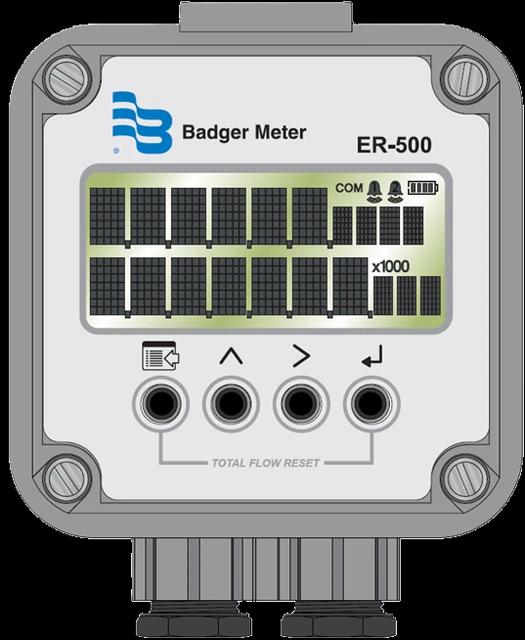
The ER-500 is the Industrial Oval Gear line’s compact flow monitor — rate and total on a dot-matrix display, a 4–20 mA output and a totalizing pulse, in a NEMA 4X / IP66 enclosure that mounts on the sensor, a pipe or DIN-rail and is rated for Class I, Division 1 areas. The standard ER-500S covers indication and totalizing; the advanced ER-500A adds two programmable control alarms and Modbus RTU over RS-485 (up to 127 units, reading rate, totals, alarm status and battery level). It reads 1 to 3,500 Hz at 0.05% with multi-point linearization on both models, and runs up to six years on a 3.6 V lithium D-cell, switching automatically to 4–20 mA loop power when the loop is live — so a remote point with no local power still logs and alarms. It is the right register when the meter has to do more than show a number: warn on flow, totalize for batches, and report on a network.
Key Features & Benefits
- Rate, total, alarm and Modbus in one box — the advanced ER-500A rolls the display, the analog signal, the totalizing pulse, the alarms and the fieldbus into one register — a complete monitoring point at the meter
- Runs for years on a battery — a 3.6 V lithium D-cell powers it for up to six years, and it switches automatically to loop power when the loop is live
- 0.05% reading with multi-point linearization — the counter holds 0.05% accuracy, and multi-point linearization tables on both models trim the reading across the flow range for batch and dispense totalizing
- Alarms that warn early — two programmable flow-rate alarms with adjustable dead band and phase flag a process change before it becomes a problem
- Fieldbus without a separate transmitter — Modbus RTU over RS-485 puts up to 127 units on one 2-wire network, reading rate, totals and battery level
- Rated for Class I, Division 1 — the ER-500 is rated for installation in Class I, Division 1 hazardous areas (UL 913 / CSA), so it can monitor flammable petroleum and chemical lines at the meter
- Weatherproof at the meter — the NEMA 4X / IP66 enclosure mounts directly on the sensor, on a pipe or on DIN-rail, indoors or out
Specifications
- Function
- A compact flow monitor and totalizer for the oval-gear meter — rate and total on a local display, a 4–20 mA output and a totalizing pulse, with control alarms and Modbus RTU on the advanced model; rated for Class I, Division 1 areas in a NEMA 4X enclosure, mounts on the sensor, a pipe or DIN-rail
- Models
- ER-500S (standard) — 4–20 mA and totalizing pulse; ER-500A (advanced) adds two control alarms and Modbus RTU over RS-485
- Signal input
- Magnetic-pickup or amplified-pulse frequency input, range 1 to 3,500 Hz, frequency accuracy ±0.1%, over-voltage protection 28 V DC; multi-point linearization tables supported on both models
- Accuracy / repeatability
- 0.05%
- Analog output
- 4–20 mA, two-wire current loop, 25 mA limit
- Pulse output
- Totalizing pulse — optoisolated open-collector transistor or non-isolated open-drain FET
- Status alarms
- Two status alarms (ER-500A) — open-collector transistor, adjustable flow rate with programmable dead band and phase
- Communication
- Modbus RTU over RS-485 (ER-500A): 127 addressable units on a 2-wire network, 9,600 baud, long-integer and IEEE 754 single-precision; reads flow rate, job totalizer, grand totalizer, alarm status and battery level; writes job- and grand-totalizer resets
- Display
- Dot-matrix STN LCD showing flow rate and total simultaneously — 6-digit rate, 7-digit total, with alarm, battery-level and RS-485 (COM) annunciators
- Power / battery
- 3.6 V DC lithium “D-cell” giving up to 6 years of service, or 4–20 mA two-wire loop power, with automatic switching between internal battery and external loop power and isolation between loop power and the other I/O
- Enclosure
- NEMA 4X / IP66; mounts on the flow sensor, on a pipe or on DIN-rail
- Operating temperature
- −22 to 158°F (−30 to 70°C); 0–90% humidity, non-condensing
Common Applications
- Local rate and total with a 4–20 mA output at the meter
- Low- or high-flow alarm contacts on a dispensing or transfer line (ER-500A)
- Modbus RTU reporting of rate, totals and battery onto an RS-485 network (ER-500A)
- Battery-powered totalizing at an unwired remote point
- Flow monitoring on flammable petroleum and chemical lines in a Class I, Division 1 area
- Outdoor metering points needing a NEMA 4X enclosure
Design & Selection Considerations
- Standard or advanced — do you need alarms and Modbus? — the ER-500S gives local display, 4–20 mA and a totalizing pulse; the ER-500A adds the alarm contacts and the RS-485 fieldbus. If the point only has to indicate and totalize, the S is enough; if it has to alarm or report on a network, the A is the one. Use the input form to tell us whether you need alarms or a fieldbus and we’ll pick the S or the A.
- Battery or loop power — a stand-alone point with no wiring runs on the lithium cell alone; a point on a live current loop draws loop power and the cell becomes the backup that holds the reading and settings through an outage. The unit arbitrates the two automatically, so the only decision is whether a loop reaches the monitor. Use the input form to tell us whether a 4–20 mA loop or local power reaches the monitor.
- Set the alarms to the process, not the meter — each alarm has an adjustable setpoint with programmable dead band and phase, so a noisy or pulsating line does not chatter the contact. Use the input form to give us the trip flow and the acceptable swing and we’ll set the dead band.
- Classified-area install needs the barrier, not just the rating — the ER-500 is rated for Class I, Division 1 (Groups C, D), Class II, Division 1 (Groups E, F, G) and Class III, but intrinsic safety is a system: the loop, pulse, reset and RS-485 connections each have entity parameters that the field barrier and wiring on your side must satisfy. Use the input form to tell us the area classification and the connections in use and we’ll confirm the entity parameters and the documentation.
To size & select the right ER-500 flow monitor:
Use the input form to tell us the meter it mounts on, the signal you need — a local display, a scaled pulse, a 4–20 mA loop, HART 7.0, Modbus RTU, an alarm contact or batch control — the power source and the area classification, and we’ll match the register or sensor to it.
Flow Meter Application Sheet ›Talk to an engineer directly — Scott Prater, Principal · 917-580-0878 · scott@pratertechnical.com
Specifications compiled by Prater Technical Partners from Badger Meter Industrial Oval Gear positive-displacement meter product literature.