Product Overview
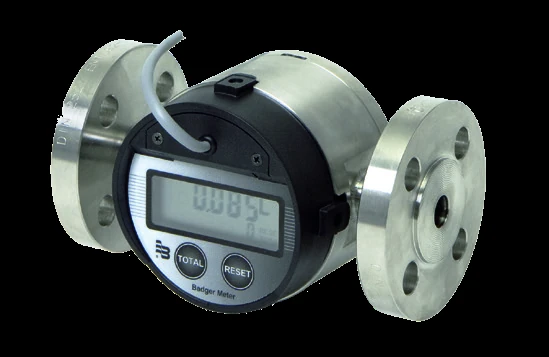
The 316L stainless Industrial Oval Gear meter is the workhorse of the line — a positive-displacement meter whose paired oval rotors sweep a fixed volume per revolution, so it reads actual volume directly and holds ±0.5% of reading on fluids above 5 cP with ±0.03% repeatability, unaffected by viscosity shifts or pulsating flow and needing no straight run. The 316L body, cover and spindle give it the widest fluid compatibility and the highest pressure rating of the three bodies — 3,000 psi in the 1/2 to 1 in. sizes — and it spans 1/8 to 3 in. (0.0044 to 185 gpm) in NPT, BSP, ANSI and DIN flange and sanitary Tri-Clamp. Rotors come in 316L stainless, Ryton or Vectra and seals in Viton, Aflas, Kalrez or EPDM, so the wetted path is matched to the fluid; standard rotors handle 1,000 mPas and the high-viscosity option reaches 500,000 mPas. Top it with the local ILR display, the ER-420 4–20 mA counter, the ER-500 monitor or an F-series register, with intrinsically safe sensors for classified areas.
Key Features & Benefits
- Widest fluid compatibility of the line — the 316L wetted parts resist corrosion and handle the broadest range of chemicals, fuels and lubricants — the default choice when the fluid is unknown or aggressive
- Reading holds as the fluid thickens or thins — a meter calibrated on one oil stays accurate as temperature moves the viscosity — the measurement does not drift with density the way a turbine does
- Highest-pressure body in the line — the natural pick for high-head dispensing and chemical-injection skids that run well above what the aluminum or plastic bodies allow
- Clean-in-place and sanitary ready — Tri-Clamp connections and food-industry documentation suit hygienic and high-purity service that the metal-only bodies cannot certify
- One meter, many fluids — rotor and seal options let a single stainless body serve duties that would each otherwise demand a different instrument
- Drops into compact skids — it needs no upstream straight pipe, so it fits dosing and batching packages where a velocity meter would not have room to read true
Specifications
- Measurement principle
- Positive displacement — paired oval rotors mesh in the metering chamber and sweep a fixed volume of fluid per revolution; magnets on the rotor ends trip a sensor in the register, so the rotation count is a true volume measurement, not an inference from velocity
- Service / fluids
- The industrial workhorse body — 316L stainless for the widest fluid compatibility and corrosion resistance: lubricants, fuels, chemicals, additives, resins, coatings, inks and coolants, including higher-purity and food / sanitary service on stainless with stainless rotors
- Accuracy
- ±0.5% of reading on fluids above 5 cP in the 1/2 in. and larger sizes; ±1.0–1.5% on the 1/8 and 1/4 in. meters
- Repeatability
- ±0.03%
- Flow range
- 0.0044 to 185 US GPM (0.017 to 700 l/min) across the size range, including a 1/4 in. low-flow body and a 1 in. high-flow body
- Sizes
- 1/8, 1/4 (and 1/4 low-flow), 1/2, 3/4, 1, 1 high-flow, 1-1/2, 2 and 3 in.
- Viscosity
- To 1,000 mPas with standard rotors; to 500,000 mPas with the high-viscosity (HV) modified rotors
- Body material
- 316L stainless steel (housing and cover)
- Rotor materials
- 316L stainless, Ryton (PPS) or Vectra (LCP), selected to the fluid
- Spindle / bearings
- 316L stainless spindle; graphite or PPS bearings
- O-rings / seals
- Viton, Aflas, Kalrez or EPDM o-rings, matched to the fluid
- Process / fluid temperature
- −22 to 240°F (−30 to 120°C); PPS / LCP plastic rotors are rated to 176°F (80°C)
- Pressure rating
- 3,000 psi (210 bar) NPT / BSP in the 1/2 to 1 in. sizes; 720 / 580 / 360 psi at 1-1/2 / 2 / 3 in.; 1,450 psi (100 bar) at 1/8 and 1/4 in. Flanged ports derate — ANSI 300# 790 psi, ANSI 150# 275 psi, DIN / Tri-Clamp 230 psi (in the 1/2 to 1 in. sizes). Higher ratings on request
- Process connections
- NPT, BSP, ANSI 150# or 300# flange, DIN flange (EN 1092-1) and sanitary Tri-Clamp
- Registers / outputs
- Meter-mounted ILR-700 / 701 / 750 local display (pulse and 4–20 mA on the 750), the ER-420 4–20 mA counter, the ER-500 flow monitor, or the advanced F-series; NAMUR / PNP / NPN / reed / Hall sensor boards for raw pulse
- Hazardous-area sensors
- Intrinsically safe NPN / PNP open-collector and NAMUR sensors — Class I, II and III, Division 1 (Groups A–G) in the USA (Class I, Division 1, Groups A–D in Canada), with ATEX and IECEx Ex ia IIC approvals
- Options
- High-viscosity (HV) rotors; 5-point calibration report; linearization with 5-point report (ILR-750 / ILR-701); 3.1 material certificate; food-industry documentation; silicone-free build; meter serialization
- Certifications / documentation
- EN 10204 3.1 material certificate for pressurized parts (stainless housings); 5-point calibration report; food-industry documentation — each a documented option specified at time of order
- Calibration
- Factory-calibrated and field-recalibratable through the electronic register; 5-point calibration report available as a documented option to be specified at time of order
Common Applications
- Batching and totalizing chemicals, additives, resins, coatings and inks on stainless wetted parts
- Lubricant, fuel and oil dispensing where corrosion resistance or high pressure rules
- Food, beverage and sanitary metering on stainless body with stainless rotors and Tri-Clamp
- Chemical-injection and dosing skids in oil & gas and water treatment
- Pharmaceutical and high-purity dosing on sanitary connections
Design & Selection Considerations
- Chemistry and pressure set the body — the body alloy is the first decision and it is fluid-driven: 316L stainless is the industrial workhorse, the highest-pressure body with the widest fluid compatibility; 6061 aluminum is the lighter, lower-cost body for petroleum, lubricants and fuel where the fluid is aluminum-compatible; and Kynar (PVDF) is the all-plastic body (Hastelloy-C spindle) for acids, caustics and solvents that attack metal. Pressure capability follows the body alloy, and it also falls as the size grows and as you move from threaded to flanged ports, so the alloy and the connection are decided together. Use the input form to give us the fluid and the working pressure together and we’ll set the body and the connection.
- Viscosity sets the rotor; chemistry sets the wetted stack — standard rotors handle fluids to 1,000 mPas; for greases, heavy oils, polymers and adhesives the high-viscosity (HV) modified rotors run to 500,000 mPas — an order option on the same body, not a separate model. Within the meter the rotor and o-ring materials are matched to the fluid, so the whole wetted path is spec’d to service. Use the input form to tell us the fluid and its viscosity at operating temperature and we’ll specify standard or HV rotors with the right seals.
- It is a positive-displacement meter — no straight run, any orientation — because the measurement is mechanical displacement rather than velocity, the meter needs no upstream straight pipe run or flow conditioning, reads true in any orientation and in tight pipework, and is unaffected by viscosity shifts and pulsating flow. That is the opposite of a turbine or paddlewheel, whose reading moves with the flow profile. It is the meter for accurate batching and totalizing where a velocity meter would need pipe it does not have.
- Keep the fluid reasonably clean — the oval rotors mesh on close tolerances, so abrasive grit and hard particulate are the wear enemy — a strainer ahead of the meter protects the gears on debris-prone fluids, and the meter is not the right choice for abrasive slurries. Use the input form to tell us the fluid’s cleanliness and we’ll advise on upstream filtration.
- Size to the flow, not the pipe — each port size covers its own flow band, with a dedicated low-flow body at the bottom of the range and a high-flow body at the top, and the meter reads its tightest accuracy class in the larger sizes on fluids above 5 cP — so the right size is the one that runs mid-band at your normal flow, not the one that matches the line. Use the input form to send the normal and maximum flow and we’ll pick the size that reads mid-band at your pressure.
- Pick the register for what the reading has to do — the meter mounts a register or sensor on top, and the choice follows the host: a local display at the meter (ILR family), a remote analog counter (ER-420), a monitor with alarms and a fieldbus (ER-500), or the advanced F-series for HART, RS-485 or batch control — with intrinsically safe sensors where the area is classified. Use the input form to tell us the output, protocol, power and area classification and we’ll configure the register into the part number.
To size & select the right Stainless 316L oval-gear meter:
Use the input form to send your fluid, its viscosity at operating temperature, the normal and maximum flow, the line size and the working pressure — with any corrosion or hazardous-area requirement — and we’ll spec the body alloy, rotors, seals, connection and the ILR, ER or F-series register for your application.
Flow Meter Application Sheet ›Talk to an engineer directly — Scott Prater, Principal · 917-580-0878 · scott@pratertechnical.com
Specifications compiled by Prater Technical Partners from Badger Meter Industrial Oval Gear positive-displacement meter product literature.