Product Overview
The WIKA-ST XPIL is the low-range member of the XP transducer platform: full-scale spans from 0–0.5 to 0–20 psi on an all-stainless body, for sub-20-psi measurements a general-industrial transmitter can only read as noise near the bottom of its scale. It comes in three output nameplates on one platform — the XPIL-1A 4–20 mA transmitter, the XPIL-1U mV/V transducer (with a ±0.10% FSO high-accuracy class and a wider −100 to +325°F range), and the XPIL-1V 0–5 V transducer with zero and span pots. Gauge or absolute reference, 1/4-NPT or 7/16-20 ports, 150% proof and 300% burst. Have a legacy tecsis part number for this measurement? Send it — WIKA acquired tecsis and now ships these under WIKA Sensor Technology, and we cross-reference the tecsis p/n to the current WIKA-ST equivalent at the same spec.
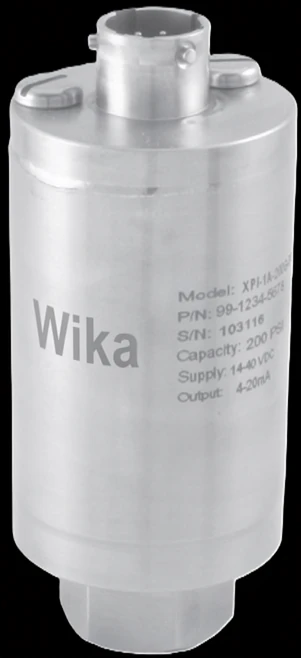
One low-range platform, three output nameplates
All three share the all-stainless body, the 0–0.5 to 0–20 psi range family, the PTIH-10-6P connector, the PA–PD port options, and 150% proof / 300% burst — the nameplate picks the output and, on the 1U, the accuracy class and temperature range.
- 4–20 mA output, 4 mA ±5% adjustable zero
- 14–40 VDC supply, ±0.15% FSO linearity
- zero & span adjustment covers
- 2 mV/V (3 mV/V optional, -H); 10 V AC-DC excitation
- ±0.10% FSO high-accuracy or ±0.25% standard class
- wider −100 to +325°F range; 17-4 PH stainless; internal shunt cal
- 0–5 VDC ±10% adjustable output; 11–28 VDC supply
- ±0.15% FSO linearity; zero & span pots
- optional shunt calibration (suffix -SC)
Key Features & Benefits
- Resolution where a wide-range sensor has none — a low-range full scale puts the whole signal span across the pressure you actually run — sub-20-psi clean-air, sterilizer, and low-head liquid work that a wide-range transmitter reads as noise near zero. Measure a small pressure like it matters.
- Pick the output without changing the footprint — the same low-range body ships as a 4–20 mA transmitter for a long PLC run, a raw mV/V bridge for a conditioner or DAQ, or an amplified 0–5 V — the mechanical envelope, ports, and connector stay put. Match the receiver, not the other way around.
- A high-accuracy class when the low reading has to be trusted — the mV/V 1U reaches ±0.10% FSO linearity with the thermal coefficients cut in half — on a 0.5-psi span, where temperature and non-linearity are first-order errors, that margin is the difference between a usable number and a guess. Small span, honest number.
Specifications
- Sensing principle
- Bonded strain-gauge sensing on an all-stainless body, tuned for low full-scale spans — the range where a general-industrial transmitter measures at the very bottom of its scale and has no resolution left. One platform, three output nameplates (4–20 mA, mV/V, 0–5 V).
- Pressure type
- Gauge (psig) standard; absolute (psia) optional — on the 1A and 1V above 5 psia, on the 1U above 15 psia.
- Measuring range
- 0–0.5 to 0–20 psi — the mV/V (1U) and 0–5 V (1V) transducers go down to 0.5 psi full scale; the 4–20 mA transmitter (1A) starts at 0–1 psi. Sub-1-psi mV/V units output 1 mV/V minimum.
- Accuracy
- Linearity ±0.15% FSO on the 1A and 1V; the mV/V 1U is offered in two classes — ±0.10% FSO high-accuracy or ±0.25% FSO standard. Hysteresis ±0.05% FSO and repeatability ±0.05% FSO across all three.
- Thermal effects
- On the 1A and 1V, ±0.005% FSO/°F on zero and ±0.005% reading/°F on span. The high-accuracy 1U halves that to ±0.0025% on each (±0.005% in the standard class).
- Output signal
- XPIL-1A: 4–20 mA, 4 mA ±5% adjustable zero. XPIL-1U: 2 mV/V ±0.25% (3 mV/V optional, suffix -H); input resistance 360 Ω min, output 350 ±5 Ω. XPIL-1V: 0–5 VDC ±10% adjustable, with zero and span pots.
- Excitation / supply
- 1A: 14–40 VDC. 1U: 10 V AC-DC (15 V max). 1V: 11–28 VDC.
- Electrical connection
- Bendix PTIH-10-6P (or equal) 6-pin connector; various electrical connections optional. The 1V carries optional shunt calibration on two pins (suffix -SC); the 1U offers internal shunt calibration.
- Wetted parts material
- Stainless steel wetted parts — 17-4 PH on the mV/V 1U; all-stainless construction; various wetted-parts materials optional.
- Process connection
- 1/4-NPT female (PA) or male (PB); 7/16-20 female (PC, per MS33649-04) or male (PD, per MS33656-04); various pressure ports optional.
- Overpressure / proof
- Proof pressure 150% of rated.
- Burst pressure
- 300% of rated.
- Operating temperature
- 1A and 1V: −50 to +250°F (−46 to +121°C). 1U: a wider −100 to +325°F (−73 to +163°C).
- Compensated temperature
- +60 to +160°F (+15 to +71°C) on all three.
- Approvals & certification
- Options: improved accuracy, internal shunt calibration, various electrical connections and pressure ports, various wetted-parts materials. Also available in metric units.
- Configuration & lead time
- Configured per the low range, the output, the reference (gauge / absolute), and the port. Quote-only, no public price list.
Common Applications
- Clean, dry low-pressure gas and instrument-air monitoring under 20 psi
- Sterilizer, autoclave, and ventilator-circuit pressure
- Low-head liquid level and tank pressure
- Filter-housing and blower / fan pressure at low spans
Design & Selection Considerations
- On a low span, temperature is a first-order error — a ±0.005% FSO/°F drift is small on a 1,000-psi sensor and large on a 0.5-psi one, because the percentage rides the same full scale either way. Keep the install inside the +60 to +160°F compensated band, or step up to the high-accuracy 1U (coefficients halved) and budget the rest. The error that dominates a low-range reading is the one that looks negligible on the datasheet.
- The 4-20 mA build does not go as low as the transducers — the mV/V and 0–5 V nameplates reach the bottom of the range family; the current-loop transmitter stops one step up (and sub-1-psi mV/V units put out 1 mV/V minimum). If the measurement is below a psi and the receiver needs a current loop, plan on a raw-output unit plus a conditioner rather than the 1A. Choose the output after you know how low the span really goes.
- FSO accuracy is a percentage of the range, not the reading — a ±0.25% FSO transducer rated for the full scale can be off by that fraction of full scale anywhere in its range — a larger relative error down at the low end. Size so the working pressure lands in the upper part of the range, and when you compare two sensors make sure both quote accuracy the same way. An oversized range quietly throws away resolution at the pressure you actually run.
- Respect the overpressure limit — the danger zone is below burst — proof / safe-overpressure is the pressure the sensor can see without losing calibration; burst is where it is destroyed. A unit driven past proof but short of burst keeps reporting plausible, wrong numbers. Size for the real worst case — including transients — and recalibrate after any suspected overpressure event. A spike that shifts calibration leaves no visible mark; the reading just drifts.
- Match the wetted material to the medium — the wetted parts see the process chemistry directly; the standard stainless suits most service, but corrosive, high-purity, or sour media want the right alloy specified up front. Use the input form to tell us the medium and we pick the wetted material to it. The wrong wetted alloy fails slowly and silently, not all at once.
To spec the right WIKA-ST low-pressure transducer:
To size and select the right transducer, send us: the pressure range and whether it is gauge, absolute, sealed, or differential; for a differential measurement, the maximum line (static) pressure as well as the differential range; the accuracy class you need (standard industrial vs. high-accuracy); the output the receiving device expects (4–20 mA, 0–5 V, 0–10 V, or raw mV/V) and the cable run; the process medium and temperature (so the wetted material and any extended temperature compensation are right); the process connection and electrical termination; and any area classification or agency approval (Ex / intrinsic safety, CSA, FM) and NACE / sour-service material requirement. For a fast transient, give us the rise time or frequency of the event so the natural frequency is sized above it.
Force & Pressure Application Sheet ›Talk to an engineer directly — Scott Prater, Principal · 917-580-0878 · scott@pratertechnical.com
Specifications compiled by Prater Technical Partners from WIKA product datasheets.