Product Overview
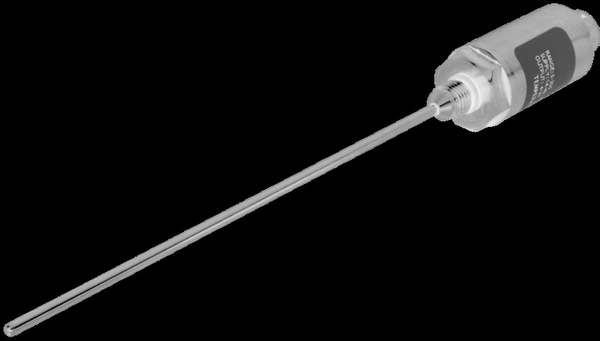
The WIKA-ST Model XRT measures temperature inside a pressurized fluid line: a hermetically sealed 17-4 PH stainless probe-and-amplifier assembly rated for a 3,000-psi-minimum line, reading a customer-specified range up to 350°F at 1.8°F (±0.1% FSO) on a 4–20 mA loop. Paired with the Model 1502 hammer-union transmitter it instruments pressure and temperature on the same well-service line from one supplier. Have a legacy tecsis part number for this measurement? Send it — WIKA acquired tecsis and now ships these under WIKA Sensor Technology, and we cross-reference the tecsis p/n to the current WIKA-ST equivalent at the same spec.
Key Features & Benefits
- Temperature from inside the pressurized line — the probe lives in the flow, behind a body rated for a 3,000-psi-minimum line, so the reading is the fluid’s temperature and not the pipe skin’s. An immersion measurement without a thermowell project.
- Probe length by ordering code — probe lengths run 0.25 to 6.0 inches so the tip lands in the flow stream of your line size — short for a manifold block, long for a full-bore line. Pick the immersion, not just the range.
- A companion to the pressure transmitter — the same MS-style process connection and Bendix termination as the wellsite pressure transmitters, so pressure and temperature instrument one line as a matched pair. Two measurements, one hardware standard.
Specifications
- Sensing principle
- Temperature measurement inside a pressurized fluid line — a hermetically sealed stainless probe-and-amplifier assembly threads into the line and reads the fluid temperature out as 4–20 mA, so temperature and pressure can be instrumented on the same well-service line.
- Measuring range
- Customer-specified temperature range, up to 350°F (ordering examples −20 to +250°F, 0 to +150°F, +32 to +90°F).
- Accuracy
- 1.8°F (±0.1% FSO); infinite resolution.
- Output signal
- 4–20 mA.
- Excitation / supply
- 14–40 VDC; insulation resistance >100 megohms at 50 VDC.
- Electrical connection
- Bendix PTIH-10-6P (or equal) stainless connector; the input/signal pins are not polarity sensitive.
- Wetted parts material
- Fluids and gases compatible with 17-4 PH stainless steel; stainless body and probe, hermetically sealed (approx. 4 oz with the short probe).
- Process connection
- 7/16-20 UNF per MS33656-4 (1/4 NPT male optional — add “-PB” to the model number); probe lengths from 0.25 to 6.0 inches by ordering code.
- Burst pressure
- Rated for a line of 3,000 psi minimum burst.
- Operating temperature
- Amplifier +60 to +250°F; probe range customer-specified.
- Approvals & certification
- CE.
- Configuration & lead time
- Configured per the temperature range, the probe length, and the process connection. Quote-only, no public price list.
Common Applications
- Pressurized-fluid line temperature on well-service equipment
- Combined pressure and temperature instrumentation on a single oil-and-gas line
- Hydraulic and process lines needing an in-flow temperature signal on 4–20 mA
Design & Selection Considerations
- Specify the range you actually run, not the maximum — the XRT is built to a customer-specified span; a tight span over the real operating band buys more usable resolution from the same ±0.1% FSO accuracy than a generic 0–350°F spread. FSO accuracy rewards a honest span.
- Mind the amplifier’s own temperature — the probe reads the process, but the amplifier body is rated +60 to +250°F — on an outdoor wellsite in winter the electronics end of the assembly, not the probe, sets the low limit. Site the body where its own rating holds.
- Confirm line compatibility with 17-4 PH — the wetted parts are 17-4 PH stainless; well-service chemistry that attacks it — strong acids, certain sour profiles — needs a different solution, so tell us the medium up front. The probe is in the flow full-time.
To spec the right WIKA-ST temperature transmitter:
To size and select the right transducer, send us: the pressure range and whether it is gauge, absolute, sealed, or differential; for a differential measurement, the maximum line (static) pressure as well as the differential range; the accuracy class you need (standard industrial vs. high-accuracy); the output the receiving device expects (4–20 mA, 0–5 V, 0–10 V, or raw mV/V) and the cable run; the process medium and temperature (so the wetted material and any extended temperature compensation are right); the process connection and electrical termination; and any area classification or agency approval (Ex / intrinsic safety, CSA, FM) and NACE / sour-service material requirement. For a fast transient, give us the rise time or frequency of the event so the natural frequency is sized above it.
Force & Pressure Application Sheet ›Talk to an engineer directly — Scott Prater, Principal · 917-580-0878 · scott@pratertechnical.com
Specifications compiled by Prater Technical Partners from WIKA product datasheets.