Product Overview
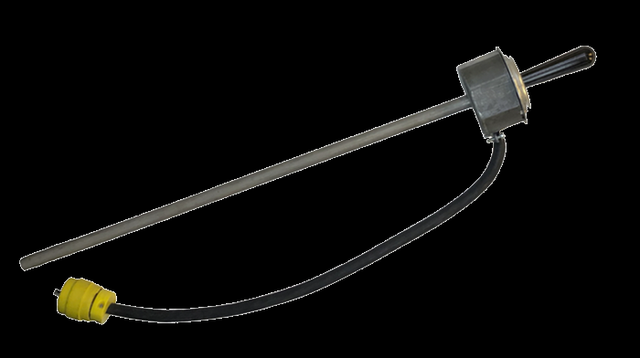
A bolt heater is a cartridge-style insertion heater that expands a large fastener or die by heating it from the inside — letting a big bolt be stretched and torqued to a known tension, or a die brought up to working temperature, fast. Dropped into a hole bored through the part, an 80/20 nickel-chrome coil in magnesium-oxide insulation inside a swaged alloy sheath drives the rated watt density into the metal and reaches full expansion in about 15 to 30 minutes. Choose a bolt heater for heat-expansion of a solid part; to warm a fluid or a tank, the immersion and circulation builds apply.
Key Features & Benefits
- Expands a large bolt so it can be torqued accurately — heat the bolt body, stretch it, run the nut down, and let it cool — the bolt clamps to a known, repeatable tension without a giant torque wrench or hydraulic tensioner. The clean way to tension a big fastener.
- Fast, even heat-up — minutes, not hours — rated to push hard into the heated length, a bolt heater warms a big fastener through quickly, and several run together for uniform heating across a flanged joint (the heat-up time and density are in the specifications). Crews are not standing around waiting for steel to warm up.
- Sized to drop into the bolt you already have — a wide range of stock diameters and lengths matches common bolt clearance holes off the shelf, and the close fit is what carries the heat into the part. Match the hole, and the heater does the rest.
- Field-serviceable and field-portable options — a plug disconnect makes the heater portable around the jobsite, and the replaceable-element model lets a worn cartridge be swapped in its cast box instead of buying a whole new heater. Built for a consumable that lives a hard life.
- Built by a long-time bolt-heater maker — Indeeco has manufactured bolt heaters for over thirty-five years and engineers each one as a purpose-built heat-expansion tool rather than a generic cartridge dropped in. A tool made for the job, not repurposed for it.
Specifications
- Operating principle
- Electric resistance (Joule) heating — an 80/20 nickel-chrome coil in compacted magnesium-oxide insulation inside a metal sheath. The cartridge slides into a clearance hole bored down the center of a large bolt, stud, die block, or platen and heats the part by conduction so it expands. It is an insertion (cartridge) heater for heat-expansion of a solid part — not an immersion element in a fluid.
- Installation
- Insertion — the heater drops into the bolt’s clearance hole and is energized in place; it can be made portable with a plug disconnect. Insert the heater into the bolt before energizing — it is not rated to run in open air. Where several bolts are heated together the heaters are energized simultaneously, so confirm the supply circuit will carry the combined load.
- Heater diameters & clearance-hole fit
- Standard (stock) heater diameters of .438″, .553″/.565″, .688″, .781″, .813″, .938″, 1.047″, 1.188″, and 1.324″ suit clearance holes from .500″ to 1.500″ (see the diameter table below). The clearance hole should be as close to the heater diameter as possible — 1/16″ (.0625″) maximum clearance; a close fit gives the heat transfer that the part needs and that the heater needs to survive.
Standard Heater Diameter by Bolt Clearance Hole
| Clearance hole (in.) | Heater diameter (in.) |
|---|---|
| .500 | .438 |
| .625 | .553 or .565 |
| .750 | .688 |
| .813 | .781 |
| .875 | .813 |
| 1.000 | .938 |
| 1.125 | 1.047 |
| 1.250 | 1.188 |
| 1.500 | 1.324 |
- Heated length
- The heated length is specified to the portion of the bolt to be expanded — typically the body, which runs roughly 65% of the bolt’s overall length (the threads are excluded). A wide range of standard heated lengths is stocked, with the catalog dimension “C” giving the heated length per catalog number.
- Element construction
- Swaged tubular construction: an 80/20 nickel-chrome resistance wire in Grade “A” magnesium-oxide, high-pressure swaged into the sheath for tight wire-to-sheath thermal contact and dielectric integrity. Indeeco builds the heater for the maximum watt-density rating the heated length will allow.
- Sheath material
- Alloy sheath, swaged — selected by Indeeco for the high sheath temperatures a bolt heater runs at. (Bolt heaters heat a solid metal part by conduction, so there is no per-fluid sheath-alloy selection as on an immersion heater.)
- Expansion & heat-up
- Most applications target a stretch of about .0015″ per inch of bolt length on alloy bolts, which produces roughly 45,000 psi of bolt stress at the root of the thread. Fast response brings a large bolt to full expansion in about 15–30 minutes. Indeeco’s applications chart suggests clearance-hole diameters by bolt size to reach that stretch with a standard heater.
- Watt density
- Built to the maximum watt density the heated tube length will carry, so the part comes up to expansion temperature quickly. Special watt densities are available to order where the part or the cycle calls for it. The close clearance-hole fit (above) is what lets the rated density move into the bolt instead of overheating the sheath.
- Wattage range
- Standard catalog ratings span roughly 270 W to 12,580 W across the diameter and length range; special wattages are available to order. The catalog selection guide lists the wattage for each diameter / length / voltage combination by catalog number.
- Voltage
- 120 V and 240 V standard on the rigid bolt heaters, with 115 V and 230 V on the 540-series rigid line; the flexible bolt heaters are 120 V and 230 / 240 V (no separate 115 V rating). The catalog number carries the voltage; field wiring must match the rated voltage on the nameplate.
- Terminal enclosure & handle
- Standard 4″ octagon electrical enclosure with knock-outs for easy field wiring, and an insulating handle for safe handling of the hot heater. (Replaceable-element models instead use a cast terminal box — see below.)
- Leads, plugs & ground
- Optional two-conductor power leads with a grounding clip and plug, or three-conductor power leads with plug, in place of the wired enclosure; lead/plug variants are selected by a catalog-number suffix (lead wires only, lead wire with ground clip, twist-lock plug with ground clip, or twist-lock plug with integral ground). Standard lead length is 2 ft; longer leads are available.
- Replaceable-element & flexible models
- Replaceable-element bolt heaters use a cast terminal box so a worn element can be unscrewed and interchanged in the field rather than scrapping the whole heater. Flexible Bolt Heaters are a separate model line for holes a rigid cartridge cannot reach.
- Operating & safety
- A bolt heater runs at high temperature and has an inherently short service life, so ultimate element failure should be anticipated and designed around. Do not energize the heater in open air — insert it into the bolt first. Each heater must be properly fused and grounded; where more than one heater shares a circuit, fuse each one individually. Connect only to a supply at the rated nameplate voltage; field wiring per NEC and local codes.
- Build & lead time
- Custom build-to-order from a wide range of standard (stock) diameters, lengths, wattages, and voltages — no published price list, quote-only. Special diameters, lengths, wattages, and watt densities are available to order.
Common Applications
- Preheating large hollow bolts and studs for heat-expansion tensioning — turbines, reactors, large flanged joints
- Heavy-duty steam-service and pressure-equipment bolting where a high concentration of heat is needed fast
- Heating die blocks and large platens — molds, presses, forming tools
- Expanding adjusting bolts on mechanical and hydraulic presses
- Uniform multi-bolt heating across a flange — several heaters energized together
Design & Selection Considerations
- Hold the clearance tight — 1/16″ is the limit — the air gap between heater and bolt is thermal resistance: too loose and the heat cannot get into the part fast enough, so the sheath overheats and the heater dies early. Keep the clearance hole within 1/16″ of the heater diameter. A sloppy hole is the most common way to kill a bolt heater.
- Never energize in open air — with no bolt to sink the heat, a bolt heater run in air overheats almost immediately. Insert it into the part first, every time. The single most damaging operating error — and an avoidable one.
- Plan for it as a consumable — bolt heaters run hot by design and have a short life; ultimate element failure should be expected, so keep spares on hand and consider the replaceable-element model for a high-cycle joint. Stock the spare before the shutdown, not during it.
- Fuse and ground every heater — individually on a shared circuit — when several heaters share a supply, fuse each one separately so a single failure cannot take the rest down or create a shock hazard, and ground every heater. Individual fusing protects both the equipment and the crew.
- Size the supply for all the heaters at once — a multi-bolt joint is heated by energizing every heater together; add up the loads and confirm the branch circuit and wire size carry the total per the code tables. Check the whole bank, not one heater.
- Match the heated length to the part you are expanding — the heated length should cover the bolt body to be stretched — about 65% of the overall length, excluding the threads — so the stretch lands where the design wants it. Heat the body, not the threads.
- Megger and dry out after storage — the magnesium-oxide insulation is hygroscopic, so a heater stored a while (or unused between jobs) can read low insulation resistance. Test it and bake out absorbed moisture before use, per the field-test sheet. A “bad” heater off the shelf is usually just damp MgO.
To spec the right Indeeco bolt heater:
Use the input form to send the bolt or part’s clearance-hole diameter and the length to be heated, the bolt material and the stretch or tension you need, how many heaters run at once, and the voltage available — and we’ll match the right Indeeco bolt heater diameter, heated length, wattage, and lead/plug option for your application.
Electric Heating Application Sheet ›Talk to an engineer directly — Scott Prater, Principal · 917-580-0878 · scott@pratertechnical.com
Specifications compiled by Prater Technical Partners from Aspeq Heating Group product datasheets.