Product Overview
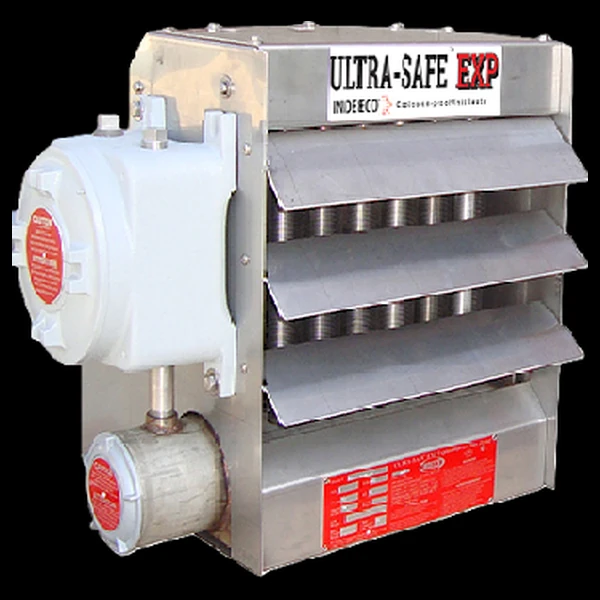
An explosion-proof unit heater puts electric space heat inside a classified hazardous area — a self-contained heater whose elements, motor, controls, and surface temperatures are all rated for the atmosphere around it. Indeeco builds the class as three series: the 233 Ultra-Safe EXP, whose sealed propylene-glycol heat exchanger holds the industry’s lowest ignition-temperature code (T3C, 320°F) with a 75 ft throw and three constructions for corrosive atmospheres; the 236 Compact EXP, the smallest, in stainless with an ABS marine option; and the fan-free 254 Convector, whose listings reach Class I Group B and which also serves NEMA 3 wet locations. Ratings run to 30 kW in cast-aluminum NEMA 7 enclosures. Pick the series by the area classification and T-code first, the construction by the atmosphere’s corrosivity, and the kW by the building heat loss. Dry, non-classified plants are served by the fan-forced 238 / 240; wet non-hazardous rooms by the washdown TRIAD.
Key Features & Benefits
- The lowest ignition-temperature code in the industry — the 233 Ultra-Safe EXP keeps its elements out of the air stream in a sealed glycol heat exchanger, so the surface the atmosphere sees stays cool enough to hold T3C — 320°F (160°C). The hazardous-area heater you can put where the atmosphere is most sensitive.
- Three constructions for areas that are corrosive as well as classified — the 233 builds in standard steel, 316 SS for wastewater plants, or a Heresite® coating for chloride-bearing chemical plants — so the digester building or the chlorination room gets a heater matched to its atmosphere twice over. Classified and corrosive handled in one order line.
- A fan-free option with the widest gas-group coverage — the 254 Convector heats by natural convection — no motor, no moving parts to maintain in the classified space — and its listings extend to Class I Group B along with Class II dust groups. Silent, service-light heat for the areas with the toughest gas groups.
- Small enough for the pump house, tough enough for the deck — the 236 Compact is the smallest heater in the class — stainless, Class I Group D, with an ABS-approved marine build — for the classified corners where a full-size unit will not fit. Classified-area heat for tight rooms, skids, and offshore compartments.
Specifications
- Operating principle
- Forced-air electric space heating built for classified areas. The 233 Ultra-Safe EXP heats indirectly: its elements are immersed in nontoxic propylene-glycol heat-transfer fluid inside a sealed liquid-to-air heat exchanger (350-psig hydrostatic test, 70-psig relief valve), so the surface the room’s atmosphere touches runs far cooler than a bare element. The 236 Compact heats the air directly through stainless finned-tubular elements; the 254 Convector is fan-free natural convection. Every series warms the room air, not a fluid in a tank or a pipe.
- Heater styles
- Three explosion-proof series. The 233 Ultra-Safe EXP is the versatile standout — the indirect glycol design holds the industry’s lowest ignition-temperature code, T3C 320°F (160°C), with the widest area coverage and the longest throw in the class. The 236 Compact EXP is the smallest — Class I Group D, stainless, with an ABS marine option. The 254 Convector is fan-free natural convection — no motor, no moving parts — and adds a Class I Group B listing, the widest gas-group coverage in the class.
Explosion-Proof Unit Heater Series Selector
| Series | EXP class | Max kW | Airflow / throw | Area rating / listing |
|---|---|---|---|---|
| 233 Ultra-Safe EXP | Indirect glycol (versatile) | 30 | 3,850 CFM / 75 ft | Cl I Gr C&D; Cl II Gr E,F&G; Zone 1/2 IIB; T3C 320°F; cCSAus |
| 236 Compact EXP | Direct fan-forced (smallest) | 12 | 1,050 CFM / 25 ft (fixed) | Class I Group D; stainless; ABS marine option |
| 254 Convector | Fan-free natural convection | 9.5 | Natural convection (no fan) | Cl I Gr B,C&D; Cl II Gr E,F&G; NEMA 3 wet locations |
- Mounting & discharge
- Factory mounting kits for wall, ceiling, or pole installation; the fan-forced series ship with a swivel bracket so the heater rotates to aim the airflow, discharging horizontally. Specify mounting with the order.
- Heating element
- The 233 Ultra-Safe EXP immerses its elements in propylene glycol inside an all-welded steel (or 316 SS) finned-tube heat exchanger — the sealed indirect design behind its low T-code. The 236 Compact uses industrial-grade stainless-steel finned-tubular elements. The 254 Convector uses a Grade-A nickel-chromium coil in a copper heater tube with large aluminum fins, sized for natural convection.
- Cabinet & construction
- The 233 offers three constructions — standard steel, a 316 SS build for wastewater plants, and a Heresite®-coated build for chloride-bearing chemical plants. The 236 Compact is stainless with an optional marine-duty (ABS-approved) build; the 254 Convector is iridite-coated.
- Fan / motor
- Fan motors are rated for the classified area — the 233’s motor carries Class I Groups C & D and Class II Groups F & G ratings. The 236 Compact runs a 120 V fan motor on a separate supply from the heating elements. The 254 Convector has no fan at all — natural convection moves the air.
- Wattage range
- 233 Ultra-Safe EXP to 30 kW; 236 Compact EXP to 12 kW; 254 Convector to 9.5 kW. Size the kW to the building heat loss.
- Air temperature rise
- The explosion-proof series sit at the low end of the catalog’s 9–79°F (5–44°C) air-rise band — the 233 EXP rises 15°F at 3 kW to 38°F at 10 kW (per the catalog listing tables). Pick the rise and throw together for the space, not the kW alone.
- Airflow (CFM) & throw
- 233 EXP to 3,850 CFM with a 75 ft throw — the longest in the family; 236 Compact a fixed 1,050 CFM / 25 ft. The 254 Convector is fan-free — it warms by natural convection rather than a thrown air stream.
- Voltage / phase
- 120, 208, 240, 277, 347, 480, and 600 V single- and three-phase (per each listing table). Single-point line-voltage connection on the 233 feeds heater, fan, and controls from one branch circuit; the 236 Compact runs its 120 V fan motor on a separate supply.
- Thermostat / temperature control
- Built-in adjustable 50–90°F thermostat on the 233 (with a 40–80°F wet-location option) and the 236 Compact. Remote control inside the classified area is by an explosion-proof bimetal or bulb-and-capillary thermostat rated for the same Class / Group — or by a control located in a non-hazardous area.
- Over-temperature protection
- The 233 EXP carries dual thermal cutouts — one automatic-reset and one manual-reset — plus the heat exchanger’s 70-psig relief valve. The 236 Compact uses primary and secondary automatic-reset cutouts.
- Built-in & remote controls
- Factory-mounted, pre-wired built-in controls package a controlling magnetic contactor, a 24 V (or 120 V) control-circuit transformer, a fan-delay relay (runs the fan to cool the elements after shutdown), and a single field-wiring terminal block. Options add a factory disconnect switch, “heater-on” and “warning” pilot lights, and an auto / fan / standby selector switch.
- Control enclosure
- Cast-aluminum NEMA 7 explosion-proof control enclosures on the 233 and 236; the iridite-coated 254 Convector also serves NEMA 3 (Type 3) wet locations.
- Hazardous / wet-location rating
- 233 Ultra-Safe EXP: Class I Div 1 & 2 Groups C & D; Class II Div 1 & 2 Groups E, F & G (Group E via the metal-dust construction / option E); Class I Zone 1 & 2 Group IIB — the industry’s lowest ignition-temperature code, T3C, 320°F (160°C). 236 Compact: Class I Div 1 & 2 Group D. 254 Convector: Class I Groups B, C & D and Class II Groups E, F & G listings; iridite-coated, it also serves NEMA 3 (Type 3) wet locations.
- Approvals & listings
- The 233, 236 Compact, and 254 Convector are cCSAus (CSA) approved; the 236 Compact adds ABS for marine duty.
- Build & lead time
- Custom build-to-order — no published price list, quote-only. Lead times typically run about 3 to 14 weeks depending on configuration, hazardous-area documentation, and code-stamp requirements.
Common Applications
- Oil refineries, drilling rigs, and petrochemical plants — Class I gas atmospheres (233 / 236)
- Paint-spray booths, solvent-handling, and finishing rooms
- Grain elevators, coal-handling, and other combustible-dust areas — Class II listings, with metal dust (Group E) via the 233’s option E construction
- Wastewater-treatment digester and headworks buildings — classified and corrosive, served by the 316 SS 233 build
- Marine and offshore classified compartments — ABS-approved 236 Compact build
- Analyzer houses, gas-detection shelters, and small enclosed classified rooms — the fan-free 254 Convector, with no motor to maintain
Design & Selection Considerations
- Match the series to the area classification and T-code first, kW second — the room’s NEC Class / Division / Group and ignition-temperature code decide which series is legal before capacity ever enters the picture — a heater whose T-code exceeds the area’s autoignition limit is a code violation and a fire risk. Use the input form to tell us the area classification (and the T-code) up front; the heating load comes after.
- The control is part of the classification, not an accessory — a heater rated for a classified area is only compliant if its temperature control is rated for the same Class and Group — an ordinary wall thermostat in the hazardous space defeats the whole design. Use the listed explosion-proof bimetal or bulb-and-capillary remote thermostat, or locate the control in a non-hazardous area. Spec the thermostat with the heater, to the same rating.
- Mind the separate motor supply on the Compact — the 236 Compact runs a 120 V fan motor on a separate supply from the heating elements — an easy detail to miss at the panel that leaves the fan dead and the cutouts tripping. Budget the second circuit when you pick the Compact.
- Classified and corrosive is a two-part spec — a hazardous area that is also wet or chemical — a wastewater digester building, a chloride-bearing chemical plant — needs the 233’s 316 SS or Heresite® construction (or the iridite-coated 254, which also serves NEMA 3 wet locations), not the standard steel build. Use the input form to tell us what the atmosphere does to metal as well as what ignites in it.
- Pick the fan-free 254 where silence and zero maintenance beat throw — the 254 Convector has no motor and no moving parts — nothing in the classified space to service — and carries the widest gas-group coverage (Class I Group B) in the family; the trade is that it warms by natural convection with no thrown air stream, so it suits smaller or enclosed classified rooms rather than a high-bay that needs reach. Choose the convector for the sealed analyzer house or gas shelter; choose the 233 for the open bay.
- Size on heat loss, then check throw and mounting height — the kW follows the building heat loss, but the throw still has to reach the occupied zone from the mounting height — the 233 throws 75 ft, the 236 a fixed 25 ft, and the fan-free 254 warms by convection rather than a thrown stream. The right kW thrown to the wrong place leaves the floor cold.
To spec the right Indeeco explosion-proof unit heater:
Use the input form to send the area classification (NEC Class / Division / Group and ignition-temperature code), whether the space is also wet or corrosive (wastewater, chlorides, marine), the building heat loss or floor area and ceiling height, the mounting, the available voltage and phase, and the temperature-control method — and we’ll pick the right explosion-proof series (233, 236, or 254), construction, kW, and the matching Class / Group-rated control.
Electric Heating Application Sheet ›Talk to an engineer directly — Scott Prater, Principal · 917-580-0878 · scott@pratertechnical.com
Specifications compiled by Prater Technical Partners from Aspeq Heating Group product datasheets.