Product Overview
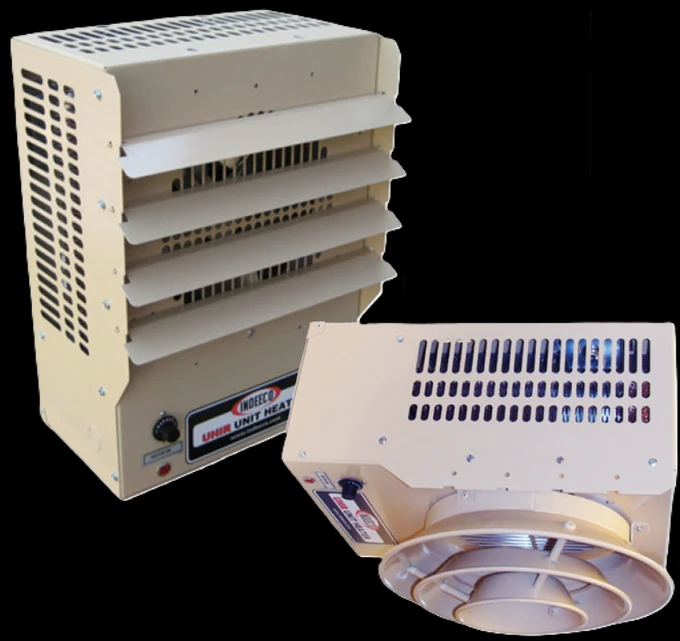
An industrial fan-forced unit heater is a self-contained forced-air space heater — an electric resistance element heats a stream of air that a fan blows into the room, warming the plant floor without a boiler, duct run, or combustion air. Indeeco builds the standard fan-forced class as two workhorse series: the 238 IUH general-purpose industrial heater and the 240 UHIR, which adds horizontal-or-vertical (down-blast) discharge and cone / radial diffusers for high-bay coverage. Both are stainless finned-tubular, factory-wired to a single branch circuit, and rated to 50 kW. Pick a fan-forced unit heater for an ordinary dry, non-corrosive plant space; size the kW to the building heat loss and the throw to the mounting height. Wet or corrosive rooms move to the washdown TRIAD, and classified hazardous areas move to the explosion-proof series.
Key Features & Benefits
- The industrial workhorse that hangs on one circuit — heater, fan, and controls land on one factory-wired terminal block fed by a single branch circuit, so putting a 238 IUH or 240 UHIR to work is a bracket, a conduit run, and a thermostat rather than a wiring project. Less field labor and far less chance of a wiring error.
- Aim the heat where the people are — swivel and pole mounts — plus the UHIR’s horizontal-or-vertical discharge and cone / radial diffuser options — put the warm air on the work area instead of the ceiling. Coverage you can point, from a high warehouse bay to a low-headroom shop.
- Down-blast a high bay from above — the 240 UHIR mounts vertically and drops a diffused air column straight down, so a heater hung well above the floor still lands its heat in the occupied zone instead of stratifying it at the roof. The right tool for high-ceiling aisles and hangar bays.
- Cool-running finned-tubular elements — stainless-steel finned-tubular elements spread the heat over a large surface, so the element runs cool for long life instead of glowing hot behind the grille. A heater built to run every winter for years.
- Extra throw when you need it — the 238 IUH’s optional 1800 RPM premium motor pushes more air and more throw from the same cabinet when a longer reach or a draftier bay calls for it. Match the air to the room without moving up a frame size.
Specifications
- Operating principle
- Forced-air electric space heating — an electric resistance element heats a stream of air that a fan blows into the space through stainless-steel finned-tubular elements. The heater is self-contained and factory-wired: one branch circuit feeds the heater, fan, and controls. It warms the room air, not a fluid in a tank or a pipe.
- Heater styles
- Two standard fan-forced series for dry, non-corrosive plants. The 238 IUH is the general-purpose industrial workhorse in a beige powder-coated cabinet, with a standard 1200 RPM or optional premium 1800 RPM fan motor. The 240 UHIR adds horizontal or vertical (down-blast) discharge with optional Anemostat (cone) or radial diffusers, so it can drop heat straight down over a high-bay work area. Neither is rated for wet, corrosive, or hazardous locations — those move to the washdown TRIAD or the explosion-proof series.
Fan-Forced Unit Heater Series Selector
| Series | Discharge | Max kW | Max CFM / throw | Listing |
|---|---|---|---|---|
| 238 IUH | Horizontal | 38.4 | 1,774 CFM / 50 ft | cULus (dry, non-corrosive) |
| 240 UHIR | Horizontal or vertical (down-blast) | 50 | 3,100 CFM | cULus (dry, non-corrosive) |
- Mounting & discharge
- Factory mounting kits for wall, ceiling, or pole installation; both series ship with a swivel bracket so the heater rotates to aim the airflow. The 240 UHIR mounts for horizontal or vertical down-blast discharge with optional cone or radial diffusers; the 238 IUH discharges horizontally. Specify mounting and discharge with the order.
- Heating element
- Industrial-grade stainless-steel finned-tubular elements spread the load over a large surface for cool, long-life operation. The 240 UHIR uses a .475″-diameter steel-sheath element with brazed copper-plated steel fins and epoxy-sealed ends in a draw-thru airflow path.
- Cabinet & construction
- Powder-coated galvanized-steel cabinet — beige on the 238 IUH, camel on the 240 UHIR — sized for indoor, dry-plant service.
- Fan / motor
- Permanently lubricated, thermally protected ball-bearing motors, factory-wired to the control enclosure. The 238 IUH offers a standard 1200 RPM and an optional premium 1800 RPM motor; the 240 UHIR uses a single permanently-lubricated, thermally-protected motor. A summer fan switch (fan-only air circulation) is available on both.
- Wattage range
- 238 IUH 3–38.4 kW; 240 UHIR 2.5–50 kW. Size the kW to the building heat loss, not to the room volume alone.
- Air temperature rise
- Approximate discharge air-temperature rise runs roughly 9–79°F (5–44°C) depending on kW and airflow — the 238 IUH reaches about 79°F at full kW (per the catalog listing tables). Pick the rise and throw together for the space, not the kW alone.
- Airflow (CFM) & throw
- 240 UHIR to 3,100 CFM; 238 IUH to 1,774 CFM with a 50 ft throw. A vertical UHIR with a diffuser drops the air onto the floor from a high mounting.
- Voltage / phase
- 120, 208, 240, 277, 347, 480, and 600 V single- and three-phase (per each listing table). Single-point line-voltage connection feeds heater, fan, and controls from one branch circuit.
- Thermostat / temperature control
- Process control by a built-in adjustable thermostat, a remote room thermostat (load-carrying or pilot-duty), or a two-stage thermostat on the UHIR. A summer fan switch runs the fan for air circulation without heat.
- Over-temperature protection
- Built-in over-temperature protection is standard. A manual-reset thermal cutout is standard on the larger UHIR (10 kW and up).
- Built-in & remote controls
- Factory-mounted, pre-wired built-in controls package a controlling magnetic contactor, a 24 V (or 120 V) control-circuit transformer, a fan-delay relay (runs the fan to cool the elements after shutdown), and a single field-wiring terminal block. Options add a factory disconnect switch, “heater-on” and “warning” pilot lights, and an auto / fan / standby selector switch. Power fusing is standard on UHIR heaters over 48 A.
- Control enclosure
- A sheet-steel terminal / control box houses the controls — an indoor, dry-location enclosure matched to the fan-forced duty.
- Approvals & listings
- cULus listed.
- Build & lead time
- Custom build-to-order — no published price list, quote-only. Lead times typically run about 3 to 14 weeks depending on configuration, hazardous-area documentation, and code-stamp requirements.
Common Applications
- Space heating for factories, warehouses, garages, workshops, and mechanical rooms
- Loading docks and high-bay warehouse aisles where a thrown air stream reaches the work area from above
- Aircraft hangars and shops where a vertical down-blast UHIR covers a large floor footprint from overhead
- Compressor and pipeline-pumping stations and pump rooms needing reliable freeze-free space heat
- Any dry, non-corrosive, non-classified plant space where a boiler and duct run are not warranted
Design & Selection Considerations
- Size on heat loss, then check throw and mounting height — the kW follows the building heat loss, but a unit heater only works if the throw reaches the occupied zone from the mounting height — an under-thrown heater stratifies all its heat at the ceiling. Match CFM and throw (and a diffuser on a vertical UHIR) to the space, not just the kW. The right kW thrown to the wrong place leaves the floor cold.
- Confirm the room is dry and non-corrosive first — the 238 / 240 are painted-steel plant heaters for ordinary dry air — a hose-down or chemical room rusts them out, and a classified area makes them a code violation. If the room is wet / corrosive, spec the washdown TRIAD; if it is a hazardous area, spec the explosion-proof series.
- Pick horizontal or vertical discharge for the space — a horizontal 238 warms along the floor from a wall; a vertical down-blast UHIR with a diffuser covers a footprint from overhead. Choosing the wrong discharge leaves cold corners or a hot ceiling. Use the input form to tell us the mounting height and the area to cover, and we’ll set the discharge.
- Plan the disconnect and clearances into the layout — NEC / CEC wants a disconnecting means within sight of the heater (a factory disconnect option covers it cleanly), and the fan needs clear inlet and outlet air plus service access. Specify the disconnect with the order and leave the airflow and maintenance clearances on the drawing.
- Fuse and size the larger UHIR correctly — power fusing is standard on UHIR heaters over 48 A and a manual-reset cutout is standard at 10 kW and up — details that set the branch-circuit and overcurrent design. Use the input form to give us the available voltage and phase so the feeder and protection are right the first time.
- Use the summer fan switch instead of a second fan — both series can run the fan alone for warm-weather air circulation, so the heater you hung for winter heat doubles as a shop air mover. One less piece of equipment to buy and hang.
To spec the right Indeeco fan-forced unit heater:
Use the input form to send the building heat loss or floor area and ceiling height, the mounting (wall / ceiling / pole) and discharge (horizontal or vertical down-blast), the available voltage and phase, and the temperature-control method — and we’ll pick the right Indeeco fan-forced series (238 IUH or 240 UHIR), kW, and controls for the space. Confirm the room is dry and non-corrosive; if it is wet, corrosive, or a classified area, we’ll move you to the washdown or explosion-proof series.
Electric Heating Application Sheet ›Talk to an engineer directly — Scott Prater, Principal · 917-580-0878 · scott@pratertechnical.com
Specifications compiled by Prater Technical Partners from Aspeq Heating Group product datasheets.