Product Overview
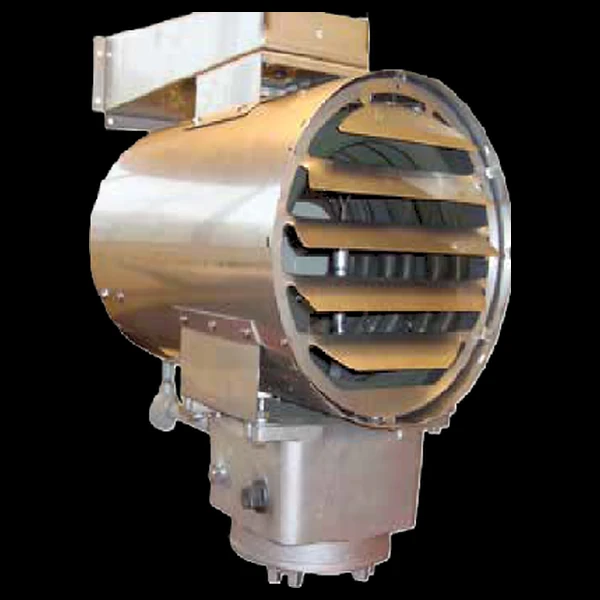
The Indeeco 234 TRIAD is a washdown, corrosion-resistant fan-forced unit heater — a self-contained forced-air space heater built to be hosed down in place. A 16-gauge stainless cabinet and shroud, a non-metallic NEMA 4X control enclosure, and a powder-coated aluminum fan blade let it work through the moisture, wash chemicals, and chlorides that rust out a painted-steel plant heater. It heats the air with stainless finned-tubular elements, is factory-wired to a single branch circuit, and is rated to 47 kW, with an ABS marine build for offshore decks. Pick the TRIAD for a wet or corrosive but non-hazardous room — wastewater plants, car washes, dairies, food and paper plants. Dry plants are served by the fan-forced 238 / 240; classified hazardous areas by the explosion-proof series.
Key Features & Benefits
- Survives the washdown that kills ordinary heaters — the TRIAD’s stainless shroud and non-metallic NEMA 4X enclosure let it be hosed down in place — no disconnect, no corrosion — in sewage plants, car washes, dairies, and food plants. Built for the wet, corrosive rooms where a painted-steel heater rusts out.
- Stainless where it counts — a 16-gauge stainless cabinet and shroud and a powder-coated aluminum fan blade stand up to chlorides, wash chemicals, and constant damp that pit and flake a galvanized plant heater. Corrosion resistance designed into the metal, not painted on.
- Rated for the deck as well as the plant — with a manual-reset cutout the TRIAD meets the U.S. Coast Guard / ABS requirement, so the same washdown heater serves marine and offshore compartments. One corrosion-duty heater for wet shore plants and salt-air decks alike.
- Wired to a single circuit, ready to hang — heater, fan, and controls land on one factory-wired terminal block, so installation in the wash bay is a bracket and a conduit run rather than a wiring project. Less field labor and far less chance of a wiring error.
- Aim the heat where the crew works — a swivel mount rotates the TRIAD to throw the warm air across the work floor instead of the ceiling. Coverage you can point in a high, damp bay.
Specifications
- Operating principle
- Forced-air electric space heating — an electric resistance element heats a stream of air that a fan blows into the space through stainless-steel finned-tubular elements. The heater is self-contained and factory-wired; it warms the room air, not a fluid in a tank or a pipe. What sets the TRIAD apart is that every wetted and exposed surface is built to be hosed down in place.
- Heater styles
- One series, one job: the 234 TRIAD is a washdown / corrosion-resistant fan-forced unit heater for wet and corrosive — but non-hazardous — areas. It carries a 16-gauge stainless-steel cabinet and shroud, a non-metallic NEMA 4X control enclosure, and a powder-coated aluminum fan blade, so it survives the hose-down and chemical exposure that rust out a painted-steel plant heater. For hazardous areas, the explosion-proof series applies instead.
234 TRIAD Washdown Unit Heater — at a glance
| Attribute | Specification |
|---|---|
| Duty class | Washdown / corrosion-resistant (non-hazardous) |
| Cabinet / enclosure | 16-ga stainless shroud; non-metallic NEMA 4X control box |
| Wattage range | 2–47 kW |
| Airflow / throw | to 2,400 CFM / 50 ft |
| Voltage | 120–600 V, single- & three-phase |
| Approvals | cULus; ABS (marine, with manual-reset cutout) |
- Mounting & discharge
- Factory mounting kits for wall or ceiling installation on a swivel bracket so the heater rotates to aim the airflow; horizontal discharge. Specify mounting with the order.
- Heating element
- Industrial-grade stainless-steel finned-tubular elements spread the load over a large surface for cool, long-life operation in a damp, corrosive atmosphere.
- Cabinet & construction
- 16-gauge stainless steel cabinet and shroud with a non-metallic NEMA 4X control enclosure and a powder-coated aluminum fan blade — built for hose-down, corrosive service.
- Fan / motor
- Permanently lubricated, thermally protected ball-bearing motor, factory-wired to the NEMA 4X control enclosure.
- Wattage range
- 2–47 kW. Size the kW to the building heat loss.
- Air temperature rise
- Approximate discharge air-temperature rise runs within the catalog’s 9–79°F (5–44°C) band depending on kW and airflow. Pick the rise and throw together for the space, not the kW alone.
- Airflow (CFM) & throw
- To 2,400 CFM with a 50 ft throw.
- Voltage / phase
- 120, 208, 240, 277, 347, 480, and 600 V single- and three-phase (per the listing table).
- Thermostat / temperature control
- Process control by a built-in adjustable thermostat, a remote room thermostat (load-carrying or pilot-duty), or a two-stage thermostat.
- Over-temperature protection
- Built-in over-temperature protection is standard. A manual-reset thermal cutout is the U.S. Coast Guard / ABS marine requirement on the TRIAD.
- Built-in & remote controls
- Factory-mounted, pre-wired built-in controls package a controlling magnetic contactor, a 24 V (or 120 V) control-circuit transformer, a fan-delay relay (runs the fan to cool the elements after shutdown), and a single field-wiring terminal block. Options add a factory disconnect switch, pilot lights, and an auto / fan / standby selector switch.
- Control enclosure
- A non-metallic NEMA 4X hose-down enclosure — the wet-location, corrosion-resistant control box that defines the washdown duty.
- Hazardous / wet-location rating
- NEMA 4X wet-location — sealed against hose-down and corrosive wash. The TRIAD is not rated for classified hazardous areas; a wet room that is also a Class I / II area moves to the explosion-proof series.
- Approvals & listings
- cULus listed; adds ABS for marine duty.
- Build & lead time
- Custom build-to-order — no published price list, quote-only. Lead times typically run about 3 to 14 weeks depending on configuration, hazardous-area documentation, and code-stamp requirements.
Common Applications
- Wastewater and sewage-treatment plants — damp, corrosive process buildings and pump rooms
- Car washes, dairies, and food- and beverage-processing rooms that are hosed down for sanitation
- Paper mills, chemical-handling rooms, and other wet or corrosive (non-hazardous) plant areas
- Marine and offshore decks and compartments — ABS-approved washdown build
- Any plant space where moisture, wash chemicals, or salt air would rust out a painted-steel heater
Design & Selection Considerations
- Wet or corrosive is its own decision, separate from hazardous — a non-hazardous but wet or chemical room (wastewater, car wash, dairy) needs the washdown stainless TRIAD — not a painted-steel plant heater, and not necessarily an explosion-proof one. Don’t pay for explosion-proof when the real enemy is moisture and chlorides.
- If the wet room is also classified, step up to explosion-proof — the TRIAD is NEMA 4X but not hazardous-area rated — a wash bay that is also a Class I or II area (some wastewater digesters, certain food / chemical rooms) needs an explosion-proof heater with a wet-location build, not the TRIAD. Use the input form to tell us if the area carries an NEC classification, not just moisture.
- Specify the manual-reset cutout for marine duty — the U.S. Coast Guard / ABS marine listing depends on the manual-reset over-temperature cutout — an easy line to miss that decides whether the heater is accepted aboard. Call out marine duty up front so the cutout and the ABS paperwork are on the order.
- Size on heat loss, then check throw and mounting height — the kW follows the building heat loss, but the 2,400 CFM / 50 ft throw still has to reach the occupied zone from the mounting height — an under-thrown heater stratifies its heat at the ceiling of a high, damp bay. Match the throw to the space, not just the kW.
- Plan the disconnect and clearances into a wet layout — NEC / CEC wants a disconnecting means within sight of the heater (a factory disconnect option covers it cleanly), and the fan needs clear inlet and outlet air plus wash-down and service access. Specify the disconnect with the order and leave the airflow and maintenance clearances on the drawing.
To spec the right Indeeco washdown unit heater:
Send whether the room is wet, corrosive, or a washdown area (and whether it also carries an NEC hazardous-area classification), the building heat loss or floor area and ceiling height, the mounting (wall / ceiling), the available voltage and phase, whether it is marine / ABS duty, and the temperature-control method — and we’ll confirm the 234 TRIAD, kW, and controls, or move you to the fan-forced or explosion-proof series if the area calls for it.
Electric Heating Application Sheet ›Talk to an engineer directly — Scott Prater, Principal · 917-580-0878 · scott@pratertechnical.com
Specifications compiled by Prater Technical Partners from Aspeq Heating Group product datasheets.