Product Overview
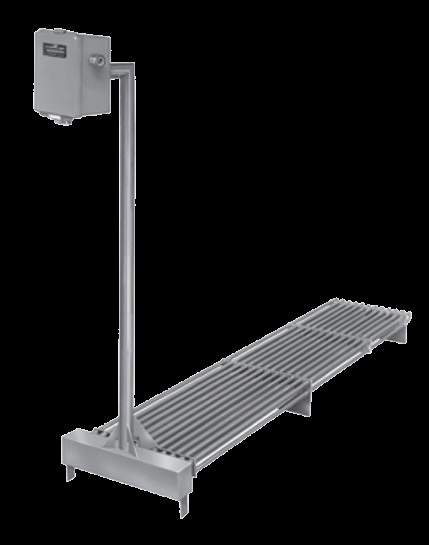
The over-the-side immersion heater hangs over the wall of an open tank on a vertical riser, with the element bundle resting near the bottom — nothing penetrates the tank. That is the whole point: it retrofits into an existing tank without cutting or draining it, and lifts straight out for cleaning. Choose over-the-side when the tank is open and you can’t (or don’t want to) put a fitting through the wall; for a pressurized or closed vessel, the flanged and screw-plug builds are the answer.
Key Features & Benefits
- Drops in over the wall — no tank penetration — the riser hangs over an open tank and the bundle sits at the bottom, so the heater retrofits without cutting or draining the tank and lifts straight out for cleaning — the reason to pick over-the-side over a flanged or screw-plug build.
- Sludge-leg spacers keep the elements out of the sediment — the spacers hold the bundle up off the sludge line so it cannot spot-overheat against settled solids — what keeps the sheath alive in a tank that collects dirt.
- The two mechanical weak points are reinforced by design — the riser joint and the splash-exposed outlet box are exactly where an over-the-side heater fails in the field — so both are built up against it (see the riser spec for the construction detail). Designed around the two things that actually break.
- Built-in thermostat on smaller units, matched panels on larger — a two-pole load-carrying thermostat switches the heater directly (to 12.4 kW at 240 V three-phase) with an integral ON/OFF switch and pilot light — plug-and-go on a small tank, no separate panel. Above that, factory-matched SCR, step, or contactor panels add proportional control, multi-stage sequencing, and a PID loop with an independent high-limit. Plug-and-go on small tanks; full process control when the load grows.
Specifications
- Operating principle
- Electric resistance (Joule) heating — AC current passes through an 80/20 nickel-chrome coil in compacted magnesium-oxide insulation inside a metal sheath. On an over-the-side heater the element bundle hangs from a vertical riser that drapes over the wall of an open tank, so the elements sit in the fluid with no penetration of the tank itself.
- Mounting / installation
- Over-the-side — the riser hangs over the tank wall and the element bundle sits horizontally near the bottom; vertical mounting is available where a horizontal bundle would block the tank. No tank penetration. Open-tank / atmospheric service — no pressure rating (a code or pressure vessel calls for the flanged build).
- Sludge-leg spacers
- The element bundle stands off the tank bottom on sludge-leg spacers that clear settled sediment: 1-1/2″ standard, to 4″ at no extra charge, with taller legs available where sludge runs deeper.
- Riser height
- Cut to the tank depth — standard builds suit tanks to about 30″ deep; taller risers are made to order, and risers over 96″ use a split coupling so the unit ships and installs in sections. A reinforced riser (gusseted to the junction box) and a 6″ extension arm are standard. Riser is 1-1/4″ O.D. pipe with 3/4″ NPT hubs.
- Element construction
- .475″ O.D. compacted tubular elements, magnesium-oxide filled and high-pressure-roller compacted, with all U-bends repressed for dielectric integrity. Sheath thermocouples are clamped to the sheath rather than welded through it — an Aspeq reliability philosophy, since a weld penetration risks a pinhole that becomes a moisture-ingress and shorting failure point over the life of the heater. Joints are welded and pressure-tested before assembly.
- Sheath materials
- Standard sheath and fitting are 304 stainless steel on water-service heaters and steel on oil-service heaters (per the over-the-side catalog listing tables). Optional 316 stainless steel · Incoloy 800 · Inconel 600 · Monel 400 are available where the fluid’s chemistry or temperature requires it (see the sheath / watt-density table below).
- Header / fitting materials
- Riser, junction box, and sludge legs match the sheath / fitting — 304 stainless steel standard on water-service builds, steel on oil-service builds; 316 stainless steel, Incoloy 800, Inconel 600, and Monel 400 available where the fluid or splash zone is corrosive.
- Cold (unheated) section length
- A minimum 2-1/2″ cold (unheated) section at the element ends prevents sheath overheating where the element exits the liquid (per the over-the-side dimensional drawings). On a vertical mount, or where the fluid may not fully cover the elements, specify a longer cold end.
- Terminal seals
- Epoxy terminal seals — moisture-resistant, standard where fluid temperatures do not exceed 250°F. For high-temperature construction, mica terminal insulators are furnished with properly sized lugs and conduit openings; above that range an extended terminal box is standard.
- Process / fluid temperature
- Standard catalog: 250°F maximum operating temperature. Higher-temperature construction is available on request; sheath selection, cold-end length, and terminal seal are matched to it.
- Watt density
- The over-the-side catalog rates water-service heaters at 50 W/in² and oil-service heaters at 20 W/in² of element surface. Watt density is matched to the process fluid (see table below) and to the maximum process temperature — the lower the density, the cooler the sheath film, which is what keeps a sensitive fluid from coking or scaling.
- Fluid & sheath compatibility
- The Aspeq immersion platform publishes a per-fluid sheath-and-watt-density selection table covering 90+ process fluids — water, glycols, fuel and heat-transfer oils, caustics, acids, brines and seawater, and forced air. Representative rows below show the highest-traffic process fluids; the full table travels with the quote.
Recommended Sheath Material & Watt Density by Fluid
| Fluid | Fluid temp | Max W/in² | Recommended sheath |
|---|---|---|---|
| Water (clean process) | 212°F | 60–75 | Copper, Steel, 304/316 SS, Incoloy 800 |
| Water (demineralized / DI) | 180°F | 40–60 | 316 SS, Incoloy 800 |
| Glycol / water mix | 212°F | 40–60 | Copper, 304/316 SS, Incoloy 800 |
| Light fuel oil / kerosene | 200°F | 15–25 | Steel, 304 SS, Incoloy 800 |
| Heavy / Bunker oil | 180°F | 3–5 | Steel, 304 SS, Incoloy 800 |
| Heat-transfer oil (Dowtherm-A) | 500°F | 3–5 | Steel, 304/316 SS, Incoloy 800 |
| Asphalt | 300°F | 5–8 | Steel, 304 SS, Incoloy 800 |
| Caustic (NaOH 50%) | 180°F | 20–30 | Steel, 304 SS, Nickel (consult factory) |
| Acetic acid (50%) | 200°F | 20–25 | 316 SS, Monel 400, Titanium |
| Sulfuric acid (10%) | 180°F | 10–15 | 316 SS, Titanium |
| Sodium chloride brine / seawater | 180°F | 15–25 | Monel 400, Titanium, Incoloy 800 |
| Air (process, forced) | 1000°F | 15–30 | Incoloy 800, Inconel 600 |
- Wattage range
- Sized to the tank and the fluid — per-bundle wattage and total kW per the catalog listing tables, matched to the required watt density at quote time.
- Voltage / phase
- 120 V, 208 V, 240 V, 277 V, and 480 V standard, single- and three-phase, and wound to order for other service voltages. Three-phase circuits are balanced using a multiple of three elements per circuit.
- Circuiting
- Catalog standard: one electrical circuit, single-stage operation. Multiple circuits available for staged and SCR-trim control schemes paired with matching panels.
- Bus bars
- Stainless-steel bus bars on higher-temperature builds; copper where amperage is high and the joint stays cool.
- Thermostat options
- A two-pole, load-carrying built-in thermostat — with integral ON/OFF switch, pilot light, and adjusting knob — switches the heater directly, up to 3.6 kW at 120 V, 6.2 / 10.8 kW at 208 V (single- / three-phase), 7.2 / 12.4 kW at 240 V, 8.3 kW at 277 V, and 4.8 kW at 480 V; larger heaters use an external contactor / panel. Standard ranges 0–100°F, 40–120°F, and 60–250°F (specify on order).
- Control integration
- Matched factory control packages cover the spectrum: contactor panels for on / off duty, SCR power controllers for proportional and tight-tolerance control, S5 / S10 step controllers for multi-stage sequencing, and Vernier Controls (hybrid step + SCR-trim). PID loop with thermocouple or RTD input plus an independent high-limit safety are standard on factory panels.
- Terminal enclosure
- The standard terminal enclosure is a cast NEMA 4 outlet box — Indeeco’s “liquidproof” box, which the catalog defines as protecting the connections from washdown, splashing, and dripping. It mounts on the riser above the liquid line: NEMA 4 is a washdown / watertight rating, not a submersible one — the box is meant to sit out of the tank. A removable cast NEMA 4 box threaded onto 1″ Sch. 40 pipe is available as an option.
- Ambient temperature
- Standard catalog: 40°C / 104°F maximum ambient. Higher-ambient and outdoor variants on request.
- Build & lead time
- Custom build-to-order — no published price list, quote-only. Lead times typically run about 3 to 14 weeks depending on configuration, hazardous-area documentation, and code-stamp requirements.
Common Applications
- Retrofitting heat into an existing open tank without cutting or draining it
- Heating and freeze protection of plating, rinse, cleaning, and process tanks — metal finishing
- Maintaining oil, parts-wash, and quench tanks at temperature — general industrial
- Tanks that need the heater pulled regularly for cleaning — food & beverage, water treatment
- Freeze protection of outdoor sumps and chemical-feed tanks — water & wastewater
- Freeze protection of rooftop water storage tanks — commercial buildings; see it in context on the Submetering & Building Systems industry page
Design & Selection Considerations
- Watt density is the make-or-break spec — set it by the fluid, not the footprint — too much W/in² drives the sheath film temperature past what the fluid tolerates: oils coke, hard water scales, glycols and heat-transfer fluids degrade, and the sheath burns out. Use the input form to tell us the fluid and we work backward to a safe watt density (see the per-fluid range in the specifications). This is the No. 1 reason immersion heaters fail early.
- In a dirty tank, spec taller legs and de-rate the watt density — an over-the-side heater sits where sediment settles; where solids run deep, order the taller sludge legs and lower the watt density. Sediment packed against the sheath insulates it and drives a burnout — tell us the expected sludge depth.
- Cut the riser to the tank, and keep the fluid above the junction box — the riser is made to the tank depth; on a vertical mount especially, the fluid level has to stay above the element junction box. In a round tank the elements can be curved (to 16″ or 20″ diameters) to follow the wall. Use the input form to give us the tank depth, shape, and the working liquid level with the quote.
- Stainless is not automatically the corrosion answer — 304 / 316 stainless stress-corrosion-cracks in chlorides — seawater, brines, and some process waters. Those services want Incoloy 800 or Monel 400, not stainless. Match the sheath alloy to the chemistry before you default to “stainless.”
- Dry-firing kills heaters — and open tanks lose level — an element fired in air instead of liquid is gone in seconds, and an open tank evaporates and gets pumped down. A low-liquid-level cutoff plus an independent high-limit are not optional. Protect the level and you eliminate the most common field failure.
- Replacing or crossing over? — an Aspeq nameplate (Indeeco / Heatrex) is all we need to rebuild it exactly; crossing from another brand, send the details and we’ll match the equivalent. New build: give us the tank depth, fluid, and working level.
- Megger and bake out after storage — the magnesium-oxide insulation is hygroscopic, so a heater off the shelf can read low insulation resistance. Megger it and bake out the absorbed moisture before putting it in service. A “bad” new heater is usually just damp MgO.
- Match the control to the temperature tolerance you actually need — the built-in thermostat is fine for a forgiving tank; a tight outlet ΔT or a heat-sensitive fluid wants SCR or step control for fine resolution and soft-start. Pick your required turndown before you pick the control.
To spec the right Indeeco over-the-side heater:
Use the input form to send your fluid or gas, target temperature rise (ΔT) and maximum outlet temperature, flow rate range (min / max), maximum design pressure and pressure drop, the heater environment (hazardous / corrosive / weatherproof), voltage and phase available, and the temperature-control method — and we’ll spec the right Aspeq heater & control package for your application.
Electric Heating Application Sheet ›Talk to an engineer directly — Scott Prater, Principal · 917-580-0878 · scott@pratertechnical.com
Specifications compiled by Prater Technical Partners from Aspeq Heating Group product datasheets.