Product Overview
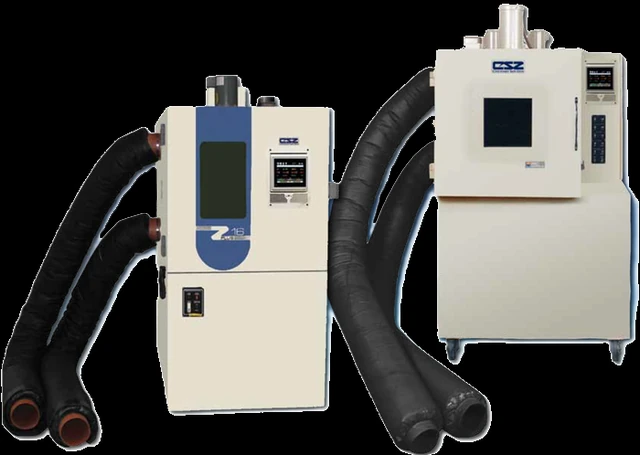
The CSZ RC-Series Remote Conditioner is a dual-purpose unit: it conditions air and delivers it through insulated ducts to a test article that cannot go inside a chamber — an engine or powertrain test stand, a moving device in a fixture, a large assembly — or it runs as a completely self-contained temperature / temperature-humidity test chamber. It can also add equipment-cooling air (ECA) or boost and backup heating and cooling to an existing chamber. Single-stage or cascade refrigeration covers −30°C to +177°C in remote mode (to −65°C cascade) and −34°C to +190°C as a chamber, with the same EZT-570S touchscreen control as the rest of the line. The compact ZPRC-Series is the smaller-footprint variant. Use it when the load is too large, too heavy, or too fixed in place to enclose.
Key Features & Benefits
- Heats and cools what will not fit in a chamber — the conditioner pipes temperature-controlled air through insulated ducts to an engine stand, a moving fixture, or a large assembly that cannot be enclosed — the test happens where the article already is. The answer when the load is too big, too heavy, or too fixed to put in a box.
- Two chambers for the price of one — the same unit runs as a self-contained temperature or temperature/humidity test chamber when you load the workspace directly — remote conditioning and standalone testing in one capital purchase. Buy one unit, get both jobs.
- Boosts or backs up an existing chamber — tied into another chamber, it extends the heating, cooling, and equipment-cooling capability of test equipment you already own — rather than buying a bigger chamber. A force multiplier for an existing test floor.
- Welded ports and pilasters that do not leak — fully welded ports and shelf pilasters eliminate the leak paths that shorten a chamber’s life, and a bi-modal heating/cooling system saves energy by not fighting an oversized heater against the refrigeration. Built to stay tight and run efficiently for years.
Specifications
- Type & operating principle
- Dual-purpose remote conditioner — it conditions air and delivers it through insulated ducts to a test article wherever it sits, OR runs as a completely self-contained temperature / temperature-humidity test chamber. One unit does the job of two. The compact ZPRC-Series is the smaller-footprint variant.
- Loading / configuration
- Two modes from one unit: pipe conditioned air out to a remote article through the ducts, or load the workspace directly and run it as a standalone chamber. (The specific remote-delivery use cases are in Applications below.)
- Cabinet & interior construction
- Brushed stainless-steel interior, fog-free windows, and fully welded ports and shelf pilasters that eliminate potential leaks for longer chamber life; both left- and right-side ports can be incorporated. Casters on the RC-308 (and RC 816 and larger as an option).
- Insulation
- Non-settling low-“K”-factor fiberglass insulation.
- Temperature range
- Remote-conditioner mode: single-stage −30°C to +177°C, cascade −65°C to +177°C. Self-contained chamber mode: single-stage −34°C to +190°C, cascade −70°C to +190°C. Ultra-low temperatures are optional.
- Refrigeration system
- Mechanical refrigeration in single-stage or cascade, with zero-ozone-depletion refrigerants; refrigeration high-temperature protection, pressure gauges, and service taps are standard. A water-cooled condenser is standard on 6 HP and up (recommended when ambient exceeds 30°C). CO₂/LN₂ boost cooling and remote refrigeration are optional.
- Cooling capacity / sizing
- Net cooling capacity is published per model across the RC and ZPRC lines — for example (single-stage, at −18°C) about 4,420 BTU/hr on the RC-308 to 44,900 BTU/hr on the RC-864-15, with 1 HP/300 CFM to 3 HP/800 CFM blower packages; cascade ratings are published at −40°C and −54°C. The model is selected to the workspace, temperature, and live load.
- Workspace / size range
- Standard workspace volumes of 8, 16, 32, 44, and 64 cu ft (227–1,812 L); custom sizes available.
- Humidity (chamber mode)
- Optional humidity in chamber mode: 10% to 95% RH self-contained (10% to 80% RH in remote-conditioner mode). RCH humidity models meet a variety of commercial and military moisture-resistance standards, with microprocessor RH programming, a fast-response humidity generation system, a water demineralizer, and a solid-state humidity sensor. (Live load affects humidity performance.)
- Conditioned-air delivery
- 6″ air supply and return ports and two 10′ flexible insulated ducts deliver conditioned air to the remote article; access ports are 2.875″ (RC) or 3.875″ (ZPRC). Optional CSZ RH-Series remote hoods / enclosures provide an air-tight seal at the article and are built to interface with the conditioner.
- Controller
- EZT-570S touchscreen controller — profiling to 99 steps and 1,000 cycles with ramp by time or °C/min, product (article) control, and a local/remote temperature switch and digital temperature limit/alarm.
- Data logging & communications
- On-board data logging (configurable interval, batch/lot entry, operator notes) with file download by LAN (FTP, email) or USB in .csv; remote monitor/control over LAN VNC; email and text alarm notification; EIA-232/485 interface standard, optional EZ-View software and IEEE-488. Optional digital-input (8) and customer-event digital-output (15) packages, refrigeration-monitor, condensation-control, and bar-code options.
- Alarms & monitoring
- Digital temperature limit and alarm standard; selectable power-failure/recovery options and full system security (up to 30 users, four levels) with an audit trail.
- Electrical / power
- 60 Hz operation standard; 50 Hz optional (performance and airflow approximately 17% less). Circuit breakers standard.
- Options & custom capabilities
- Additional access ports and shelves, custom-size chambers, explosion-proof construction (RC models only), ultra-low temperatures, extended RH range, CO₂/LN₂ boost cooling, dry-air purge, recirculating water supply, RO water filtration, remote refrigeration, temperature recorders, running-time meter, electrical disconnect, and custom control interface.
- Build & lead time
- Quote-only — there is no published CSZ price list, because most units are configured or custom-engineered to the application. A standard freezer carries a routine build lead time; a large or custom unit (custom size, custom temperature range, explosion-proof, LN₂ cooling) carries a longer engineered-build lead. Prater Technical Partners scopes the configuration and lead time with the quote.
Common Applications
- Temperature-conditioning a specimen during physical tests — engine and powertrain test stands
- Conditioning a moving device in a special fixture that cannot be placed in a conventional chamber
- Adding equipment-cooling air (ECA) to an existing test chamber
- Adding boost or backup heating and cooling to an existing temperature test chamber
- Running self-contained for steady-state or temperature-cycling test profiles
Design & Selection Considerations
- Decide remote-delivery vs. self-contained up front — the temperature envelope differs between the two modes (remote conditioning is narrower than standalone chamber operation), and the duct run and remote hood matter for remote delivery. Use the input form to tell us how you will use it — the primary mode sets the configuration.
- Account for the duct and the remote article in the thermal budget — conditioning air across a duct run to an external, often un-insulated article loses capacity versus a sealed workspace; an RH-Series remote hood/enclosure seals the article for performance. Size the conditioner to the article and the duct, not just to a nominal volume.
- Match the refrigeration tier to the low temperature — single-stage reaches −30°C (remote) / −34°C (chamber); cascade reaches −65°C / −70°C; ultra-low is an option. Deeper cold costs capital and energy. Specify the deepest temperature the test actually needs.
- A powered article adds live load — an article energized during the test dissipates heat the conditioner must remove on top of the air load, and live load also degrades humidity control. Use the input form to give us the powered heat dissipation so the model is sized for the real load.
- Plan condenser cooling for warm ambients — a warm site (ambient above 30°C) wants the water-cooled condenser option and a cooling-water supply, and 50 Hz operation costs roughly 17% of capacity and airflow versus 60 Hz. Confirm the heat-rejection path and the supply frequency at the site.
To spec the right CSZ RC-Series remote conditioner:
Use the input form to tell us whether you are conditioning a remote article (engine stand, fixture, oversized assembly) or running a self-contained chamber, the temperature and humidity range you need, the article size and any powered heat load, and the duct run. We size the RC or ZPRC model and an RH-Series remote hood to your setup.
Environmental Test Application Sheet ›Talk to an engineer directly — Scott Prater, Principal · 917-580-0878 · scott@pratertechnical.com
Specifications compiled by Prater Technical Partners from Cincinnati Sub-Zero published product specifications.