Product Overview
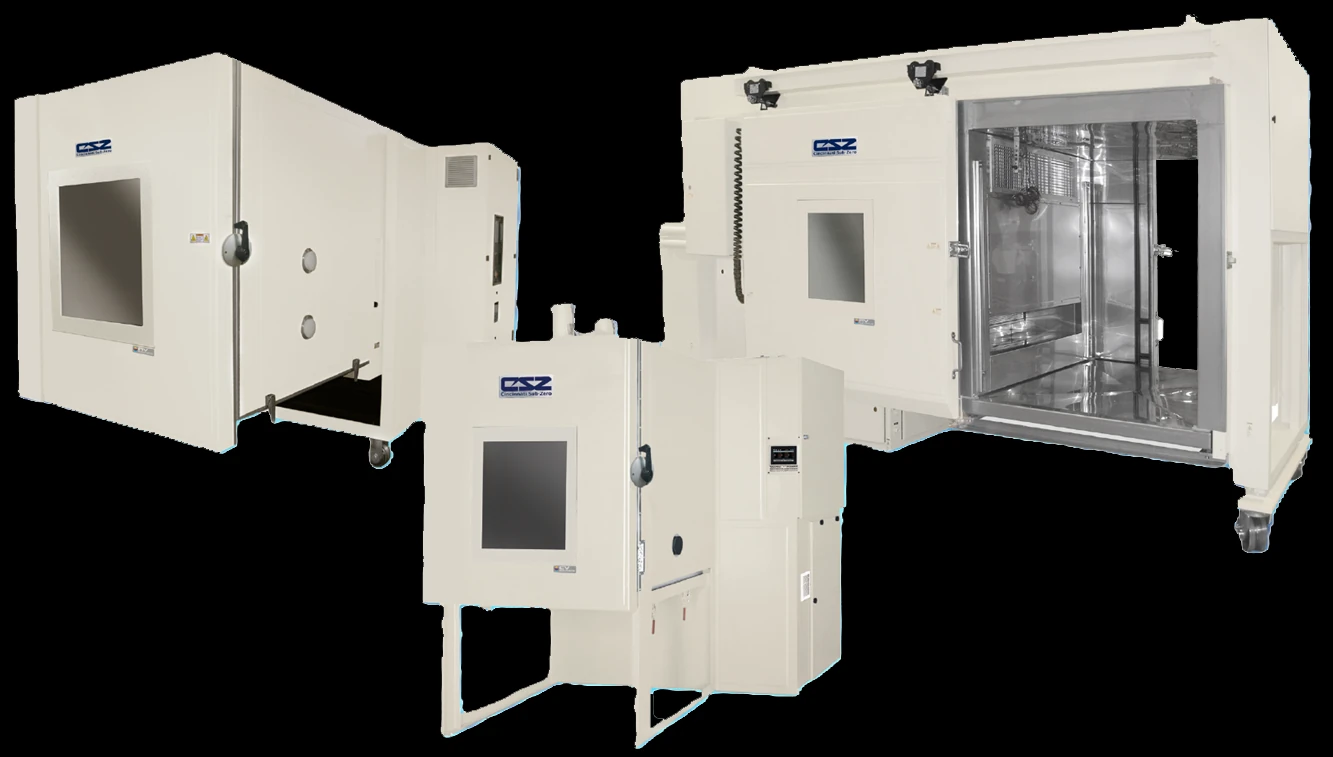
An AGREE chamber combines temperature, humidity, and vibration in one enclosure so an article is exercised under simultaneous thermal and mechanical stress — the combined environment that MIL-STD-810 and RTCA/DO-160 qualification call for. CSZ builds the AV-Series (horizontal or vertical shaker interface) and the CV-Series (vertical), each coupling to a vibration shaker through a diaphragm. The shaker — electrodynamic or mechanical — is selected and supplied separately; Prater specs the chamber to integrate with your new or existing shaker, but the shaker itself is not part of the CSZ chamber. Each model also runs as a standalone temperature/humidity chamber. Refrigeration is tiered from single-stage to cascade (−70 °C).
Key Features & Benefits
- Three environments at once for true qualification — temperature, humidity, and vibration applied together reproduce the combined stress a fielded electronic unit actually sees, which is exactly what the military and avionics methods demand. One chamber covers the combined-environment methods in MIL-STD-810 and DO-160.
- Works with the shaker you choose — the chamber interfaces to a horizontal or vertical electrodynamic or mechanical shaker through a diaphragm, so you can integrate a new shaker or the one you already own — the shaker is sourced separately. Bring your shaker; we build the chamber around it.
- Dual purpose when vibration is idle — with the shaker disengaged the AV/CV runs as a full temperature/humidity chamber, so the asset is not sitting idle between vibration campaigns. A qualification chamber that also earns its keep as a workhorse.
- EZT-570S touchscreen control, ready out of the box — the same color touchscreen controller runs every chamber in the line — 99-step / 1,000-cycle profiles, on-board data logging and audit trail, and email / text alarms if a parameter strays — so an operator who knows one CSZ chamber knows them all. One control platform across your whole test lab.
- Monitor and run it from anywhere — Ethernet / LAN VNC lets you watch and control the chamber from a PC, phone, or tablet, and optional EZ-View software brings several chambers onto one dashboard. Long soak and cycle tests do not need someone standing at the chamber.
Specifications
- How it works
- Combined-environment chamber — runs temperature, humidity, and vibration together so an article is exercised under simultaneous thermal and mechanical stress, the combination called for by military and avionics qualification standards. The chamber interfaces to a vibration shaker through a diaphragm; the shaker is selected and supplied separately (electrodynamic or mechanical) and is not part of the CSZ chamber.
- Chamber configuration
- Two families. AV-Series — interfaces with both horizontal and vertical electrodynamic shakers, with a rear or vertical sliding door and adjustable chamber height. CV-Series — integrates with vibration systems in the vertical mode only. Both interface to the shaker through a fog-free wiperless window and a diaphragm that protects the workspace.
- Standard models & sizes
- AV-Series — AV-14-6-6 through AV-144-27-27 (workspace 28″ up to 72″ wide). CV-Series — CV-8-3.5-3.5 through CV-64-15-15 (24″ to 48″ cube). Each is a standard design, custom-engineered to the test and to your shaker.
- Temperature range
- Tiered by refrigeration, all to +190 °C: single-stage −34 °C, Tundra® −45 °C, Tundra® II −54 °C, and cascade −70 °C. Fast change rates for accelerated stress testing.
- Humidity range
- 10% to 95% RH on humidity builds, as limited by a +85 °C (185 °F) maximum dry-bulb and a +7 °C (+45 °F) minimum dewpoint; a solid-state RH sensor and a demineralizer water system are fitted. (Temperature-only AV/CV builds omit humidity.)
- Vibration
- The chamber couples to a customer-selected electrodynamic or mechanical shaker — AV interfaces horizontally or vertically, CV vertically only — through a diaphragm at the chamber floor or wall. Prater can spec the chamber to integrate with your existing or new shaker; the shaker itself is sourced separately and is not supplied by CSZ.
- Workspace volume
- AV — from 28″×28″×30″ (AV-14) up to 72″×72″×48″ / 78″×54″×48″ on the larger frames; maximum vibration-table size 24″ square up to 48″ square (66″ ×48″ and 60″ square on the widest models). CV — 24″ cube up to 48″ cube, with a maximum shaker body diameter of 23″ to 46″. Custom-size chambers available.
- Live-load capacity
- Rated as a live-load capacity in watts — the heat (from a powered article) the refrigeration can pull while holding setpoint: roughly 2,000 to 10,000 W on the AV-Series and 1,100 to 5,500 W on the CV-Series by model. Empty-chamber cooling and heating are rated in minutes to setpoint. Any heat a powered article dissipates draws against this watt budget.
- Refrigeration system
- Mechanical refrigeration in three tiers (single-stage, Tundra®, cascade) with zero-ozone-depletion refrigerants and a water-cooled condenser; the design protects the compressors across all operating conditions and uses less power for lower operating cost.
- Controller
- EZT-570S touchscreen — up to 99-step / 1,000-cycle profiles, data logging, audit trail, and email / text alarms, with Ethernet TCP/IP and EIA-232/485 interfaces. User-friendly controls for integration into the wider vibration test system.
- PC software & connectivity
- Remote view and control via LAN VNC from PC, phone, or tablet; optional EZ-View PC software; optional custom control-interface capability and remote instrument console for integration with the shaker controller and the broader qualification test rig.
- Safety & interlocks
- Digital temperature limit & alarm, refrigeration high-temperature protection, fused electrical components, and a vapor-proof internal light; explosion-proof electrical construction is available as an option for the workspace environment.
- Test standards
- The combined temperature/humidity/vibration capability is the standard answer for MIL-STD-810 and RTCA/DO-160 electronics qualification, where the methods call for environments applied simultaneously. AGREE is named for the U.S. military Advisory Group on Reliability of Electronic Equipment.
- Utilities & installation
- Recommended supply 480 V / 3-phase / 60 Hz (full-load amps scale with model and refrigeration tier); water-cooled condenser; 50 Hz operation optional. Chamber height is set to suit your shaker, and a site and shaker-interface review is run during specification.
Common Applications
- MIL-STD-810 environmental qualification of military electronics
- RTCA/DO-160 avionics equipment qualification — combined temperature, humidity, vibration
- Accelerated stress testing of electronic assemblies with fast thermal change rates
- Combined-environment reliability programs for defense and aerospace suppliers
- Standalone temperature/humidity conditioning between vibration campaigns
Design & Selection Considerations
- The shaker is yours to source — plan the interface early — CSZ builds the chamber and its diaphragm interface, not the vibration system; the electrodynamic or mechanical shaker is selected and supplied separately. Decide the shaker, its force, and horizontal-vs-vertical orientation up front, because they drive the chamber family (AV vs CV), the door, and the chamber height. Bring the shaker spec into the conversation at the start, not after the chamber is designed.
- Account for the live load the powered article dissipates — a unit under qualification is usually energized and gives off heat that the refrigeration must remove on top of pulling the setpoint — the AV/CV are rated by a live-load capacity in watts set against exactly this. Undersize it and the chamber cannot hold low temperature with the DUT running. Use the input form to tell us the powered heat load, not just the article weight.
- Match the refrigeration tier to the real test extremes — reaching deeper cold costs money and energy: single-stage covers −34 °C, cascade reaches −70 °C. Specify the range the standard actually requires rather than the widest available. The method’s called-out extremes set the tier — not a wish for headroom.
- Thermal mass sets the real change rate — the published ramp or transition rate is for a near-empty chamber; a heavy or dense load slows it down and may need a larger refrigeration package to still hit your transition times. Rate the chamber against your actual loaded mass, not the empty-chamber number.
To configure the right CSZ AGREE chamber:
Use the input form to send the test standard you are working to, the article size and weight (and any heat it dissipates when powered), the temperature range and change rate you need, and any combined stress — vibration, humidity, or altitude — and we will configure the chamber, refrigeration tier, and controller / documentation package to match.
Environmental Test Application Sheet ›Talk to an engineer directly — Scott Prater, Principal · 917-580-0878 · scott@pratertechnical.com
Specifications compiled by Prater Technical Partners from Cincinnati Sub-Zero published product specifications.