Product Overview
A CSZ altitude chamber combines low pressure with temperature (and optional humidity) — a vacuum system pumps the workspace down to simulate high altitude while the chamber holds the thermal setpoint, the combined environment avionics and aerospace components meet in flight. Standard chambers simulate 100,000 ft (8.2 Torr), with 175,000 ft optional, and a dive valve gives rapid decompression for RTCA DO-160E. The CA-Series spans 8 to 64 cu ft with refrigeration tiered to cascade (−68 °C), and each chamber also runs as a standalone temperature/humidity chamber.
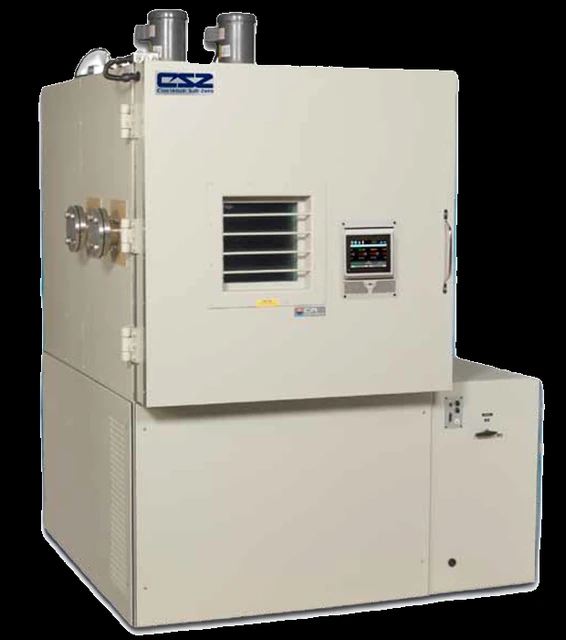
Key Features & Benefits
- Low pressure and temperature in one test — the vacuum system and the thermal system run together, so a part is qualified under the combined altitude-plus-temperature environment it actually faces aloft rather than each stress in isolation. The combined environment, not two separate tests stitched together.
- Rapid decompression for DO-160 programs — a dive valve drops altitude quickly and the chamber is customizable for RTCA DO-160E rapid-decompression methods, so an avionics qualification plan is covered. Built for the decompression methods, not just steady-state altitude.
- Reaches well past the standard ceiling when you need it — beyond the 100,000 ft standard, optional ranges extend to 175,000 ft and even down to simulate sea level when the site sits high above it. Headroom for the unusual altitude profile.
- EZT-570S touchscreen control, ready out of the box — the same color touchscreen controller runs every chamber in the line — 99-step / 1,000-cycle profiles, on-board data logging and audit trail, and email / text alarms if a parameter strays — so an operator who knows one CSZ chamber knows them all. One control platform across your whole test lab.
- Monitor and run it from anywhere — Ethernet / LAN VNC lets you watch and control the chamber from a PC, phone, or tablet, and optional EZ-View software brings several chambers onto one dashboard. Long soak and cycle tests do not need someone standing at the chamber.
Specifications
- How it works
- Altitude (low-pressure) chamber — a vacuum system pumps the workspace down to simulate high altitude while the chamber holds temperature (and optional humidity), so components and sub-assemblies are tested under the combined low-pressure / temperature environment they meet in flight. It also runs as a separate temperature/humidity chamber.
- Chamber configuration
- Welded steel frame with a brushed-stainless interior, non-settling low-k foam or fiberglass insulation, a 3″ access port, and removable service panels. CA-8, CA-16, CA-32, CA-64 standard (8 to 64 cu ft); larger custom chambers are designed to the application.
- Standard models & sizes
- CA-8 (8 cu ft, 24″ cube) · CA-16 (16 cu ft, 30″ cube) · CA-32 (32 cu ft, 38″ cube) · CA-64 (64 cu ft, 48″ cube). Custom sizes and performance packages available.
- Temperature range
- Tiered by refrigeration to +190 °C high: single-stage −34 °C, Tundra® −45 °C, Tundra® II −50 °C, cascade −68 °C. Ultra-high and ultra-low temperatures are an option.
- Humidity range
- Optional 10% to 95% RH on humidity-equipped builds, with a solid-state RH sensor and a demineralizer water system (reverse-osmosis filtration optional).
- Altitude range
- 100,000 ft (8.2 Torr) standard; 175,000 ft (0.37 Torr) optional. Extended ranges can simulate sea-level conditions when the installation site itself sits well above sea level.
- Vacuum system
- Heavy-duty, high-capacity vacuum pumps with a flexible section in the vacuum lines to keep pump vibration out of the chamber. Altitude setpoints are held automatically with a regulated rate of ascent and descent; an automatic altitude-control valve is optional.
- Rapid decompression
- A dive valve rapidly decreases altitude (rapid recompression); chambers are customizable to meet RTCA DO-160E rapid-decompression test requirements.
- Workspace volume
- 8 to 64 cu ft standard (24″ cube up to 48″ cube); larger custom chambers designed to the application.
- Refrigeration system
- Mechanical refrigeration in four tiers (single-stage to cascade) with zero-ozone-depletion refrigerants, a water-cooled condenser, compressor overload and crankcase-heater protection, and high/low pressure switches; LN2 / CO2 boost cooling is optional. Remote refrigeration placement is available.
- Controller
- EZT-570S touchscreen (7″ or optional 10″) — up to 99-step / 1,000-cycle profiles, data logging, audit trail, and email / text alarm notification, with EIA-232/485 computer interface.
- PC software & connectivity
- Remote view and control via LAN VNC from PC, phone, or tablet; optional EZ-View PC software; optional refrigeration-monitor package logging compressor suction/discharge pressures, and a condensation-control option that manages workspace dewpoint.
- Safety & interlocks
- A range of electronic, refrigeration, and cabinet safeties protect product and chamber: digital temperature limit & alarm, fused components, oil-pressure switches, high/low pressure switches, refrigeration high-temperature protection, and pressure-relief devices.
- Test standards
- Customized to meet RTCA DO-160E rapid-decompression requirements; the combined low-pressure / temperature environment supports avionics and aerospace component qualification. Bring the specific method and altitude profile and the chamber is built to it.
- Utilities & installation
- Water-cooled condenser (adequate cooling water or air-cooled space required); compliance to wiring standards optional; main power disconnect optional. A site review is run during specification.
Common Applications
- Avionics component and sub-assembly qualification under altitude and temperature
- RTCA DO-160E rapid-decompression testing of aircraft equipment
- Aerospace and defense electronics environmental qualification
- High-altitude performance verification of sensors, batteries, and electronics
- Standalone temperature/humidity conditioning between altitude campaigns
Design & Selection Considerations
- Decide the altitude ceiling and decompression rate up front — the 100,000 ft standard, the 175,000 ft option, and a DO-160E rapid-decompression rate each size the vacuum system and valving differently. Specify the altitude profile your method calls for early, because it drives the pump capacity and the dive-valve build. The altitude spec is the long-lead part of the chamber.
- Pressure changes what the refrigeration has to do — thin air carries heat poorly, so the load behaves differently under altitude than at sea level; match the refrigeration tier (single-stage to cascade) to the temperature extreme you need at altitude, not just at ground pressure. Spec the cold against the worst-case combined condition.
- Plan vacuum-pump siting and condenser cooling — the high-capacity pumps need siting (a flexible line section keeps their vibration out of the chamber) and the water-cooled condenser needs cooling water or air-cooled space. The vacuum and cooling utilities belong in the site plan before the chamber arrives.
- Thermal mass sets the real change rate — the published ramp or transition rate is for a near-empty chamber; a heavy or dense load slows it down and may need a larger refrigeration package to still hit your transition times. Rate the chamber against your actual loaded mass, not the empty-chamber number.
To configure the right CSZ altitude chamber:
Use the input form to send the test standard you are working to, the article size and weight (and any heat it dissipates when powered), the temperature range and change rate you need, and any combined stress — vibration, humidity, or altitude — and we will configure the chamber, refrigeration tier, and controller / documentation package to match.
Environmental Test Application Sheet ›Talk to an engineer directly — Scott Prater, Principal · 917-580-0878 · scott@pratertechnical.com
Specifications compiled by Prater Technical Partners from Cincinnati Sub-Zero published product specifications.