Product Overview
A thermal shock chamber moves the product physically between a pre-heated zone and a pre-chilled zone, so it sees a near-instant temperature jump — in seconds, not minutes — rather than the gradual air ramp of a cycling chamber. That speed is the point: it imposes severe mechanical stress at solder joints, bonded assemblies, and dissimilar-material interfaces, precipitating defects a slow ramp never finds. CSZ builds both air-to-air shock (the VTS vertical and DTS three-zone double-duty chambers) and liquid-to-liquid shock (the TSB Galden® perfluorinated baths — the most rapid and severe transition available). Designed to MIL-STD-883 Method 1011 and JESD22-A104/A106. If your spec says "shock," a cycling chamber will not satisfy it.
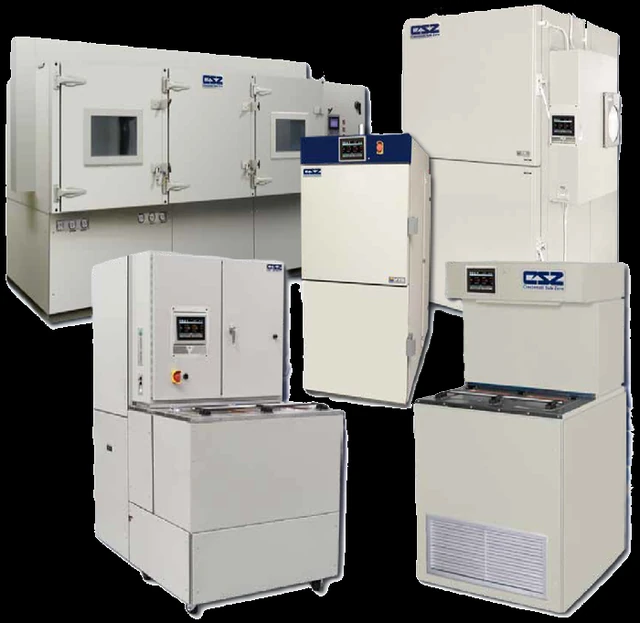
Two media, two severities
CSZ thermal shock comes in two forms. Both transfer the product between a pre-heated and a pre-chilled zone in seconds — the near-instant jump a cycling chamber cannot make; the transfer medium and the achievable severity differ.
- VTS vertical (1–11 cu ft) single hot/cold-zone; DTS three-zone double-duty (16–27 cu ft) exposes two baskets at once
- Hot zone to +210 °C, cold zone to −75 °C
- Product load to 200 lb (rated per MIL-STD-883 Method 1010.8 Test Condition C); the rapid transition satisfies JESD22-A104
- The cold zone doubles as a standalone temperature-cycling chamber; optional LN₂ boost
- A single mesh-stainless basket gear-driven between a hot and a cold Galden® DO2-TS bath; one fluid serves both baths to eliminate cross-contamination
- Hot bath to +160 °C, cold bath to −75 °C
- The most rapid and severe transition available; satisfies JESD22-A106
- Product load 2–5 lb of integrated circuits (rated per Method 1011.9 Test Condition C at 5½ cycles/hr)
Key Features & Benefits
- A near-instant temperature jump a cycling chamber cannot make — transferring the product between pre-conditioned hot and cold zones in seconds imposes the interface stress that a gradual air ramp simply does not reach. The difference between cycling and shock is the whole reason the standard calls for shock.
- Air or liquid — matched to how severe the transition must be — air-to-air shock suits most board- and component-level work; the Galden® liquid bath is reserved for the toughest specs that demand the harshest, fastest jump. Pick the medium by the severity your standard demands.
- Double-duty designs that earn their floor space — the DTS three-zone build tests two baskets at once, and the VTS cold zone doubles as a standalone temperature-cycling chamber — the equipment does more than one job. More throughput, or a second function, from one chamber.
- EZT-570S touchscreen control, ready out of the box — the same color touchscreen controller runs every chamber in the line — 99-step / 1,000-cycle profiles, on-board data logging and audit trail, and email / text alarms if a parameter strays — so an operator who knows one CSZ chamber knows them all. One control platform across your whole test lab.
- Monitor and run it from anywhere — Ethernet / LAN VNC lets you watch and control the chamber from a PC, phone, or tablet, and optional EZ-View software brings several chambers onto one dashboard. Long soak and cycle tests do not need someone standing at the chamber.
Specifications
- How it works
- Thermal shock test — the product is moved physically between a pre-heated zone and a pre-chilled zone so it sees a near-instant temperature jump (not a gradual air ramp). That speed imposes severe mechanical stress at material interfaces — solder joints, bonded assemblies, dissimilar materials — and precipitates hidden manufacturing defects through the expansion and contraction of critical parts.
- Chamber configuration
- Two product lines: air-to-air shock — the VTS vertical chambers (single hot/cold-zone arrangement) and the DTS double-duty chambers (three zones, two baskets) — and liquid-to-liquid shock, the TSB thermal-shock baths. The air chambers’ cold zone has its own heating and cooling and can also run as a standalone temperature-cycling chamber.
- Zones & transfer
- VTS — vertical hot/cold zones with a product carriage that transfers the basket between them (the VTS-1 and VTS-3 transfer without compressed air). DTS — three zones (a hot chamber at each end, a cold chamber in the middle) so two baskets expose twice the product at once, via a pneumatic transfer cylinder. TSB — a single mesh-stainless basket gear-driven between a hot and a cold bath.
- Shock medium
- Air (VTS / DTS) — high-velocity conditioned air passed over the product. Liquid (TSB) — the product is submersed in Galden® DO2-TS perfluorinated fluid, the most severe and rapid transition available; one fluid serves both baths to eliminate cross-contamination. Other fluids may be used with factory approval.
- Standard models & sizes
- Air (VTS vertical): VTS-1 / VTS-3 / VTS-9 / VTS-11 (1, 3, 9, 11 cu ft); air (DTS double-duty three-zone): DTS-16-22-22 / DTS-27-30-30 (16, 27 cu ft); a horizontal HTS series serves larger batch loads. Liquid (TSB baths): TSB-2P-1.5-1.5 / TSB-5P-3-3. Custom sizes (CSZ has built a 144 cu ft vertical chamber) are available.
- Temperature range
- Air (VTS): hot zone +50 °C to +210 °C, cold zone −75 °C to +190 °C. DTS: hot +70 °C to +210 °C, cold −75 °C to +190 °C. Liquid (TSB): hot bath ambient to +160 °C, cold bath ambient to −75 °C.
- Transition time
- The product is transferred between zones in seconds — rapid airflow (air) or basket transfer (liquid) gives the near-instant temperature change that defines shock. The liquid TSB delivers the most rapid and severe transition of the line.
- Workspace volume
- Air: 1 to 27 cu ft (VTS-1 at 28 L through DTS-27 at 765 L; custom larger). Liquid: net bath 12″×12″ (TSB-2) to 15″×15″ (TSB-5).
- Product load
- Per MIL-STD-883 Method 1010.8 Test Condition C: VTS-1 8 lb, VTS-3 17 lb, VTS-9 50 lb, DTS 50–100 lb per basket; maximum product load to 200 lb. Liquid (per Method 1011.9 Cond. C at 5½ cycles/hr): TSB-2 2 lb, TSB-5 5 lb of integrated circuits.
- Refrigeration system
- Mechanical refrigeration using zero-ozone-depletion refrigerants; optional LN2 boost on the air chambers. The TSB baths use bi-modal heating/cooling controls to avoid oversizing the heater against the cooling system, lowering operating cost.
- Controller
- EZT-570S touchscreen — up to 99-step / 1,000-cycle profiles, data logging, audit trail, and email / text alarm notification, with RS-232/485 serial (Ethernet control & monitoring on the DTS).
- PC software & connectivity
- Remote view and control via LAN VNC from PC, phone, or tablet; optional EZ-View PC software for multi-chamber management; optional condensation-control to manage workspace dewpoint and a barcode option for data-file association.
- Safety & interlocks
- Door safety interlocks prevent the door opening during operation; an emergency-stop button cuts chamber power. On the TSB the gear-driven transfer uses proximity switches that freeze the basket on loss of power, fluid, or an opened lid; the bath is a continuously welded type-304 stainless, gasketed-lid vapor-tight enclosure with a vapor-expansion bladder to cut fluid loss.
- Test standards
- Designed to MIL-STD-883 Method 1011 (thermal shock) — CSZ rates product load per Method 1010.8 (air) and 1011.9 (liquid) Test Condition C — and the rapid transition also satisfies JESD22-A104 (air) and JESD22-A106 (liquid) test conditions. If your spec calls for "shock," a thermal-cycling chamber will not satisfy it.
- Utilities & installation
- Three-phase service (200–230 V or 380–460 V depending on model and size); casters and leveling legs on the VTS for mobility. TSB performance is rated at 60 Hz / +75 °F ambient (about 17% less at 50 Hz). A site review is run during specification.
Common Applications
- Solder-joint and circuit-board reliability — precipitating interface failures
- Component and sub-assembly qualification to MIL-STD-883 Method 1011
- Semiconductor and IC package thermal-shock screening (JESD22-A104 / A106)
- Bonded-assembly and dissimilar-material stress testing
- Manufacturing-defect detection on electronic sub-assemblies before shipment
Design & Selection Considerations
- Shock is not cycling — do not substitute one for the other — in cycling, the air ramps over minutes and the product follows gradually; in shock, the product itself is moved between conditioned zones for a near-instant jump. A spec that calls out thermal shock (MIL-STD-883 Method 1011, JESD22-A106) is not met by a cycling chamber. Read the standard’s method number before you pick the chamber type.
- Air vs liquid is a severity-and-handling trade — the Galden® liquid bath gives the fastest, most severe transition, but it adds fluid handling, vapor containment, and per-cycle fluid cost; air-to-air is cleaner to operate and covers most board-level work. Let the test severity and your operating tolerance for fluid decide.
- Rate the load by the standard, and leave basket clearance — product-load ratings are stated per MIL-STD-883 Test Condition C — a denser load slows recovery and eats into the transition you can hold, so size to the rated load with airflow (or fluid) clearance around the parts. The published load is a tested figure, not a packing limit.
- Thermal mass sets the real change rate — the published ramp or transition rate is for a near-empty chamber; a heavy or dense load slows it down and may need a larger refrigeration package to still hit your transition times. Rate the chamber against your actual loaded mass, not the empty-chamber number.
To configure the right CSZ thermal shock chamber:
Use the input form to send the test standard you are working to, the article size and weight (and any heat it dissipates when powered), the temperature range and change rate you need, and any combined stress — vibration, humidity, or altitude — and we will configure the chamber, refrigeration tier, and controller / documentation package to match.
Environmental Test Application Sheet ›Talk to an engineer directly — Scott Prater, Principal · 917-580-0878 · scott@pratertechnical.com
Specifications compiled by Prater Technical Partners from Cincinnati Sub-Zero published product specifications.