Product Overview
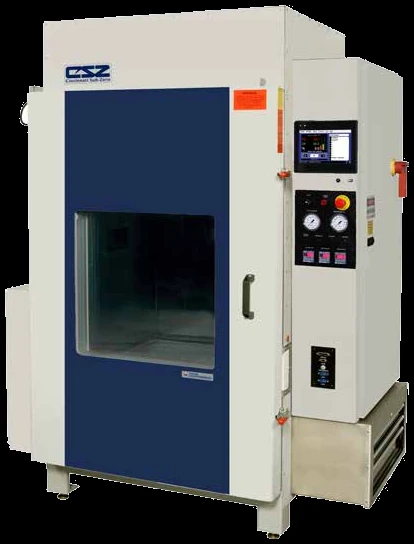
A HALT/HASS Time Compressor® chamber applies rapid thermal cycling and all-axis vibration at the same time — the combination precipitates and exposes defects in a fraction of the time either stress would take alone. Run it as HALT (Highly Accelerated Life Test) during development to push a design past its limits and find weak points, or as HASS (Highly Accelerated Stress Screen) in production to catch latent manufacturing defects on units coming off the line — same platform, opposite intent. CSZ builds four standard sizes reaching −100 °C to +200 °C at 70–100 °C/min and 1 to 90 GRMS. Size the article to the vibration table’s rated payload.
Key Features & Benefits
- Two stresses at once, so defects surface fast — rapid thermal cycling and all-axis vibration applied together precipitate failures that neither stress finds alone — that combination is the whole point of a Time Compressor chamber. Compress months of field exposure into days of test.
- One platform for development and for the production line — the same chamber runs HALT to break a new design on purpose and HASS to screen finished units — you do not buy two machines. Find the weak points in design, then guard the line against them.
- Broad vibration range for both precipitation and detection — a wide-dynamic-range shaker lets you drive hard to provoke a defect, then drop to low level with Modulated Excitation to hear it — the high and low ends both matter. Better detection limits, not just a bigger number.
- EZT-570S touchscreen control, ready out of the box — the same color touchscreen controller runs every chamber in the line — 99-step / 1,000-cycle profiles, on-board data logging and audit trail, and email / text alarms if a parameter strays — so an operator who knows one CSZ chamber knows them all. One control platform across your whole test lab.
- Monitor and run it from anywhere — Ethernet / LAN VNC lets you watch and control the chamber from a PC, phone, or tablet, and optional EZ-View software brings several chambers onto one dashboard. Long soak and cycle tests do not need someone standing at the chamber.
Specifications
- How it works
- Combined-stress reliability chamber — subjects a product to rapid thermal cycling and all-axis broadband vibration simultaneously, precipitating and detecting design and process defects far faster than thermal or vibration stress applied alone. The vibration table design originates with Dr. Gregg Hobbs, who developed HALT & HASS methodology.
- Chamber configuration
- Four standard sizes — TC-2.0, TC-2.5, TC-3.0, TC-4.0, with front and back access doors (double doors on the larger units), a heated viewing window, and front and side cable ports. The door carries a safety interlock that prevents the system running with the door open.
- Standard models & sizes
- TC-2.0 30″×30″×30″ workspace · TC-2.5 34″ cube · TC-3.0 40″ cube · TC-4.0 58″×58″×54″. Vibration tables run 24″ to 48″ square to match.
- Temperature range
- −100 °C to +200 °C — deep cold reached with liquid-nitrogen (LN2) cooling for the fast ramps HALT requires.
- Temperature change rate
- 70 °C to 100 °C per minute (product change rate, measured −65 °C to +85 °C, 6″ above table center with hoses attached; rate varies by model and dwell time).
- Vibration
- 1 to 90 GRMS all-axis (six degrees of freedom) on a bare table, from a large-dynamic-range repetitive-shock shaker with 4 to 13 actuators. High GRMS enhances precipitation of defects; low GRMS with Modulated Excitation aids detection. The TC-4.0 rates 1–80 GRMS.
- Degrees of freedom
- Six degrees of freedom — broadband random vibration in the x, y, and z axes plus roll, pitch, and yaw, applied by pneumatically actuated vibration hammers.
- Workspace volume
- 30″ (76 cm) cube on the TC-2.0 up to 58″×58″×54″ (147×147×137 cm) on the TC-4.0.
- Vibration-table payload
- The vibration table has a rated payload and GRMS capacity, so the article’s mass must fit within the chosen table. Heavier articles step up to a larger table or move to an AGREE (AV/CV) chamber with a separately sourced shaker. Table sizes 24″ to 48″ square.
- Refrigeration system
- Mechanical refrigeration with LN2 (liquid-nitrogen) boost for the deep cold and fast ramps; engineered for low LN2 and utility usage. A fresh-air purge (standard on TC-4.0) flushes nitrogen from the workspace with compressed air.
- Controller
- EZT-570S touchscreen, preloaded with HALT/HASS test profiles; profiles run up to 99 steps and 1,000 cycles, with on-board data logging, audit trail, and email / text alarm notification.
- PC software & connectivity
- RS-232/485 serial and Ethernet; remote view and control from PC, phone, or tablet via LAN VNC; optional EZ-View PC software for multi-chamber monitoring and profile management; optional spectrum-analyzer data acquisition for vibration-spectrum monitoring of the product under test.
- Safety & interlocks
- Factory-preset mechanical over-temperature limit plus separate user-adjustable electronic over/under temperature and vibration limits (fully redundant), a heated-window door interlock, and a safety-relay connection that removes DUT power when the chamber is not running. Optional oxygen-concentration monitor & alarm shuts off LN2 flow on alarm.
- Test standards
- Used across electronics, computing, defense, automotive, and medical reliability programs for HALT (design) and HASS (production) screening. Bring the screen or qualification spec you are working to and the profile is built to it.
- Utilities & installation
- Sound levels 70–76 dBA at 3′ / 30 GRMS depending on model; bulk LN2 supply with safe venting and personnel oxygen monitoring where LN2 is used. A site review is run during specification.
Common Applications
- Electronics and circuit-board ruggedization — finding design margins before launch (HALT)
- Production stress-screening of finished assemblies to catch latent defects (HASS)
- Defense and automotive electronics reliability programs
- Medical-device and computing-hardware reliability growth
- Warranty-cost and field-return reduction through accelerated life testing
Design & Selection Considerations
- HALT or HASS — decide which question you are answering — HALT is a development test: push escalating thermal and vibration stress well past spec to find and fix design margins, run once per design. HASS is a tuned, repeatable screen run on every unit (or a sample) gently enough not to consume useful life. Same chamber, opposite intent — the profile, not the hardware, is what changes.
- Size the article to the vibration table, first — every table is rated for a maximum mass; if the article weighs more than that, you lose the vibration spectrum you need to drive the test. A heavier article steps up to a larger table, or moves to an AGREE chamber driven by a high-force electrodynamic shaker. Check the mass against the table before you check anything else.
- Plan the LN2 supply and oxygen safety — the fast ramps and −100 °C floor are LN2-cooled, so the install needs a bulk nitrogen supply, safe venting, and personnel oxygen monitoring (an O2 monitor that cuts LN2 flow on alarm is available). The deep-cold capability comes with a gas-handling plan.
- Thermal mass sets the real change rate — the published ramp or transition rate is for a near-empty chamber; a heavy or dense load slows it down and may need a larger refrigeration package to still hit your transition times. Rate the chamber against your actual loaded mass, not the empty-chamber number.
To configure the right CSZ HALT/HASS chamber:
Use the input form to send the test standard you are working to, the article size and weight (and any heat it dissipates when powered), the temperature range and change rate you need, and any combined stress — vibration, humidity, or altitude — and we will configure the chamber, refrigeration tier, and controller / documentation package to match.
Environmental Test Application Sheet ›Talk to an engineer directly — Scott Prater, Principal · 917-580-0878 · scott@pratertechnical.com
Specifications compiled by Prater Technical Partners from Cincinnati Sub-Zero published product specifications.