Product Overview
The Classic is Flo-tech’s single-rotor turbine flow sensor — the sensor you plumb into a hydraulic circuit and wire to your own electronics or to a Flo-tech display. Fluid spins a bladed rotor at a speed proportional to flow, and a magnetic pick-up reads it as a frequency signal; specify the optional IFC instead and that same body delivers a 4–20 mA or 0–5 VDC analog output. On the frequency pick-up it holds ±1% of full scale; with the IFC it holds ±1% of reading at 32 cSt, both repeating to ±0.2% with a turbine response under 200 ms. It comes in three bodies on one datasheet — anodized-aluminum FSC, flanged-aluminum FSB, and Stressproof-steel FSD (see Variants) — together covering 0.4 to 350 GPM and rated to 5000 psi in aluminum or 6000 psi in steel. It measures forward flow only; for a reversing line use the bi-directional Quad. The smallest sensor (FSC-375) uses the F5140 K-Factor Scaler to drive the F6600/F6650 displays.
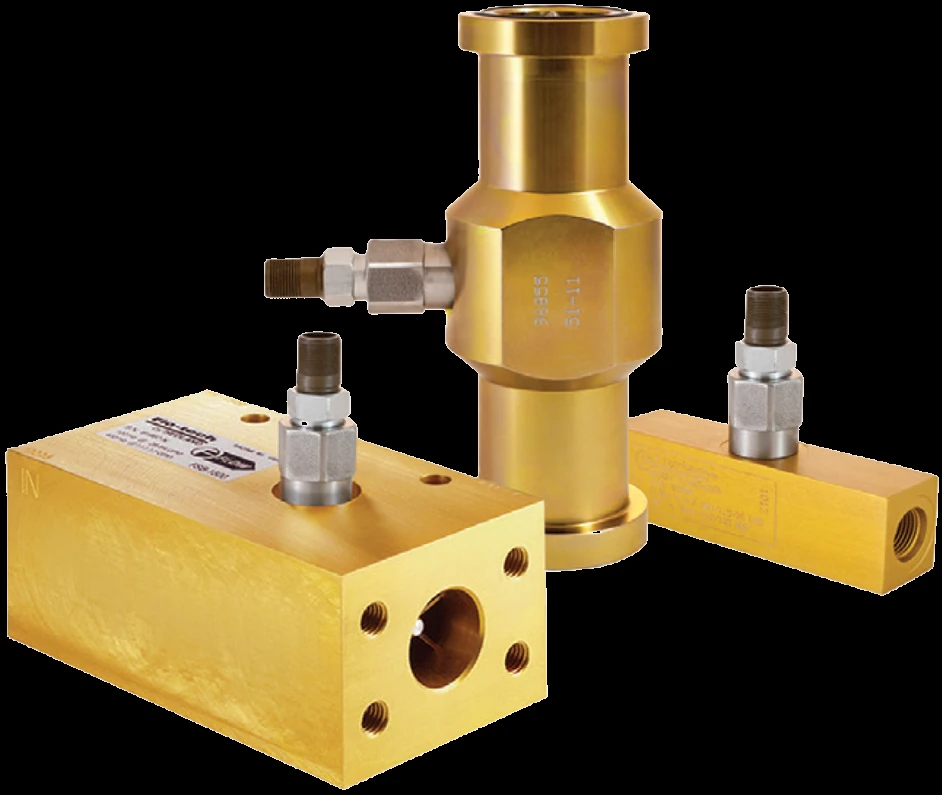
One datasheet, three bodies
The Classic is the same single-rotor turbine in three body styles — same rotor, magnetic pick-up, optional IFC, ±0.2% repeatability, and ≤200 ms response. The body sets the material, the port style, the size range, and the pressure rating.
- Anodized 6013-T651 aluminum body with SAE J1926/1 straight-thread ports
- Models FSC-375 through FSC-1005 — SAE 8 to SAE 16, 0.4 to 85 GPM
- Rated to 5000 psi (345 bar); the FSC-375 needs the F5140 K-Factor Scaler for the F6600/F6650 displays
- Anodized aluminum body with Code 61 4-bolt-face flange ports
- Models FSB-1250 and FSB-1500 — SAE 20 and SAE 24, 5 to 200 GPM
- Rated to 5000 psi (345 bar)
- Stressproof steel body (zinc-plate dichromate) with Code 62 flange-head ports (SAE J518); tungsten-carbide journal bearings
- Models FSD-1250 through FSD-2000 — SAE 20 to SAE 32, 5 to 350 GPM
- Rated to 6000 psi (414 bar) — the high-pressure body
Key Features & Benefits
- Three bodies, one rotor — the same single-rotor turbine ships in an anodized-aluminum body (FSC), a flanged aluminum body (FSB), or a Stressproof-steel body (FSD) — so one sensor type covers SAE-threaded, 4-bolt-face, and flange-head plumbing from low-flow lines to 350 GPM. Pick the body the circuit needs.
- Frequency native, analog when you want it — the standard magnetic pick-up puts out a frequency pulse for a Flo-tech F6600/F6650 display or a counter; add the optional IFC and the same sensor gives a 0–5 VDC or 4–20 mA analog signal for a PLC, recorder, or the F6700/F6750 display. One sensor, the signal your host reads.
- Reads more accurately with the IFC — the magnetic pick-up version is rated ±1% of full scale; the IFC version tightens that to ±1% of reading at 32 cSt — the figure that matters where the value has to track across the range. Spec the output to the accuracy you need.
- Built to take hydraulic pressure — aluminum FSC and FSB bodies are rated to 5000 psi and the Stressproof-steel FSD to 6000 psi, with built-in flow straighteners and a ball- or tungsten-carbide journal-bearing rotor. Plumb it into the working circuit.
Specifications
- Measurement principle
- Single-rotor turbine. Fluid through the sensor spins a bladed rotor at a speed proportional to flow rate; as the blades pass a magnetic pick-up they generate a frequency signal. Built-in flow straighteners condition the stream. Uni-directional — the Quad is the bi-directional derivative.
- Measured parameters
- Flow rate — hydraulic fluid and compatible liquids. Optional pressure and temperature sensors share the body so one line break returns flow, pressure, and temperature.
- Flow ranges
- 0.4 to 350 GPM (1.5 to 1324 LPM) across the bodies, by model — FSC-375 0.4–7 GPM at the low end, FSD-2000 10–350 GPM at the top.
- Accuracy
- By output. IFC versions: ±1% of reading @ 32 cSt (4–20 mA or 0–5 VDC). Standard magnetic-pickup / frequency versions: ±1% of full scale (±1% of rate when read on the F6600/F6650 display).
- Repeatability
- ±0.2%.
- Turbine response time
- ≤200 ms.
- Calibration reference fluid
- Calibrated on 0.876 SG, 150 SUS (32 cSt) hydraulic oil, irrespective of final fluid; three points of calibration data ship with every sensor.
- Functional viscosity range
- Functional range 25 to 500 SUS (2 to 110 cSt).
- Operating / fluid temperature
- Fluid −4 to +300°F (−20 to +150°C); ambient −4 to +131°F (−20 to +55°C).
- Maximum pressure
- FSC and FSB: 5000 psi (345 bar). FSD: 6000 psi (414 bar). See Variants.
- Port / connection sizes
- SAE straight-thread (J1926/1) on FSC; Code 61 4-bolt face on FSB; Code 62 flange head (SAE J518) on FSD. Sizes SAE 8 through SAE 32 by model.
- Body / housing materials
- Anodized 6013-T651 aluminum (FSC, FSB); Stressproof steel, zinc-plate dichromate finish (FSD). See Variants.
- Wetted materials
- T416 stainless turbine rotor; 440C stainless ball bearings (tungsten-carbide journal bearings on FSD); T303 stainless rotor shaft. Buna-N seals standard; Viton or EPR optional.
- Outputs
- Frequency (native magnetic pick-up), 4–20 mA, or 0–5 VDC — the analog outputs come from the optional IFC (Intelligent Frequency Converter), at 1:4000 resolution.
- Calibration certificate
- Three-point calibration data standard. Optional NIST-traceable 5-point (F001109) or 10-point (F001110) certificate.
Common Applications
- Feeding flow into a Flo-tech digital display, a PLC, a recorder, or a PC data-acquisition card on a permanent hydraulic stand
- OEM machine and test-stand flow indication where the sensor is plumbed in and wired to existing electronics
- Pump-output, motor, and cylinder-circuit flow monitoring on stationary and mobile hydraulics
- Feedback for hydraulic-system control — a frequency signal back to a PLC for speed or position
- Lubrication and fuel-oil flow indication on machine tools and gearbox circuits
Design & Selection Considerations
- Output sets the accuracy — and the display — order the IFC analog output (4–20 mA / 0–5 VDC) when you need ±1% of reading or a PLC/recorder/F6700-series input; order the standard frequency pick-up for a counter or the F6600/F6650 display, where the sensor reads ±1% of full scale. The choice is made at order — tell us how the reading has to land.
- The smallest sensors need the F5140 K-Factor Scaler — the low-level frequency of the FSC-375 (F2945) is too weak to drive the F6600/F6650 displays directly, so it takes the F5140 K-Factor Scaler to amplify and scale the signal. Larger FSC/FSB/FSD bodies drive the displays without it.
- Plan straight run and filtration — for laminar flow allow at least 10 port diameters of unobstructed upstream pipe and 5 downstream, and filter to 40 micron or better; mounting the sensor a little high in the circuit keeps debris from collecting in it.
- Uni-directional — step to the Quad if the line reverses — the Classic measures forward flow only. For a closed-loop or reversing circuit use the Quad, the bi-directional turbine derived from the FSC series.
- Order traceable calibration when the reading must hold up — every sensor ships with three points of calibration data on 0.876 SG / 150 SUS (32 cSt) oil; for warranty, contract, or lab work order the NIST-traceable 5-point or 10-point certificate, and tell us the operating viscosity if it sits far from 32 cSt so we set the right accuracy expectation.
To size & select the right Classic turbine sensor:
Use the input form to tell us the hydraulic circuit, the flow range and port size, the working pressure and temperature, the fluid and its operating viscosity, and what you need the reading to do — a live field check, recorded data, or a permanent stand — and we’ll match the tester, sensor, and display, confirm the output and any NIST-traceable calibration, and price it — with programming and commissioning available as an optional, quoted service.
Flow Meter Application Sheet ›Talk to an engineer directly — Scott Prater, Principal · 917-580-0878 · scott@pratertechnical.com
Specifications compiled by Prater Technical Partners from Badger Meter Flo-tech hydraulic test & diagnostics product literature.