Product Overview
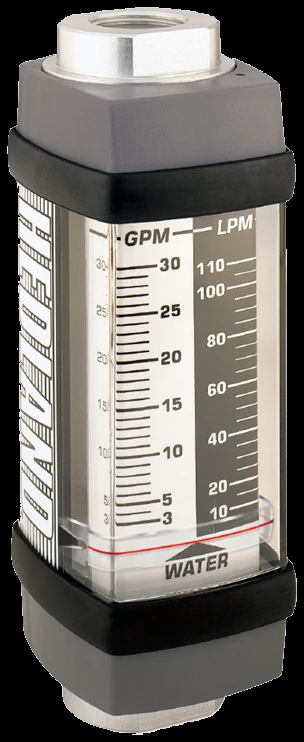
Hedland’s corrosive-liquids meters put the variable-area piston in a solid 316 stainless body for A.P.I. oil, caustics and corrosive liquids that attack aluminum and brass. Wetted parts are all T316 stainless with Viton seals, and because stainless does not derate with temperature the meter holds its full rating — 6,000 psi in the small sizes, 5,000 psi in the larger ones (3:1 safety factor). It reads ±2% of full scale in any orientation with no straight run, on a scale calibrated for the specified fluid, across ¼ to 1½ in. ports in NPTF and BSPP. Add a Flow-Alert switch or MR transmitter when the line needs an alarm or an analog signal.
Key Features & Benefits
- 316 stainless wetted parts — a solid T316 stainless body, piston and cone stands up to caustics, corrosive oils and corrosive aqueous chemistries that attack aluminum and brass
- No temperature derating — stainless holds its full pressure rating across the temperature range — no derating above 240°F the way aluminum and brass require
- Reads in any position — the spring-loaded piston measures accurately in any orientation — no straight run or flow straighteners
- High-pressure rated — rated to 6,000 psi in ¼ & ½ in. and 5,000 psi in larger sizes (3:1 safety factor)
- Scaled to your fluid — the linear scale is calibrated for the specified corrosive fluid; special scales cover off-standard gravities and units
- Size and connection range — ¼ to 1½ in. ports in NPTF and BSPP
Specifications
- Measurement principle
- Variable area — a spring-loaded piston and sharp-edged orifice form an annular opening against a contoured metering cone; a magnet on the piston couples to an external indicator that reads directly on a linear scale
- Compatible fluids
- A.P.I. oil, caustics and corrosive liquids — corrosive oils and corrosive aqueous / chemical liquids handled by 316 stainless wetted parts
- Accuracy
- ±2% of full scale (±7% of full scale on ¼ in. meters)
- Repeatability
- ±1%
- Flow ranges
- 0.1 to 100 US GPM (0.5 to 380 LPM), by port size (¼–1½ in.), fluid scale and full-scale range
- Port / line sizes
- ¼ to 1½ in.
- Body material
- T316 stainless steel
- Wetted materials
- All-T316 stainless body, piston, cone, spring, spider plate and fasteners; PPS / ceramic indicator magnet
- Seals
- Viton
- Process / fluid temperature
- Standard −20 to +240°F (−29 to +116°C); the Hostile-Environment (HE) option extends the range to +400°F (+205°C) continuous and +500°F (+260°C) intermittent (stainless does not derate with temperature)
- Pressure rating
- Stainless 6,000 psi (414 bar) in ¼ & ½ in. and 5,000 psi (345 bar) in ¾–1½ in.; 3:1 safety factor
- End connections / threads
- NPTF (ANSI B2.2) and BSPP (ISO 1179)
- Mounting orientation
- Any orientation, including inverted; guard / scale rotates 360° after install
- Flow scale
- Linear scale calibrated for the specified fluid (e.g. 0.876 s.g. oil or 1.0 s.g. water-based); special scales available in any unit for other gravities or viscosities
- Viscosity range
- Good accuracy over 40 to 500 SUS (4.2 to 108 cSt) on high-flow models
- Filtration
- 200 mesh (74 micron) or better required
- Options
- Hostile-Environment (HE) option for severe service — cylindrical Pyrex glass guard, T416 stainless indicator, all-T316 stainless bumper, end caps and scale support, and a Teflon-coated Alnico magnet, rated to +400°F continuous (+500°F intermittent); special scales for off-standard gravities or units
- Electronics / outputs
- Direct-reading; add a Flow-Alert switch for a trip contact or an MR transmitter for rate / total with a 4–20 mA or DC-voltage output
- Calibration
- Calibrated against NIST-traceable master meters (oil- or water-based per fluid); a new-meter Calibration Certificate is available
- Certifications
- Certificate of Conformance, NIST-traceable Calibration Certificate, and Certified Drawings available
- Standards & fatigue rating
- Fatigue rated per NFPA T2.6.1 R1-1991 (C/90)
Common Applications
- Caustic (sodium hydroxide) and acid dosing / transfer flow
- Corrosive-oil and chemical-process liquid metering
- A.P.I. oil and oilfield chemical flow indication
- Water-treatment and chemical-injection flow checks where stainless is required
Design & Selection Considerations
- Match the body and seals to the fluid — the meter is offered in anodized aluminum, brass and 303 / 316 stainless steel with Viton or EPR seals, and the right pairing is fluid-driven: aluminum for petroleum and air, brass for water, and 316 stainless for caustics and corrosive liquids or corrosive gases. Phosphate ester is the seal exception — it attacks Viton, so that family alone runs EPR in place of the standard Viton seals. Use the input form to tell us the fluid and we’ll pair the body alloy and elastomer to it — the wrong seal is the usual failure mode.
- Order the scale for your fluid — the meter is calibrated to a specific gravity — a Hedland scale is printed for one fluid: 0.876 s.g. for petroleum, 1.18 s.g. for phosphate ester and 1.0 s.g. for water and water-based fluids. Read a different fluid and the indication shifts with density. Hedland computer-corrects the phosphate-ester and water-based scales at the factory, and special scales are available in any unit for off-standard gravities or viscosities. Use the input form to give us the actual fluid, specific gravity and units — we order the scale that reads true in service.
- Size to the flow, not the pipe — and watch the pressure drop — a variable-area meter reads full scale at the top of its band, so size to the real flow and keep the permanent pressure drop in check (most hydraulic sizing targets 10 psid maximum). Each port size offers several full-scale ranges. Use the input form to send the normal and maximum flow and we’ll pick the range that reads mid-scale and stays inside your allowable ΔP.
- Install it anywhere — no straight run or flow straighteners — the spring-loaded piston design reads accurately in any orientation, including inverted, and tolerates mounting immediately next to elbows, valves and pumps with no upstream straight run or flow straighteners. The guard / scale rotates 360° after install for readability. This is the meter for tight, awkward plumbing where a turbine or rotameter would need straight pipe it doesn’t have.
- Filter the line to 200 mesh — the meter is more contamination-tolerant than most system components, but 200 mesh (74 micron) or better filtration is required for reliable indication and to protect the metering orifice and piston. Confirm upstream filtration before commissioning — grit in the annulus is what pulls a variable-area reading off.
- Mind material and temperature when you set the pressure rating — pressure capability follows the body alloy: in ¼–1½ in. liquid service aluminum and brass are rated 3,500 psi and stainless 5,000–6,000 psi, all to a 3:1 safety factor. Aluminum and brass derate above 240°F; stainless does not. A high-temperature build extends the range to +400°F continuous (+500°F intermittent). Use the input form to give us the working pressure and the peak temperature together — they set the alloy and whether you need the HT build.
- Add the electronics only where the job needs a signal — the standard meter is direct-reading. Where the application needs an alarm or a feed to a control system, specify a Flow-Alert switch for a trip contact at a set flow, or an MR transmitter for rate / total plus a 4–20 mA or DC-voltage output. Local indication is free; choose the switch or transmitter when you need a contact or an analog signal.
To size & select the right flow meter for corrosive liquids:
Use the input form to send your fluid, specific gravity, normal and maximum flow, line size and the working pressure and temperature — with any corrosion or hazardous-area requirement — and we’ll spec the body alloy, seals, port, scale and any switch or transmitter for your application.
Flow Meter Application Sheet ›Talk to an engineer directly — Scott Prater, Principal · 917-580-0878 · scott@pratertechnical.com
Specifications compiled by Prater Technical Partners from Badger Meter Hedland variable-area flow-meter product literature.