Product Overview
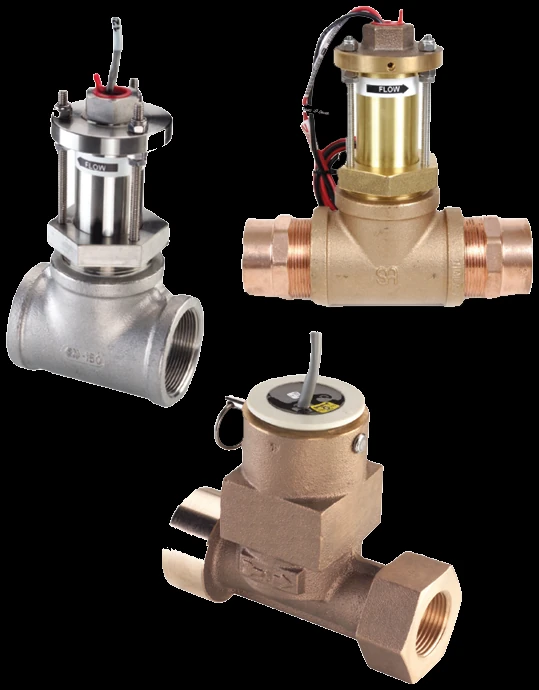
The metal Tee Series 228 and 250 put a six-bladed impeller into small and mid-size metal lines as a factory-assembled meter — the sensor is preset in a threaded tee, so the install is a single plumbing connection with no saddle, no pipe tap and no insertion depth to set. The Series 228 comes in cast bronze (228BR) and cast iron (228CB) in 2 and 2-1/2 in. and cast 316 stainless (228SS) in 2 in., and holds ±1% of full scale; the compact cast-bronze Series 250 reaches down to 1/2 in. and runs to 1-1/2 in. at ±1% of rate over a 60:1 turndown. Both run the same proprietary non-magnetic impeller element — the reason a single calibration table covers the pair — and both carry a two-wire raw frequency up to 2000 ft to a 300-series transmitter, an FC-5000 display or the BTU electronics. On the Series 250 the electronics lift out of the tee and the impeller, bearing and shaft replace in the field without recalibration.
Key Features & Benefits
- Drops in as one preassembled piece — a sensor-in-tee assembly installs with a single threaded connection — no saddle, no tap, no insertion-depth setting to get right
- Bronze, stainless or cast iron — the 228 tee comes in cast bronze or cast iron in 2 and 2-1/2 in. and cast 316 stainless in 2 in., to suit the fluid and the line
- Compact 250 down to 1/2 in. — the cast-bronze Series 250 reaches small lines as the rate-accurate energy and sub-metering meter, where the larger 228 reads to full scale
- Fouling-resistant six-bladed rotor — the non-magnetic forward-swept impeller holds its reading at low flow where a draggier four-bladed rotor would stall
- Field-serviceable without recalibration — the 250 sensor pulls from the tee for service and similar units interchange with no recalibration
- Raw signal travels 2000 ft — the two-wire square-wave frequency carries up to 2000 ft to a transmitter, display or BTU monitor without amplification
Specifications
- Measurement principle
- Tee-mounted impeller (paddle-wheel) — a six-bladed forward-swept impeller (Series 228) or a six-bladed rotor in a compact cast-bronze housing (Series 250) preset in a threaded tee; the proprietary non-magnetic sensing mechanism gives consistent torque, resists debris fouling, and is unaffected by the rust and metallic particles common to ferrous lines
- Service / fluids
- Clean-liquid flow in small and mid-size metal lines — water, condenser, cooling-tower and condensate-return service and building energy / BTU sub-metering
- Accuracy
- Series 228 ±1% of full scale; Series 250 ±1% of rate over a 60:1 turndown
- Repeatability
- Series 228 ±0.3% of full scale (linearity ±0.2%); Series 250 ±0.7%
- Flow range
- Series 228 0.5 to 30 ft/sec; Series 250 0.3 to 15 ft/sec
- Line sizes
- Series 228: 2 in. (228SS) and 2 / 2-1/2 in. (228BR, 228CB); Series 250: 1/2 to 1-1/2 in.
- Tee / body material
- Series 228 cast bronze (228BR, Class 125 per ASME B16.15), cast 316 stainless (228SS, Class 150 per MSS SP-114) or cast iron (228CB, Class 125 per ASME B16.4); Series 250 cast valve bronze, UNS C83600
- Wetted materials
- On the 228 the sensor sleeve and hex adapter follow the body — admiralty-brass sleeve (UNS C44300) with a lead-free-brass hex adapter (C89833) on the 228BR / 228CB, Series 300 stainless on the 228SS; o-ring, shaft, impeller and bearing per the part-number matrix
- O-rings / seals
- EPDM standard; Viton or Buna-N optional
- Process / fluid temperature
- Standard 221°F (105°C) continuous; IR irrigation electronics 150°F (66°C)
- Pressure rating
- At ≤150°F: 228BR 200 psi, 228SS 300 psi, cast-iron 228CB 175 psi (each derating with temperature); Series 250 400 psi at 100°F
- End connections
- Threaded NPT tee — bronze, stainless or cast-iron on the 228, female-NPT cast bronze on the 250
- Signal / output
- Two-wire raw frequency (low-impedance square wave) proportional to flow; power and signal share a single pair
- Signal transmission
- Travels up to 2000 ft (610 m) without amplification; supplied with 20 ft of shielded cable
- Electronics options
- Pairs with a 300-series transmitter (4–20 mA, pulse or relay), an FC-5000 display, or the 380DS / 340 BTU energy path
- Field serviceability
- Series 250 sensor electronics lift out of the tee and the impeller, bearing and shaft replace in the field without changing calibration
- Certifications
- Series 250 meets CE standards for noise immunity and susceptibility
- Options
- IR irrigation electronics with direct-burial leads; high-temperature 228 build (PEEK housing); o-ring, shaft, impeller and bearing choices
Common Applications
- Building chilled- and hot-water and condenser-loop flow on small and mid metal lines
- Cooling-tower and condensate-return flow
- Energy management and BTU sub-metering — the compact Series 250
- Process- and city-water branch metering
- Pump and booster flow verification during commissioning
Design & Selection Considerations
- Size the tee to the line and the body to the fluid — the tee meter ships as one preassembled piece — the sensor already set in a tee of the right size — so installation is a single plumbing connection. Choose the body for the fluid: cast bronze for water, condenser and cooling-tower service, 316 stainless for aggressive or higher-purity water, cast iron where cost rules, and Schedule 80 PVC for potable and corrosive lines. Use the input form to give us the line size, material and fluid and we’ll spec the tee and the wetted stack.
- Give it straight run — it is still a velocity meter — mounted in a tee or not, an impeller meter reads one point in the flow profile, so the same rule applies: at least 10 pipe diameters of straight run upstream and 5 downstream of any elbow, valve or pump. Use the input form to send us the pipe run around the meter location and we’ll confirm it will read true.
- Read the accuracy class against the duty — the tee meters span a range of accuracy: the metal Series 228 holds ±1% of full scale, the compact Series 250 ±1% of rate over a 60:1 turndown, and the economical 735 irrigation tee ±3% of full scale. Use the input form to tell us how tight the reading has to be and we’ll match the meter to it — billing and energy sub-metering want the rate-accurate meter; a wet-utility check tolerates the economy tee.
- Keep the fluid clean and the pipe full — as with every impeller meter the rotor wants reasonably clean water and a full pipe; grit and heavy solids wear the bearing and a partial pipe under-reads. If the water carries solids, a strainer ahead of the meter protects it.
- Pick the electronics for the signal you need — the tee sensor is a two-wire raw-pulse device; pair it with a 300-series transmitter for a 4–20 mA, scaled-pulse or relay output, an FC-5000 display for local rate / total, or the Series 380DS path for energy. Use the input form to tell us where the reading goes and we’ll match the electronics.
To size & select the right Metal Tee Series 228 & 250:
Use the input form to send your pipe size and material, the fluid with its temperature and pressure, and the flow range — with whether you need a local display, an analog or pulse output, or a Modbus / BACnet signal — and we’ll spec the insertion style or tee, the wetted materials and the electronics.
Flow Meter Application Sheet ›Talk to an engineer directly — Scott Prater, Principal · 917-580-0878 · scott@pratertechnical.com
Specifications compiled by Prater Technical Partners from Badger Meter Data Industrial impeller flow-sensor product literature.