Product Overview
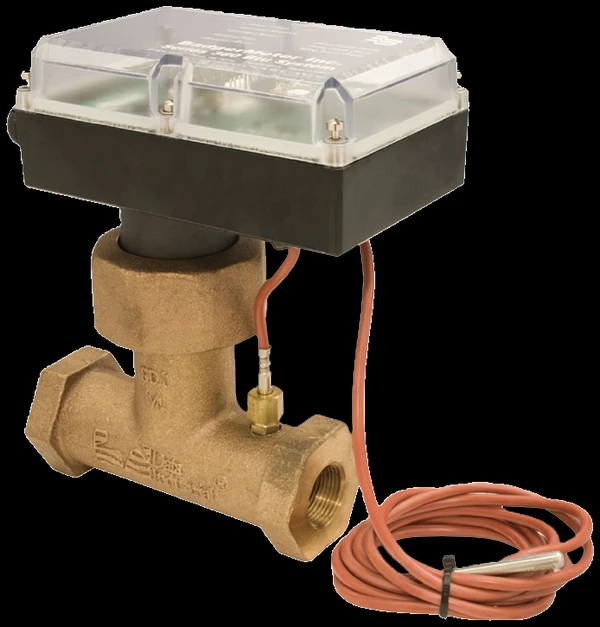
The Series 380DS is the all-in-one thermal-energy meter for hydronic heating and chilled-water loops: flow, temperature and energy combine in one brass tee, sized 3/4 to 2 in., so a complete BTU point goes in as a single device rather than a flow meter, a temperature pair and an energy computer wired together. One RTD sits in the flow tee and the second goes on the supply or return line, whichever is easier to reach. It computes energy at ±2% of flow rate and reports flow rate and total, energy rate and total, both temperatures and Delta-T over BACnet MS/TP or Modbus RTU (field-selectable), with a scaled pulse output as the simple alternative. A laptop sets it up in the field — the energy units and method, the bus protocol, the pulse scaling, and the heat-transfer properties of the loop fluid — and the one-device build brings energy metering within reach where two or three separate instruments were never cost-justified.
Key Features & Benefits
- Flow, temperature and energy in one tee — a single brass tee carries the impeller flow sensor, a built-in temperature probe and the energy electronics — the second probe goes on the supply or return line
- BACnet and Modbus standard — both BACnet MS/TP and Modbus RTU ship on every unit; select the protocol in the field and read flow, energy, both temperatures and Delta-T on the bus
- Or a simple scaled pulse — where a network is not needed, an open-drain scaled pulse representing energy total drops into a PLC or counter
- Cost-effective energy metering — integrating flow and temperature in one device meters energy where a separate flow-plus-energy system was never justified
- Five tee sizes — 3/4 to 2 in., 1.65 to 157 gpm, covers building and tenant hydronic loops
- Field-commissioned — set energy units, method, protocol, pulse scaling, fluid density and specific heat from a computer at start-up
Specifications
- Function
- Integrated thermal-energy (BTU) meter — an impeller flow sensor, two temperature probes and the energy electronics in a single brass tee
- Measurement principle
- Impeller flow sensor plus a temperature pair; the on-board computer integrates flow and the supply-to-return temperature differential to compute hydronic heating or cooling energy
- Service / fluids
- Hydronic heating and chilled-water energy sub-metering and tenant billing
- Measured parameters
- Flow rate, flow total, energy rate, energy total, supply (Temp 1) and return (Temp 2) temperature, and Delta-T — all available over RS-485
- Flow accuracy
- ±2% of flow rate within the flow range
- Repeatability
- ±0.5%; RTD meets IEC 751 Class B
- Flow range
- 1 to 15 ft/sec — 1.65 to 24.69 gpm (3/4 in.), 2.70 to 40.48 gpm (1 in.), 4.66 to 69.93 gpm (1-1/4 in.), 6.35 to 95.18 gpm (1-1/2 in.) and 10.49 to 157.34 gpm (2 in.)
- Tee sizes
- 3/4, 1, 1-1/4, 1-1/2 and 2 in. tee
- Temperature sensors
- Two temperature probes — one mounted directly in the flow-sensor tee, the second on the supply or return line for installation convenience
- Outputs
- Scaled pulse (open-drain, 0.01 to 100 Hz) representing energy total, plus RS-485
- Communication
- BACnet MS/TP and Modbus RTU standard — the protocol is field-selected
- Power
- 12 to 35V DC or 12 to 28V AC
- Wetted / sensor materials
- PEEK flow sensor; EPDM o-ring; tungsten-carbide shaft; stainless impeller; Ketron bearing
- Tee material
- Brass
- Fluid temperature
- Fluid 20 to 260°F (−6.7 to 126.7°C)
- Pressure rating
- 230 psig at 260°F, up to 400 psig at 20°F
- Ambient temperature
- −4 to 149°F (−20 to 65°C)
- Commissioning
- Field-commissioned via a computer connection — energy units, measurement method, communication protocol, pulse-output scaling, fluid density and specific heat
Common Applications
- Tenant and process energy (BTU) sub-metering and cost allocation
- Chilled-water and hot-water loop energy measurement
- Building-automation energy reporting over BACnet or Modbus
- Branch and zone energy monitoring on a campus or multi-building hydronic plant
- Retrofit energy metering where a full BTU system was too costly
Design & Selection Considerations
- Energy accuracy lives in the temperature pair — the BTU calculation is flow times the supply-to-return temperature differential, so the matched RTD pair and a representative Delta-T matter more than the flow reading on a low-ΔT loop. The 380DS puts one probe in the flow tee and the second on the supply or return line; place the second probe where it sees true loop temperature. Use the input form to tell us the design supply / return temperatures and we’ll confirm the meter resolves your ΔT.
- Set the fluid properties at commissioning — energy depends on the fluid’s density and specific heat, so a glycol loop reads differently from water. The 380DS takes fluid density and specific heat at field commissioning along with the energy units and method. Use the input form to give us the fluid and glycol percentage and we’ll set the commissioning parameters.
- Size the tee to the flow, and pick the bus — each tee size carries its own gpm band (1.65 to 24.69 gpm at 3/4 in. up to 10.49 to 157.34 gpm at 2 in.), so size to the real flow; then choose BACnet MS/TP or Modbus RTU — both are standard — or the scaled pulse. Use the input form to send the loop flow and the building-automation protocol and we’ll spec the tee and the output.
To size & select the right Series 380DS BTU System:
Use the input form to tell us the flow sensor, the pipe size and the fluid — and, for energy, the supply and return temperatures — plus what the output has to do (a trip relay, a 4–20 mA loop, a scaled pulse, or Modbus / BACnet), and we’ll match the transmitter or computer to it.
Flow Meter Application Sheet ›Talk to an engineer directly — Scott Prater, Principal · 917-580-0878 · scott@pratertechnical.com
Specifications compiled by Prater Technical Partners from Badger Meter Data Industrial impeller flow-sensor product literature.