Product Overview
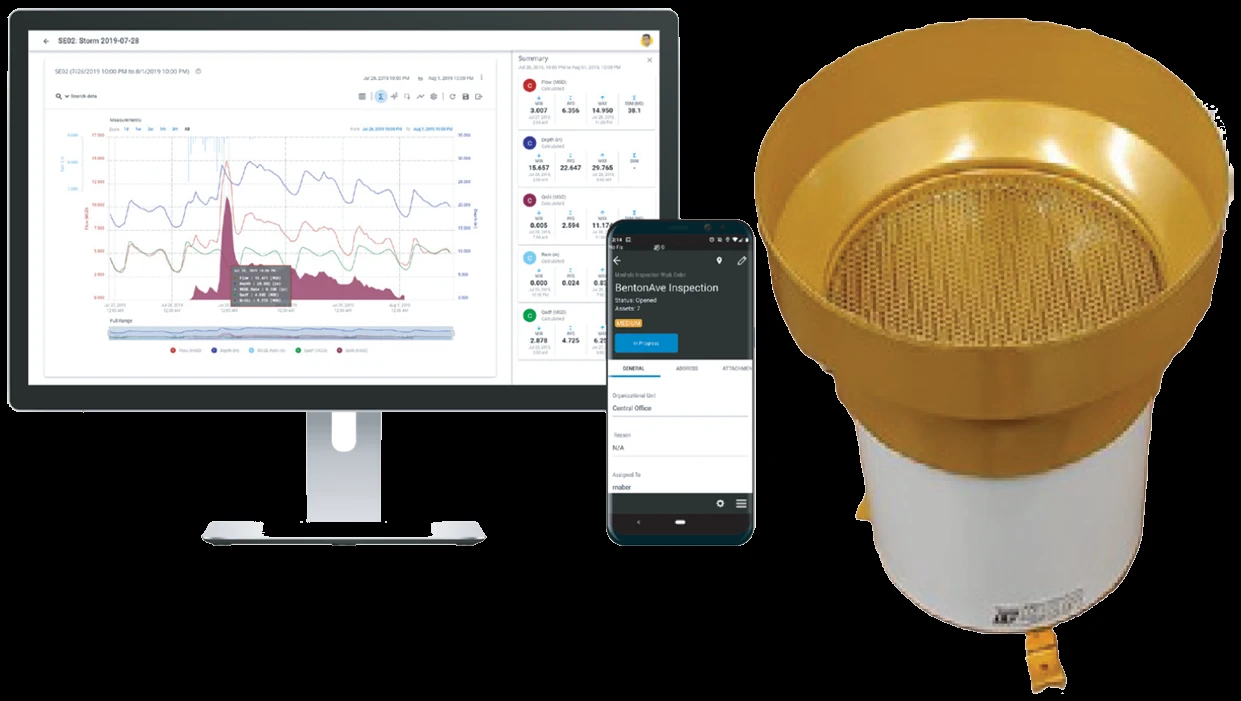
The Telog RG-32A is Badger Meter’s wireless, battery-powered rain-gauge recorder — a single-channel logger that records the pulse output of a tipping-bucket rain-gauge sensor (the GR-6 or GR-8, ordered separately) to local memory and transfers it automatically over a cellular network. Its job is correlation: rainfall logged at the RG-32A lines up against Telog flow and level data to tie rainfall to runoff and to sewer response — the core measurement behind inflow-and-infiltration (I&I) and stormwater studies. The recorder is self-contained: a user-replaceable lithium pack carries a gauge site for years off a single battery with no mains power, and the antenna and cellular modem are built into the same small enclosure, so the rain-gauge cable is the only field connection. It buffers readings between scheduled calls and reports to the Telog Online / RM cloud once networked, while RS-232 and Bluetooth give you a local download path on site.
Key Features & Benefits
- Dedicated rain-gauge recorder — a single-channel pulse recorder for a tipping-bucket rain-gauge sensor (GR-6 or GR-8), with rainfall scaled in the configured units
- Multi-year battery, no site power — runs on a field-replaceable BP-4 lithium pack — 5 years nominal at two calls a day — so a rain-gauge site needs no mains power
- Cellular by design — the built-in LTE Category M modem (Verizon-certified) and internal antenna transmit on a scheduled call — no external gateway, and data buffers locally between calls
- Local download too — pull data on site over RS-232 or Bluetooth BLE 4.1 when a network call is not wanted
- Pairs rainfall with flow data — rainfall logs line up against Telog flow and level records to correlate storm response
Specifications
- Function
- Wireless, battery-powered single-channel rain-gauge recorder that logs the pulse output of a tipping-bucket rain-gauge sensor to local memory and transfers it over cellular
- Measures
- Rainfall — pulse counts from a tipping-bucket rain-gauge sensor (GR-6 6 in. or GR-8 8 in., ordered separately); recording interval selectable from 1/sec to 8 hr
- Recording & memory
- 128 kB memory, wrap-around (first-in first-out): 80,000 interval pulse totals or 60,000 event timestamps
- Power
- Field-replaceable Telog BP-4 lithium battery pack; 5 years nominal at two data calls per day
- Telemetry / download
- Built-in cellular LTE Category M modem (certified for Verizon Wireless) transmits on a scheduled call; local download over RS-232 (5-pin, IP67) or Bluetooth BLE 4.1. No external gateway required
- Outputs
- Transmits over its integral cellular (LTE Category M) modem to the Telog Online / Remote Monitoring (RM) cloud; local data via RS-232 or Bluetooth
- Enclosure / protection
- Polycarbonate, NEMA 6P (IP68); −40…158°F (−40…70°C). The tipping-bucket sensor needs a heated housing to operate in freezing conditions
- Mounting
- 4 × 4 × 3 in. (102 × 102 × 76 mm), 2.5 lb; flange-mounts to a pole or platform within reach of the tipping-bucket sensor
- Platform compatibility
- Optional Telog Online / RM cloud; works standalone otherwise
Common Applications
- Rainfall-runoff correlation across a collection system
- Inflow-and-infiltration (I&I) studies — rainfall against sewer response
- Stormwater monitoring and wet-weather event capture
- Collection-system analysis and hydraulic-model calibration
Design & Selection Considerations
- Log locally first — no power or signal required — every Telog device records to local memory and runs standalone indefinitely, so a site keeps recording even with no power and no network. Connectivity is optional at the start — a standalone logger can be promoted to live telemetry later without re-engineering.
- Recorder or cellular RTU? — battery recorders (HPR-32A, PR-32A, RG-32A) suit surveys and temporary studies you collect on a schedule; cellular RTUs (Ru-32, Ru-35, RS-45) transmit to the Telog RM cloud for permanent, real-time monitoring and alarming. Recorder for portable or temporary work; RTU for fixed sites you watch continuously.
- Match power and housing to the site — choose a multi-year lithium battery, solar, or AC power, and an IP68 submersible housing for vaults and sewers. The RS-45 runs continuous AC/solar duty; the Ru-35 is the submersible choice. Power and ingress rating decide where a site can go — spec them with the measurement.
- Open-channel: radar or submerged ultrasonic? — for sewers and partially-full pipes Telog uses the area-velocity method. The Raven-Eye 2 is non-contact radar (±0.5% velocity) — nothing touches the stream, so no fouling and no confined-space entry; the Beluga is submerged ultrasonic (±1%) that works even when the pipe surcharges, with integrated level and shallow-flow capability. Radar when you can see the surface and want the highest velocity accuracy; ultrasonic when it surcharges or radar can’t see in.
- Capture transients when they matter — for surge and water-hammer analysis specify the high-speed impulse variants — HPR-32iA, PR-32iA and the Ru-32iMA — which capture fast pressure transients a standard recorder would miss. Routine pressure logging and transient capture are different jobs — pick the impulse build when surge is the question.
- Plan the data path — cloud, SCADA, or both — Telog devices report to the Telog RM cloud (built on Esri ArcGIS) over their cellular link; the line-powered RTUs and gateways can also export to your SCADA over Modbus RTU, 4–20 mA or SDI-12, while the battery cellular recorders deliver through the cloud. Decide the destination — and confirm the outputs your specific device carries — up front.
To size & select the right Telog RG-32A:
Use the input form to tell us what you need to measure and where, how the site is powered (battery, solar or AC), and how you want the data (the Telog RM cloud, your SCADA, or both) — and we’ll spec the recorder, RTU, sensor and outputs for your monitoring program.
Flow Meter Application Sheet ›Talk to an engineer directly — Scott Prater, Principal · 917-580-0878 · scott@pratertechnical.com
Specifications compiled by Prater Technical Partners from Badger Meter Telog product datasheets.