Product Overview
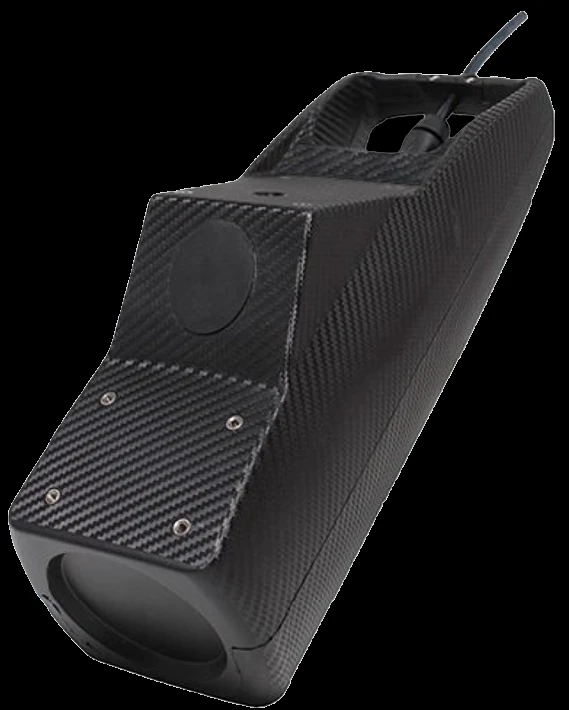
The Telog Raven-Eye 2 is Badger Meter’s non-contact radar area/velocity flow meter for open-channel and partially-full-pipe monitoring. Mounted above the stream, a radar-Doppler sensor reads surface velocity and a self-learning algorithm converts it to average velocity without site calibration; an attached ultrasonic sensor supplies depth, and the two combine into flow through the continuity equation — no flume or weir needed. Because nothing touches the flow there is no fouling and no confined-space entry to service it; the install is single-entry and the sensor is self-calibrating, sealed to IP68 / NEMA 6P, and runs on 4–26 V DC for long battery life. Velocity holds to ±0.5% of reading (plus ±0.06 ft/s zero stability) bidirectionally to ±29.53 ft/s, with ±5% flow across 0–90% pipe fill. The radar reads only above the water line, so where a pipe surcharges an optional pressure level sensor extends the system to flooded conditions. RS-485 Modbus ASCII (with a 4–20 mA velocity output) feeds a Telog Ru-35 or RS-45 RTU, or the IFQ Monitor head-end, for cloud or SCADA delivery — the standard tool for CSO/SSO monitoring, inflow-and-infiltration analysis, and custody-transfer billing.
Key Features & Benefits
- Non-contact radar — mounts above the flow — nothing fouls, and servicing it is a single manhole entry with no confined-space work in the stream
- ±0.5% velocity accuracy — radar-Doppler velocity to ±0.5% of reading, bidirectional over the full range
- Self-calibrating — a self-learning velocity algorithm needs no site calibration or routine field upkeep
- Low-power, long battery life — 4–26 V DC operation suits battery and remote sites
- Survives submergence — IP68 / NEMA 6P polyurethane and stainless enclosure rides out surcharge events (the radar itself reads only above water)
- Modbus & analog output — RS-485 Modbus ASCII into an RTU, head-end or SCADA, with a 4–20 mA velocity output
- Built for CSO/SSO & I&I — pairs with the Ru-35 for overflow-event capture, inflow-and-infiltration and custody-transfer billing
Specifications
- Measurement principle
- Non-contact radar Doppler area/velocity — a radar sensor mounted above the flow reads surface velocity and converts it to average velocity by a self-learning algorithm (no site calibration), while an attached ultrasonic sensor reads level; flow is computed by the area-velocity method, with no flume or weir.
- Measures
- Open-channel level, velocity and flow (area-velocity), bidirectional
- Velocity accuracy
- ±0.5% of reading, plus ±0.06 ft/s zero stability
- Velocity range
- ±0.26 to ±29.53 ft/s, bidirectional
- Level measurement
- Attached ultrasonic pulse-echo level sensor, two range models (4 in.–7 ft or 1–13 ft). Optional pressure level sensor adds surcharge monitoring.
- Flow accuracy
- ±5% under normal flow, pipe 0–90% full
- Power
- 4–26 V DC, low-power operation for long battery life
- Output / interface
- RS-485 (serial Modbus ASCII, open protocol); 4–20 mA output carries velocity only
- Enclosure / protection
- IP68 / NEMA 6P fully sealed polyurethane and stainless-steel enclosure
- Mounting
- Non-contact, mounted above the flow — nothing touches the stream; single-entry install
- Maintenance
- Self-calibrating; no field calibration or routine maintenance, and no confined-space entry to service it
- Pairs with
- Pairs with the Telog Ru-35 or RS-45 RTU, or the IFQ Monitor head-end, for cloud or SCADA delivery
Common Applications
- CSO/SSO overflow-event monitoring for regulatory compliance
- Inflow-and-infiltration (I&I) studies and collection-network model calibration
- Open-channel and partially-full-pipe flow measurement
- Custody-transfer billing on sewer interceptors
- Confined-space-free sewer monitoring
Design & Selection Considerations
- Log locally first — no power or signal required — every Telog device records to local memory and runs standalone indefinitely, so a site keeps recording even with no power and no network. Connectivity is optional at the start — a standalone logger can be promoted to live telemetry later without re-engineering.
- Recorder or cellular RTU? — battery recorders (HPR-32A, PR-32A, RG-32A) suit surveys and temporary studies you collect on a schedule; cellular RTUs (Ru-32, Ru-35, RS-45) transmit to the Telog RM cloud for permanent, real-time monitoring and alarming. Recorder for portable or temporary work; RTU for fixed sites you watch continuously.
- Match power and housing to the site — choose a multi-year lithium battery, solar, or AC power, and an IP68 submersible housing for vaults and sewers. The RS-45 runs continuous AC/solar duty; the Ru-35 is the submersible choice. Power and ingress rating decide where a site can go — spec them with the measurement.
- Open-channel: radar or submerged ultrasonic? — for sewers and partially-full pipes Telog uses the area-velocity method. The Raven-Eye 2 is non-contact radar (±0.5% velocity) — nothing touches the stream, so no fouling and no confined-space entry; the Beluga is submerged ultrasonic (±1%) that works even when the pipe surcharges, with integrated level and shallow-flow capability. Radar when you can see the surface and want the highest velocity accuracy; ultrasonic when it surcharges or radar can’t see in.
- Capture transients when they matter — for surge and water-hammer analysis specify the high-speed impulse variants — HPR-32iA, PR-32iA and the Ru-32iMA — which capture fast pressure transients a standard recorder would miss. Routine pressure logging and transient capture are different jobs — pick the impulse build when surge is the question.
- Plan the data path — cloud, SCADA, or both — Telog devices report to the Telog RM cloud (built on Esri ArcGIS) over their cellular link; the line-powered RTUs and gateways can also export to your SCADA over Modbus RTU, 4–20 mA or SDI-12, while the battery cellular recorders deliver through the cloud. Decide the destination — and confirm the outputs your specific device carries — up front.
To size & select the right Telog Raven-Eye 2:
Use the input form to tell us what you need to measure and where, how the site is powered (battery, solar or AC), and how you want the data (the Telog RM cloud, your SCADA, or both) — and we’ll spec the recorder, RTU, sensor and outputs for your monitoring program.
Flow Meter Application Sheet ›Talk to an engineer directly — Scott Prater, Principal · 917-580-0878 · scott@pratertechnical.com
Specifications compiled by Prater Technical Partners from Badger Meter Telog product datasheets.